Analog privacy scrambler and scrambling method

Inactive Publication Date: 2005-11-01
LOCKHEED MARTIN CORP
View PDF4 Cites 0 Cited by
  • Summary
  • Abstract
  • Description
  • Claims
  • Application Information

AI Technical Summary

Benefits of technology

[0008]The present invention extends the usual phase modulation of a digital signal to provide privacy for an analog signal. The technique starts by segmenting an analog signal, then combines the segments using a Walsh transform, for example. This process obscures individual signals by burying the signal in a number of other added signals. The phase modulation introduces a random transformation of the segments that cannot be undone by a casual receiver of the signal.

Problems solved by technology

When the bandwidth to be transmitted is high enough, this process is not possible.
Conversion of the signal to digital form is difficult for high bandwidth signals.
Scrambling of these high data rates and the transmission bandwidth required, even for sophisticated modulation techniques, are very difficult.
Even when the bandwidth is not high, privacy for analog signals is difficult.
However, the privacy afforded by this technique is limited since the possible inversion of the signal bandwidth is performed at regular intervals.
In addition the transitions generate transients in the signal that interfere with the quality of the signal after it has been reconstructed.

Method used

the structure of the environmentally friendly knitted fabric provided by the present invention; figure 2 Flow chart of the yarn wrapping machine for environmentally friendly knitted fabrics and storage devices; image 3 Is the parameter map of the yarn covering machine
View more

Image

Smart Image Click on the blue labels to locate them in the text.
Viewing Examples
Smart Image
  • Analog privacy scrambler and scrambling method
  • Analog privacy scrambler and scrambling method
  • Analog privacy scrambler and scrambling method

Examples

Experimental program
Comparison scheme
Effect test

Embodiment Construction

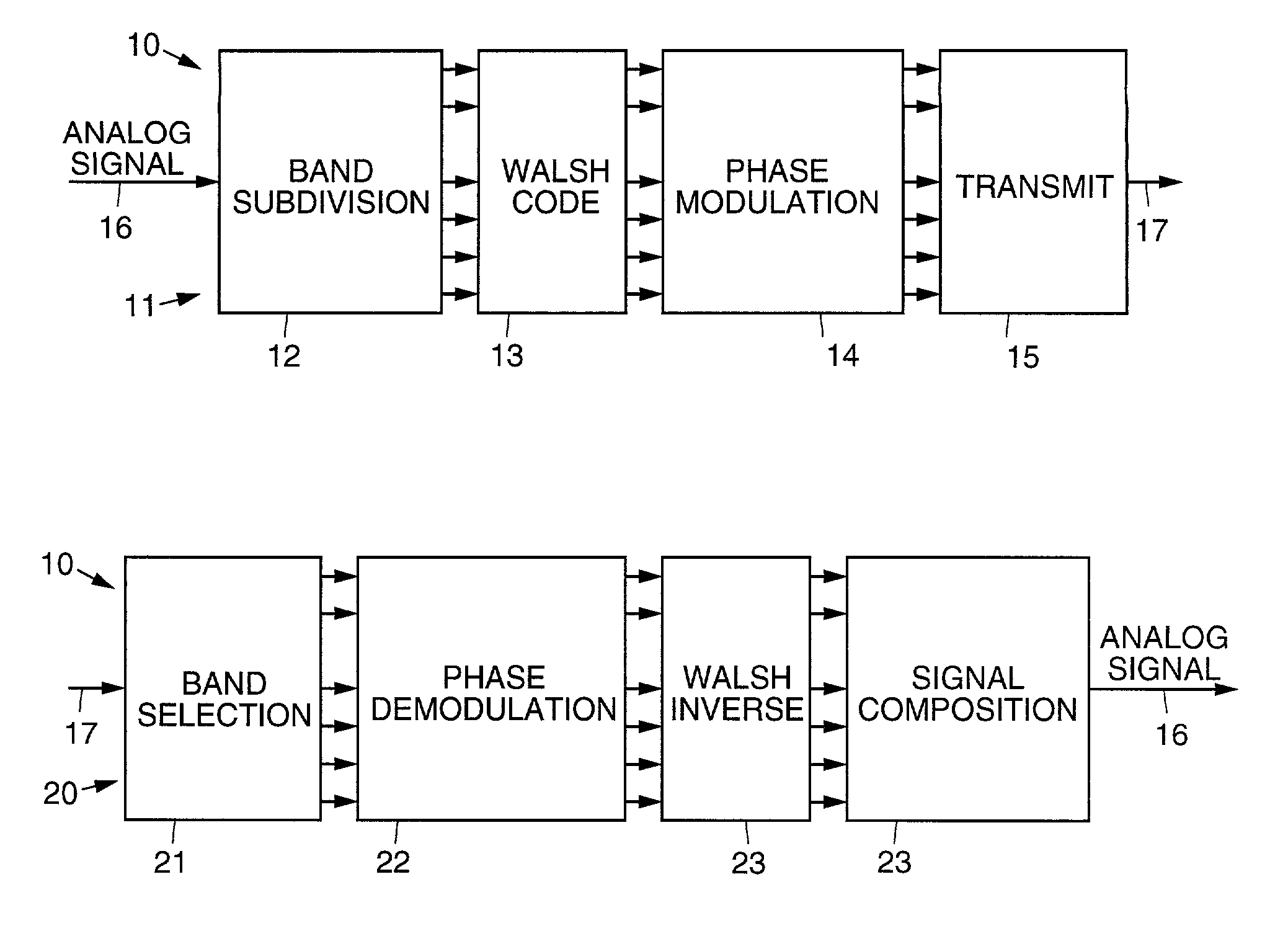
[0018]Referring to the drawing figures, FIG. 1 a illustrates a transmitter 11 of an exemplary analog scrambler 10 in accordance with the principles of the present invention, while FIG. 1b illustrates a receiver 20 employed with the transmitter 11 shown in FIG. 1a. The exemplary analog scrambler 10 employs a technique based on the use of Walsh codes and continuous phase modulation.

[0019]Referring to FIG. 1a, the transmitter 11 of the exemplary analog scrambler 10 comprises a band subdivision circuit 12 that receives an analog input signal that is to be scrambled. The band subdivision circuit 12 segments the analog signal and applies the segmented signal to a coding circuit 13, such a Walsh coding circuit 13. The Walsh coding circuit 13 combines the segments using a Walsh transform, for example.

[0020]The outputs of the Walsh coding circuit 13 are input to a phase modulation circuit 14. The phase modulation circuit 14 introduces a random transformation of the combined segments. The pha...

the structure of the environmentally friendly knitted fabric provided by the present invention; figure 2 Flow chart of the yarn wrapping machine for environmentally friendly knitted fabrics and storage devices; image 3 Is the parameter map of the yarn covering machine
Login to View More

PUM

No PUM Login to View More

Abstract

A system and method for maintaining privacy in transmission of a high bandwidth analog signal. A preferred system and method breaks an input signal into bands and then uses Walsh codes to overlay many signals on top of each other with a set of phase modulators to establish scrambling of the input signal. The scrambled signal is then transmitted. The received scrambled signal has the phase modulation removed and an inverse Walsh transform recovers the original bands. The recovered bands are added together to recover the original signal. The system and method use techniques that establish synchronization and phase coherency complete the process.

Description

BACKGROUND[0001]The present invention relates generally to scrambling systems and methods, and more particularly, to an analog privacy scrambling system and method that scrambles analog signals such that a casual receiver cannot recover the analog information contained in the signal.[0002]Historically, privacy for signals is established by digitizing the signals, then scrambling bits of the signal with a noise sequence to generate a transmitted signal. The modulation by the noise sequence is removed at the receiver resulting in a digital signal that is a replica of the original digitized signal. If an analog signal is desired, the signal may be passed through an digital-to-analog converter to recover the analog signal.[0003]When the bandwidth to be transmitted is high enough, this process is not possible. Conversion of the signal to digital form is difficult for high bandwidth signals. If the conversion to digital format were possible, the transmission of the digital format requires...

Claims

the structure of the environmentally friendly knitted fabric provided by the present invention; figure 2 Flow chart of the yarn wrapping machine for environmentally friendly knitted fabrics and storage devices; image 3 Is the parameter map of the yarn covering machine
Login to View More

Application Information

Patent Timeline
no application Login to View More
IPC IPC(8): H04N7/167H04N21/2347H04N21/4405
CPCH04N7/167H04N21/2347H04N21/4405
InventorWILSON, DENNIS L.LANGE, JULIUSBROWN, ANDREW
OwnerLOCKHEED MARTIN CORP