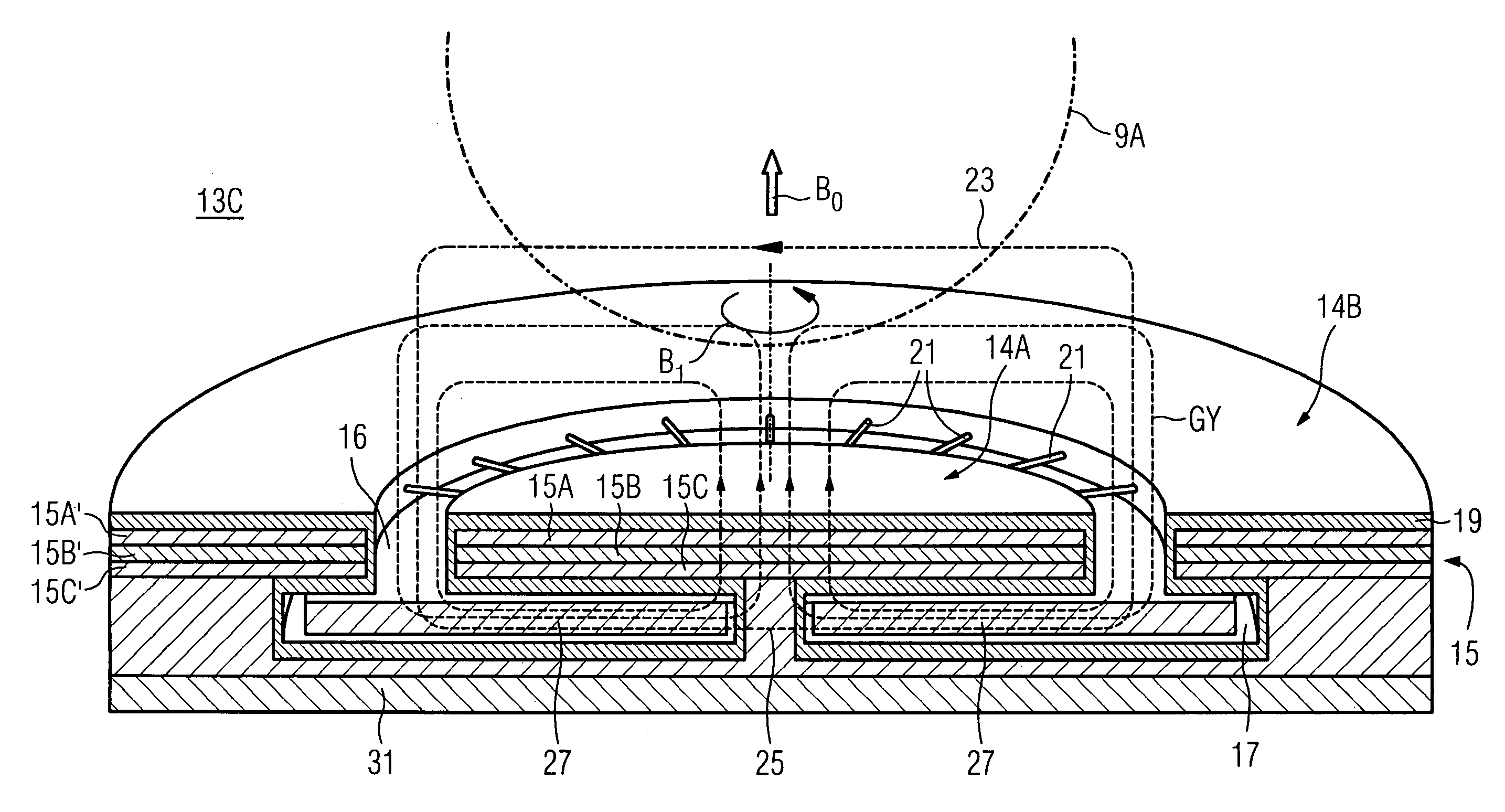
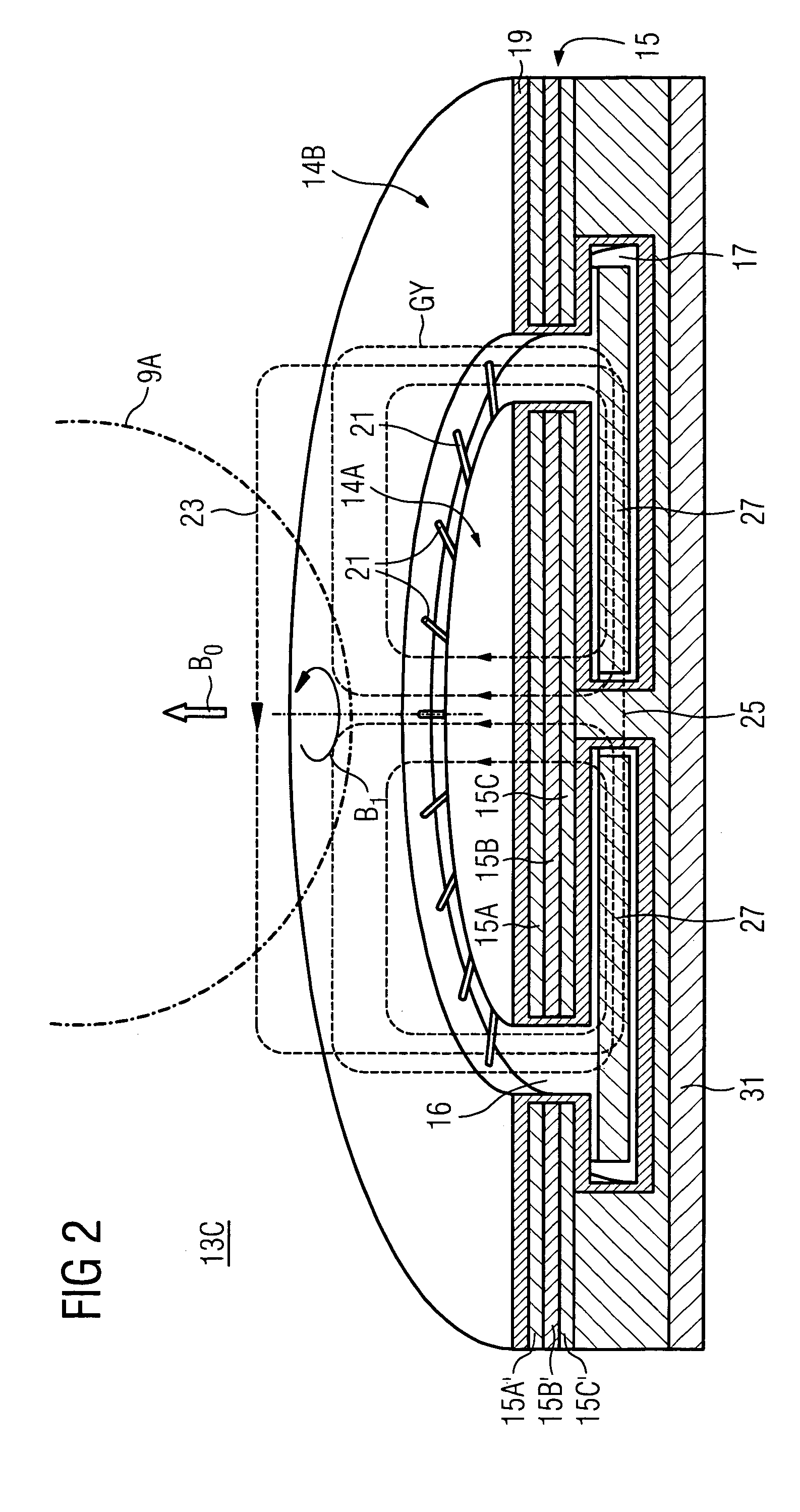
[0011]An advantage of the invention lies in the fact that the sub-assembly influences with the magnetizable material the magnetic field (H field) which is present in the field flux return space, the magnetic induction (B field) remaining the same. This enables efficient generation of a magnetic field (B field) in the examination space since, with the current from the generator being the same, a reduced H field and thus a lower magnetic energy density, proportional to H×B, is present in the field flux return space. Here, the H field is essentially inversely proportional to the effective permeability of the magnetizable material, effective permeability being understood to be the permeability which can be assigned to the entire field flux return space. Consequently, the same magnetic field can be generated in gradient conductors with less current, for example. Furthermore, a field flux return space can be realized that is smaller than it would be without a sub-assembly of this type, while the magnetic field strength in the examination space remains the same. This leads to smaller, more compact and thus more cost-effective structures.
[0012]A further advantage is based upon the fact that because of the magnetization a diminished ‘active’ magnetic field is present, i.e. reduced magnetic interaction takes place with electrical components which are arranged in the proximity of the field flux return space.
[0013]Because of the reduced H field, lower ohmic losses occur in adjacent electrical components, for example in electrical conductors, because of the time-variable magnetic field. Accordingly, the time-variable magnetic field can be generated more efficiently since less current has to flow in the gradient coil. For this reason also, a field flux return space can be realized that is smaller than it would be without a sub-assembly of this type, while the magnetic field strength in the examination space remains the same. This leads, as stated, to smaller, more compact and thus more cost-effective structures.
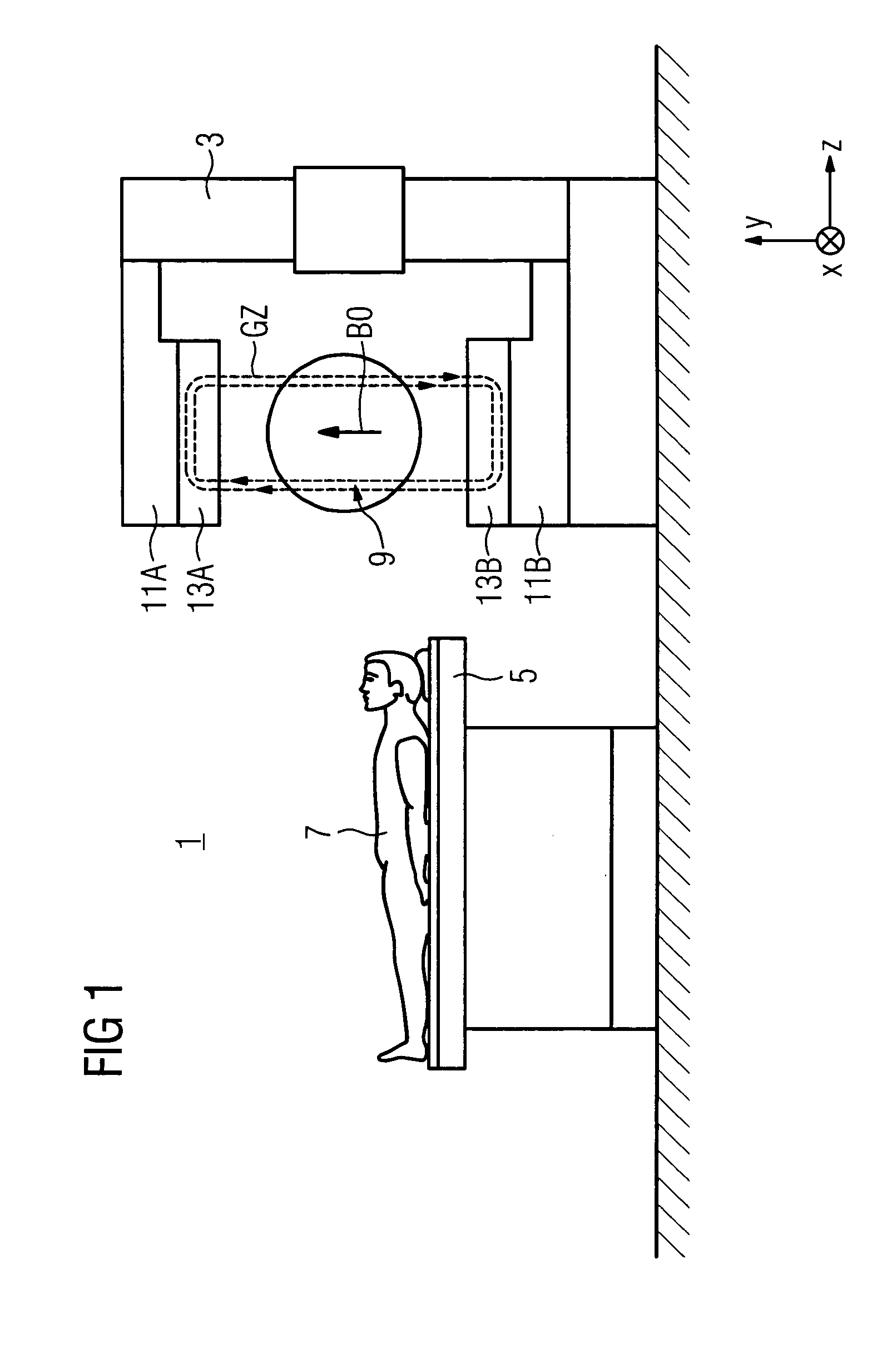
[0014]A great variety of types of time-variable magnetic fields is generated in a magnetic resonance device: For example, high-frequency fields are irradiated into the examination space with the aid of a high-frequency antenna unit having an antenna conductor for stimulating tissue located there to emit magnetic resonance signals. Furthermore, so-called gradient fields which produce a location-dependence of the emitted magnetic resonance signal are needed e.g. for location coding of the examination space. A primary gradient field of this type is generated with the aid of a primary gradient coil having a gradient conductor through which very strong currents flow. Often, to offset the primary gradient field outside the examination space, a secondary gradient-coil unit having a secondary gradient conductor is used, the secondary gradient-coil unit usually being further away from the examination space than the primary gradient-coil unit. The conductors mentioned are generally fashioned differently in accordance with their function and arranged in the magnetic resonance device.
[0015]One or more of these conductors can generate magnetic fields individually or jointly, generation with the aid of the sub-assembly being more efficient than without, so that, as stated, less current, for example, is needed and / or more space is available because of a smaller and more compact design. The magnetic fields in the field flux return space cause losses, for example through induced currents in the adjacent conductive HF shield. These are, since the magnetic energy density of the magnetic field in the field flux return space is generally greater than in the examination space, correspondingly large and their reduction with the aid of the sub-assembly has a direct impact on the efficiency of field generation.
[0016]In accordance with the invention, a sub-assembly which has magnetizable material is arranged in the field flux return space. Overall, this causes a reduction in magnetic energy density in the field flux return space and consequently for example reduced gradient currents and leads moreover to less disadvantageous effects of the magnetic field in the field flux return space on the adjacent electrical components.


 Login to View More
  Login to View More