Check patentability & draft patents in minutes with Patsnap Eureka AI!

Feeding bottle system

a feeding bottle and bottle body technology, applied in the field of infant feeding, can solve the problems of infants' choking or liquid going down the wrong way, difficulty in breathing back, risk of suffocation, coughing, spitting, etc., and achieve the effects of reducing the risk of choking, and improving the quality of li

Inactive Publication Date: 2014-10-21
LAU CHANTAL
View PDF67 Cites 3 Cited by
  • Summary
  • Abstract
  • Description
  • Claims
  • Application Information

AI Technical Summary

Benefits of technology

The solution effectively reduces the risk of suffocation and aspiration by allowing caregivers to easily maintain optimal feeding conditions, ensuring the liquid flows only when the infant is feeding, thereby preventing breathing difficulties and promoting comfortable feeding.

Problems solved by technology

Feeding with a feeding bottle has for the infant risks of suffocating, choking or liquid going down the wrong way, when the rate or the pressure of the liquid flowing through the teat is too high.
Although the majority of full-term babies are able to control and adjust the force and the duration of the suction in order to maintain an acceptable rate of liquid in light of their capacity to coordinate the three aforementioned steps, this is not the case for a few of them, in particular in the event of fatigue, and for the majority of premature babies or who have chronic diseases.
Faced with the uncontrolled flow of liquid flowing from the feeding bottle, the infant can have difficulties in getting its breath back or for resting, and as such runs the risk of suffocation, coughing, spittle, aspiration of liquid into the lungs or fatigue.

Method used

the structure of the environmentally friendly knitted fabric provided by the present invention; figure 2 Flow chart of the yarn wrapping machine for environmentally friendly knitted fabrics and storage devices; image 3 Is the parameter map of the yarn covering machine
View more

Image

Smart Image Click on the blue labels to locate them in the text.
Viewing Examples
Smart Image
  • Feeding bottle system
  • Feeding bottle system
  • Feeding bottle system

Examples

Experimental program
Comparison scheme
Effect test

Embodiment Construction

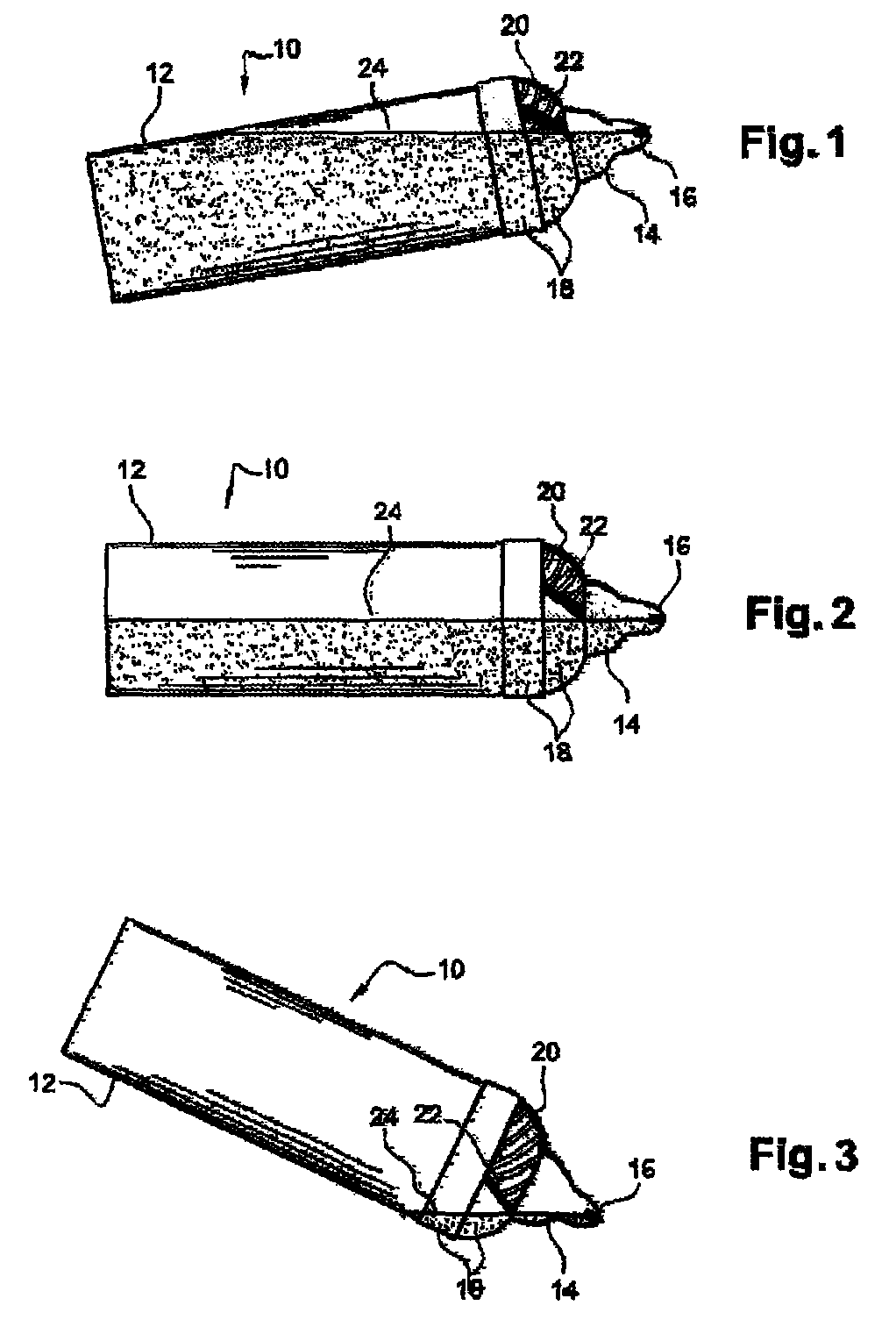
[0043]FIG. 1 shows a feeding bottle 10 of the conventional type, comprising a transparent or translucent recipient (body) 12 made of glass, plastic or analogous material, and a teat 14 comprising an outlet orifice 16, mounted on a neck of the recipient (body) 12 by means of a tightening ring 18 which is screwed on the recipient (body) 12.

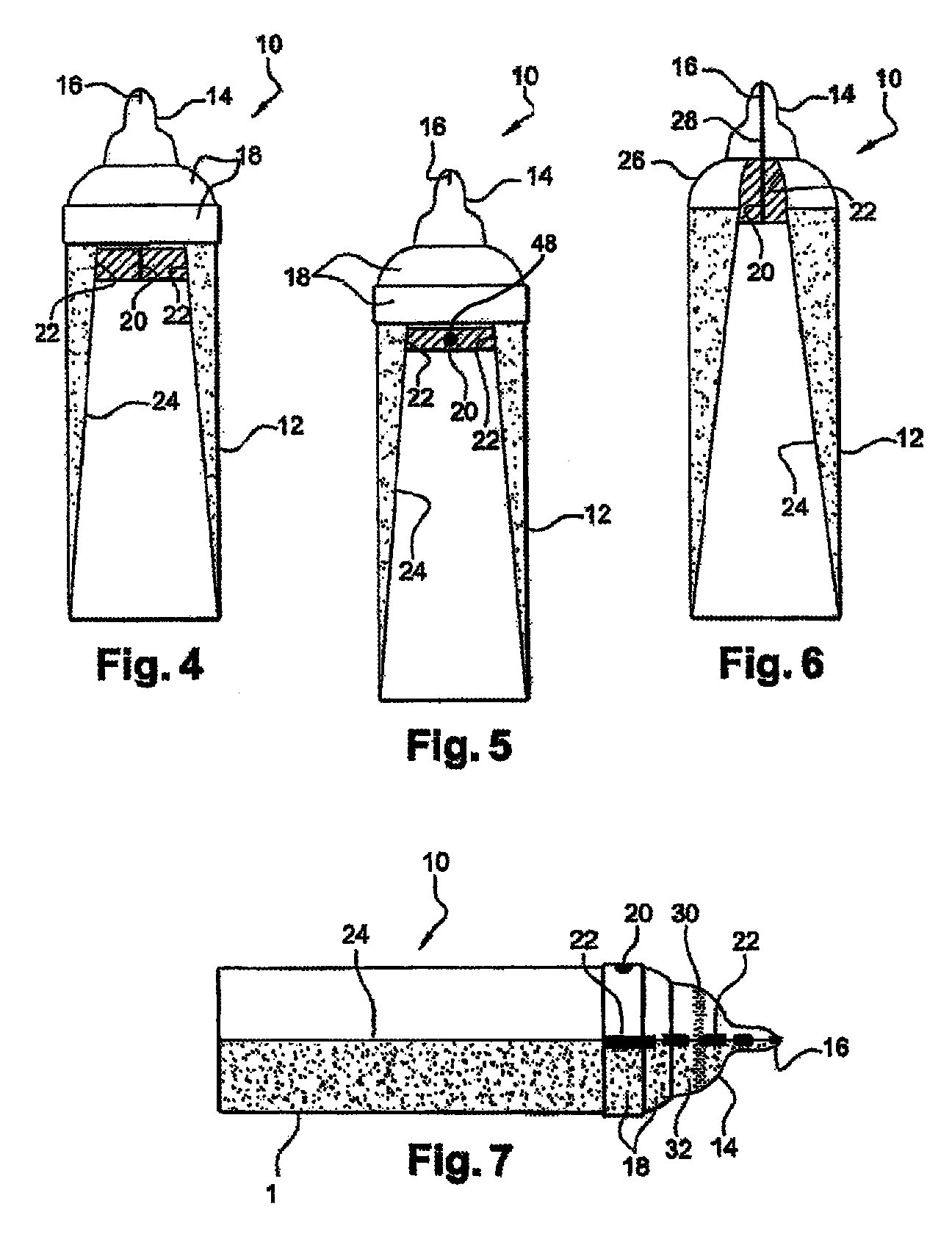
[0044]The tightening ring 18 of the teat 14 comprises a central visual mark 20 formed for example of a colored dash, intended to be directed upwards during the feeding, and at least one side visual mark 22 formed for example of a colored dash, through which the user of the feeding bottle must pass the free surface 24 of the liquid contained in the feeding bottle in order to maintain a substantially zero hydrostatic pressure at the orifice 16 of the teat. These two marks 20 and 22 can be of a color or of any nature making it possible to distinguish them well from the rest of the ring 18.

[0045]The angular separation around the axis of the feeding bott...

the structure of the environmentally friendly knitted fabric provided by the present invention; figure 2 Flow chart of the yarn wrapping machine for environmentally friendly knitted fabrics and storage devices; image 3 Is the parameter map of the yarn covering machine
Login to View More

PUM

No PUM Login to View More

Abstract

Feeding bottle (10) comprising a neck to which a teat (14) is attached, characterized in that it comprises at least two visual marks (20, 22) located on one and the same circumference near the neck or near the teat and separated from one another about the axis of the feeding bottle, one of these marks (20) defining an angular position of the feeding bottle (10) about its axis for which the other mark (22) indicates a point through which the free surface (24) of the liquid contained in the feeding bottle needs to pass in order for the hydrostatic pressure of the liquid at an outlet orifice (16) of the teat (14) to be substantially zero.

Description

CROSS-REFERENCE TO RELATED APPLICATIONS[0001]This application is a Continuation-in-Part of U.S. application Ser. No. 12 / 675,134 by Lau et al., filed Sep. 21, 2010, and published on Jan. 6, 2011 as US Patent Application Publication No. US 2011 / 0000867 A1; and which issued as U.S. Pat. No. 8,308,001 B2 on Nov. 13, 2012; which claims the benefit of PCT application No. PCT / FR2008 / 001217, filed Aug. 29, 2008; and which also claims the benefit of foreign patent application No. 0706190 filed Sep. 4, 2007 in France; all of which are incorporated herein by reference.STATEMENT REGARDING FEDERALLY SPONSORED RESEARCH OR DEVELOPMENT[0002]This invention was made, in part, with US government support under Contract No. HD028140 awarded by the National Institutes of Health. The US government has certain rights in the invention.THE NAMES OF THE PARTIES TO A JOINT RESEARCH AGREEMENT[0003]Not ApplicableINCORPORATION-BY-REFERENCE OF MATERIAL SUBMITTED ON A COMPACT DISC[0004]Not ApplicableBACKGROUND OF T...

Claims

the structure of the environmentally friendly knitted fabric provided by the present invention; figure 2 Flow chart of the yarn wrapping machine for environmentally friendly knitted fabrics and storage devices; image 3 Is the parameter map of the yarn covering machine
Login to View More

Application Information

Patent Timeline
no application Login to View More
Patent Type & Authority Patents(United States)
IPC IPC(8): B65D41/02B65D43/02A61J9/00A61J9/04B65D85/72B65D23/00
CPCA61J2200/76A61J9/04A61J11/00
Inventor LAU, CHANTAL
Owner LAU CHANTAL
Features
  • R&D
  • Intellectual Property
  • Life Sciences
  • Materials
  • Tech Scout
Why Patsnap Eureka
  • Unparalleled Data Quality
  • Higher Quality Content
  • 60% Fewer Hallucinations
Social media
Patsnap Eureka Blog
Learn More