
Synthesis of clopidogrel impurity intermediate
A diastereomer and process technology, which is applied in the field of important intermediates for the preparation of clopidogrel, a highly active anti-platelet aggregation drug, can solve the problems of potential danger, long reaction time, large loss of raw materials, etc., and can achieve the operation cycle Short, easy to operate, good for yield
Patent Information
- Authority / Receiving Office
- CN · China
- Patent Type
- Applications(China)
- Current Assignee / Owner
- Publication Date
- 2010-06-23
- Estimated Expiration
- Not applicable · inactive patent
Smart Images
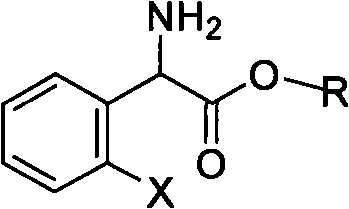
Figure 1 
Figure 2 
Figure 3
Abstract
Description
technical field
[0001] The present invention relates to a high-yield resolution process for 2-substituted phenylglycine methyl esters (or acids), wherein S-(+)-o-chlorophenylglycine methyl esters are used to prepare clopidogrel, a drug with high activity against platelet aggregation important intermediates. R-(-)-o-chlorophenylglycine methyl ester is an important intermediate for the preparation of liquid-phase-localized impurities of clopidogrel.
[0002] The 2-substituted phenylglycine methyl ester and acid in the structural formula I prepared by the present invention are important non-natural amino acids with physiological activity, and are also important intermediates of the highly active anti-platelet aggregation drug clopidogrel.
[0003]
[0004] Structural Formula I
[0005] Here, R=H, alkyl (C 1 -C 4 ,benzene)
[0006] X = halogen, OR 1 、SR 1
[0007] here R 1 = H or alkane (C 1 -C 3 )
[0008] = Benzene and optionally substituted benzene Background t...
Examples
specific Embodiment 1
[0037] Add D-(-)-tartaric acid (6.6 g, 0.044 mol) and anhydrous methanol (64 ml) into a 100 ml three-necked flask, and stir at room temperature until they are completely dissolved. A mixed solution of 2-chlorophenylglycine methyl ester (8.0 g, 0.04 mol) and acetone (16 ml) was added dropwise into the reactor, and solids were precipitated during the dropwise addition, which took about 1 hour. After the dropwise addition, react at 28-32°C for 15-20 hours. After the reaction was cooled, stirring was continued for one hour. Suction filtration and filter cake drying to obtain dry solid (R)-(-)-2-chlorophenylglycine methyl ester tartrate, yield 89%, melting point 164-166°C (document: 163-167°C) optical rotation [α] D -86 0 (C=1, CH 3 Oh)
specific Embodiment 2
[0038] Add D-(-)-tartaric acid (6.6 g, 0.044 mol) and anhydrous methanol (64 ml) into a 100 ml three-necked flask, and stir at room temperature until they are completely dissolved. After adding catalytic amount of acetophenone, the mixed solution of 2-chlorophenylglycine methyl ester (8.0g, 0.04mol) and acetone (16ml) is added dropwise in the reactor, there is solid to separate out in the process of dropping, about 1 Hour. After the dropwise addition, react at 28-32°C for 5-6 hours. After the reaction was cooled, stirring was continued for 1 hour. Suction filtration and drying of the filter cake gave dry solid (R)-(-)-2-chlorophenylglycine methyl ester tartrate. Yield 92%, melting point 164-166°C (document: 163-167°C) optical rotation [α] D -88 0 (C=1, CH 3 OH).
specific Embodiment 3
[0039]Add D-(-)-tartaric acid (6.6 g, 0.044 mol) and anhydrous methanol (64 ml) into a 100 ml three-necked flask, and stir at room temperature until they are completely dissolved. After adding a catalytic amount of formaldehyde, a mixed solution of 2-chlorophenylglycine methyl ester (8.0g, 0.04mol) and acetone (16ml) was added dropwise into the reactor, and solids were precipitated during the dropwise addition, which took about one hour . After the dropwise addition, react at 28-32° C. for 10-20 hours. After the reaction was cooled, stirring was continued for one hour. Suction filtration and drying of the filter cake gave dry solid (R)-(-)-2-chlorophenylglycine methyl ester tartrate. Yield 85%, melting point 164-166°C (document: 163-167°C) optical rotation [α] D -88 0 (C=1, CH 3 OH).