
Learning processing method of 3D (three-dimensional) spectacles and learner
A technology of 3D glasses and a processing method, which is applied in the 3D field, can solve problems such as inability to use interchangeably, increase purchase costs, and inconvenience for users, and achieve the effects of reducing purchase costs, saving purchase costs, and being convenient to use
Patent Information
- Authority / Receiving Office
- CN · China
- Patent Type
- Patents(China)
- Current Assignee / Owner
- Publication Date
- 2012-12-26
- Estimated Expiration
- Not applicable · inactive patent
Smart Images
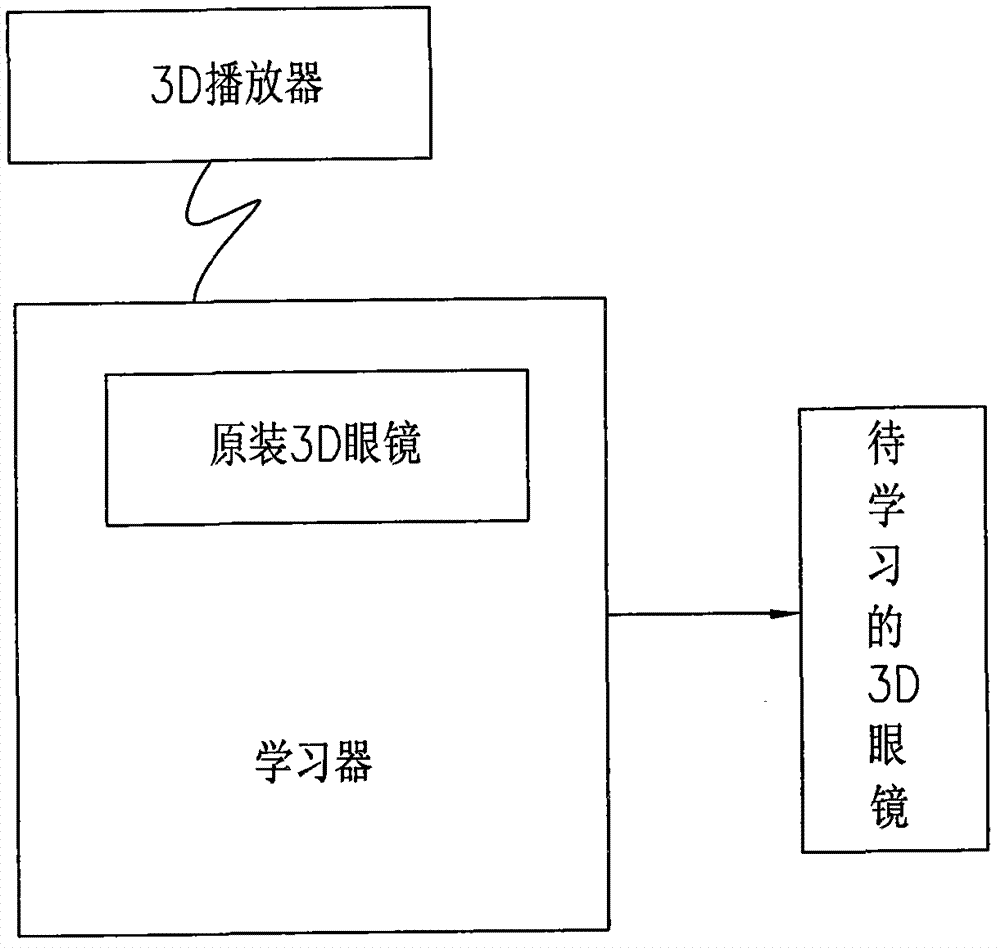
Figure 1 
Figure 2 
Figure 3
Abstract
Description
technical field
[0001] The present invention relates to the field of 3D technology, in particular to a method for learning and processing 3D glasses, which can learn 3D playback synchronization signals of various brands of playback devices, so that the 3D glasses to be learned are adapted to current 3D playback devices; and also relates to the above method The learning device and learning 3D glasses used in the matching. Background technique
[0002] 3D is the abbreviation of three-dimensional, which refers to three-dimensional graphics, three-dimensional video TV, that is, the three-dimensional display effect of 3D LCD TV. Glasses-free 3D TV is to add a special precision cylindrical lens screen to the LCD panel, which will be encoded. The 3D video images are independently sent to the left and right eyes of people, so that users can experience the stereoscopic feeling with naked eyes without the help of stereo glasses, and at the same time, they are compatible with 2D images...
Examples
Embodiment Construction
[0036] Such as figure 1 As shown, a schematic diagram of the combination principle of a learning type 3D glasses of the present invention, including a learning device for placing the 3D glasses to be learned and a supporting 3D glasses to be learned, the 3D glasses to be learned include a frame, left and right liquid crystals Lens, a receiver installed on the frame, a processor, and a memory. The above-mentioned receiver is an infrared receiver matching the infrared transmitter in the learner, and other components can be commonly used components. The infrared receiver receives the corresponding data information sent by the learner and stores it in the memory, which is used as the current synchronous control signal protocol of the processor to make the lens work according to the received and stored parameters.
[0037] Such as Figure 5As shown, in this embodiment, the learner is composed of commonly used components such as a receiver, a microprocessor (model C8051F911) with l...