
Polyethylene glycol-modified integrin blocking agent HM-3 and application thereof
An integrin blocker, HM-3 technology, applied in the field of medicine to achieve the effect of inhibiting tumor growth and metastasis, and inhibiting tumor angiogenesis
Patent Information
- Authority / Receiving Office
- CN · China
- Patent Type
- Applications(China)
- Current Assignee / Owner
- Publication Date
- 2012-04-18
- Estimated Expiration
- Not applicable · inactive patent
Smart Images
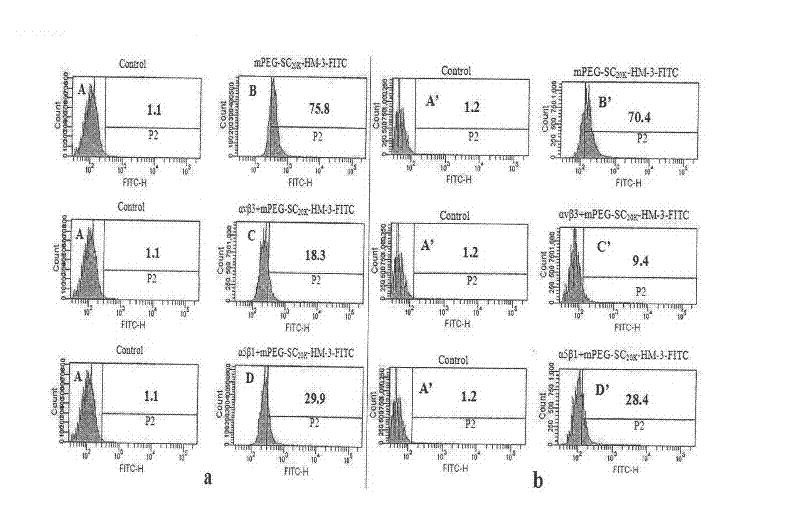
Figure 1 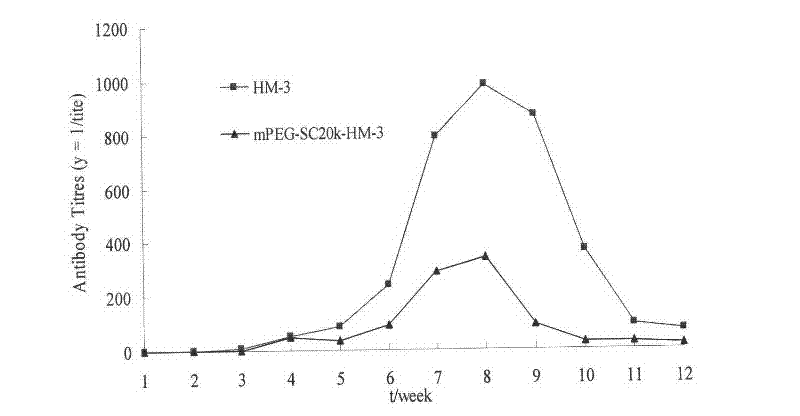
Figure 2 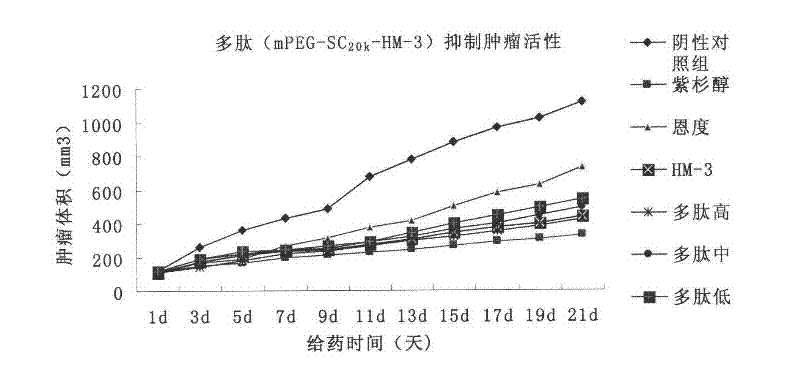
Figure 3
Abstract
Description
technical field
[0001] The present invention relates to the field of medicine, in particular to an integrin blocker capable of inhibiting tumor angiogenesis, and having integrin affinity and binding ability. The blocker is a polyethylene glycol modified polypeptide, and the integrin blocker The interrupting agent polyethylene glycol modified polypeptide can be used for the treatment of solid tumors. Background technique
[0002] Studies have shown that the growth of solid tumors depends on angiogenesis, and angiogenesis can not only provide the nutrients and oxygen needed by the tumor, excrete metabolites, but also serve as a way for distant metastasis. Therefore, blocking neovascularization may be a means to prevent tumor growth and metastasis, thereby motivating extensive research on pro-angiogenic and anti-angiogenic molecules.
[0003] Compared with traditional tumor treatment drugs, the biggest advantages of tumor angiogenesis inhibitors are: ①Selective action on vascu...
Examples
Embodiment 1
[0041] Example 1 Integrin Blocker HM-3
[0042] The solid-phase synthesis method of Ile-Val-Arg-Arg-Ala-Asp-Arg-Ala-Ala-Val-Pro-Gly-Gly-Gly-Gly-Gly-Arg-Gly-Asp, which uses Fmoc-Ile-wang resin or Fmoc-Ile-CTC resin is used as the starting material, and then dipeptide to octadecapeptide are sequentially connected with protected amino acids. After the peptide connection is completed, it is fully washed, and then the peptide is cut and post-treated to obtain the crude product of HM-3. Purify the crude product by first dissolving it, then using preparative high-performance liquid phase for two purifications, and finally concentrating and freeze-drying to obtain the pure product.
[0043] Specific steps are as follows:
[0044] 1. Synthesis:
[0045] Weigh 14.7g of Fmoc-Ile-Wang resin, pour it into a 1L reaction column with glass sand core, add CH 2 Cl 2 147ml to fully expand the resin.
[0046] Uncapping: Add 25ml of hexahydropyridine / DMF decapping solution, seal it and place ...
Embodiment 2
[0070] Embodiment 2 The step of polyethylene glycol modification polypeptide
[0071] mPEG-SC 20K Reaction with HM-3
[0072] Weigh 2gmPEG-SC respectively 20K and 106.24mg of HM-3 (molar ratio 1.5:1) were placed in 40ml-100ml of prepared PBS buffer solution of pH 5-8.5, and reacted overnight at 4°C. PEG-SC500-20000 can be linked according to Example 2 to synthesize modified polypeptides.
Embodiment 3
[0073] Embodiment 3 separation and purification steps
[0074] 1. Separation
[0075] The sample after the reaction was purified by semi-preparative high-performance liquid phase (HPLC, BIO-RAD), and the purification conditions were:
[0076] Mobile phase: ACN (+0.1% TFA), H 2 O(+0.1%TFA); ACN linear gradient: 40%-95%;
[0077] Flow rate: 2ml / min; running time: 12min;
[0078] Sample volume: 1.0ml; detection wavelength: 220nm.
[0079] Semi-preparative chromatographic column: YMC, 250mm×10mm (5μm filler).
[0080] During the eluting process of the target peak, collect the product with a centrifuge tube.
[0081] 2. Purification
[0082] The product collected by HPLC was first pre-frozen overnight in a -70°C low-temperature refrigerator, and then freeze-dried in a freeze dryer that had been cooled in advance until it was completely white powder by visual inspection (about 30 hours). Harvest the freeze-dried product, weigh and record the weight of the product and store it...