
Hollow microsphere reinforced polylactic acid (PLA)-based composite foaming material and preparation method thereof
A composite foaming and polylactic acid technology, applied in the field of foaming materials, can solve the problems of high cost, poor mechanical properties, poor processing and molding stability, etc., achieve small stress concentration, improve processing performance, and improve melt rheology. performance effect
Patent Information
- Authority / Receiving Office
- CN · China
- Patent Type
- Patents(China)
- Current Assignee / Owner
- Publication Date
- 2013-11-06
Smart Images
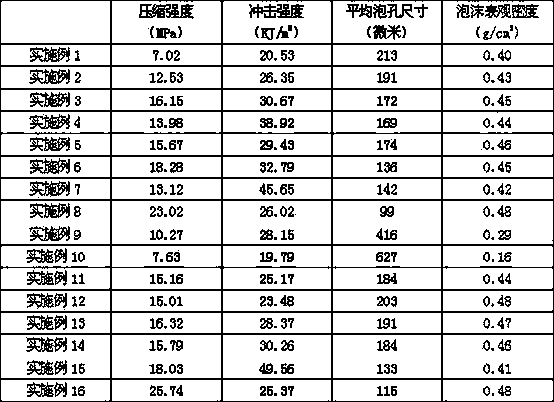
Figure 1
Abstract
Description
technical field
[0001] The invention belongs to the field of foaming materials, and in particular relates to a hollow microbead reinforced polylactic acid-based composite foaming material and a preparation method thereof. Background technique
[0002] As a non-renewable resource, oil reserves are very limited. my country's oil consumption is the second largest in the world, while its reserves only account for 2% of the world's total. At the same time, the "white pollution" caused by a large number of petroleum-based plastic products on the market today has also brought great harm to human production and living environment. Therefore, the research and vigorous development of bio-based plastics and their composite materials is the key to solving resources, energy diversification, environmental friendliness, and sustainable development.
[0003] Polylactic acid (PLA), including poly-L-lactic acid (L-PLA), poly-D-lactic acid (D-PLA), and poly-DL-lactic acid (DL-PLA), is a clas...
Examples
Embodiment 1
[0043] The raw material components are by weight: 80 parts of poly DL-lactic acid with a weight average molecular weight of 150,000, 5 parts of hollow glass microspheres, 5 parts of polybutylene succinate, 3 parts of nano calcium carbonate, 1 part of di Benzoyl, 3 parts of azodicarbonamide, 0.5 parts of zinc oxide, 1 part of didodecyl thiodipropionate, 1 part of paraffin, 0.5 parts of sodium dodecylbenzenesulfonate. The molecular weight distribution Mw / Mn value of poly DL-lactic acid is 1.6, and the crystallinity is 35%.
[0044] According to the above formula, the fully dried raw materials are mixed evenly in a high mixer, then extruded with a twin-screw extruder at 160°C, and pelletized with a pelletizer to prepare a length of 5-10mm and a particle size of about 5mm. foaming masterbatch; put a certain amount of foaming masterbatch in the mold, heat and foam molding on a flat vulcanizing machine at 180 °C, the foaming time is 10min, and the apparent density is 0.40 g / cm 3 Ho...
Embodiment 2
[0046] The raw material components are by weight: 70 parts of poly DL-lactic acid with a weight average molecular weight of 150,000, 10 parts of hollow glass microspheres, 10 parts of polybutylene succinate, 3 parts of nano calcium carbonate, 1 part of di Benzoyl, 3 parts of azodicarbonamide, 0.5 parts of zinc oxide, 1 part of didodecyl thiodipropionate, 1 part of paraffin, 0.5 parts of sodium dodecylbenzenesulfonate.
[0047] According to the above formula, the fully dried raw materials are mixed evenly in a high mixer, then extruded with a twin-screw extruder at 160°C, and pelletized with a pelletizer to prepare a length of 5-10mm and a particle size of about 5mm. foaming masterbatch; put a certain amount of foaming masterbatch in the mold, heat foam molding on a flat vulcanizing machine at 180 °C, the foaming time is 10min, and the apparent density is 0.43 g / cm 3 Hollow microbeads reinforced polylactic acid-based composite foam materials.
Embodiment 3
[0049] The raw material components are by weight: 60 parts of poly DL-lactic acid with a weight average molecular weight of 150,000, 15 parts of hollow glass microspheres, 15 parts of polybutylene succinate, 3 parts of nano calcium carbonate, 0.5 parts of di Cumene, 3 parts of azodicarbonamide, 0.5 part of zinc oxide, 1 part of didodecyl thiodipropionate, 1 part of paraffin wax, 1 part of sodium dodecylbenzenesulfonate.
[0050] According to the above formula, the fully dried raw materials are mixed evenly in a high mixer, then extruded with a twin-screw extruder at 160°C, and pelletized with a pelletizer to prepare a length of 5-10mm and a particle size of about 5mm. foaming masterbatch; put a certain amount of foaming masterbatch in the mold, heat and foam on a flat vulcanizing machine at 180 °C, and the foaming time is 5 minutes to obtain an apparent density of 0.45 g / cm 3 Hollow microbeads reinforced polylactic acid-based composite foam materials.