
A Position Sensorless Control Technology for Four-Phase Doubly Salient Motor
A salient pole motor, four-phase dual technology, applied in the field of motor control and position sensorless control, can solve the problems of RC filter potential phase offset, inability to obtain commutation point, low sine degree, etc.
Patent Information
- Authority / Receiving Office
- CN · China
- Patent Type
- Patents(China)
- Current Assignee / Owner
- Publication Date
- 2015-12-16
- Estimated Expiration
- Not applicable · inactive patent
Smart Images
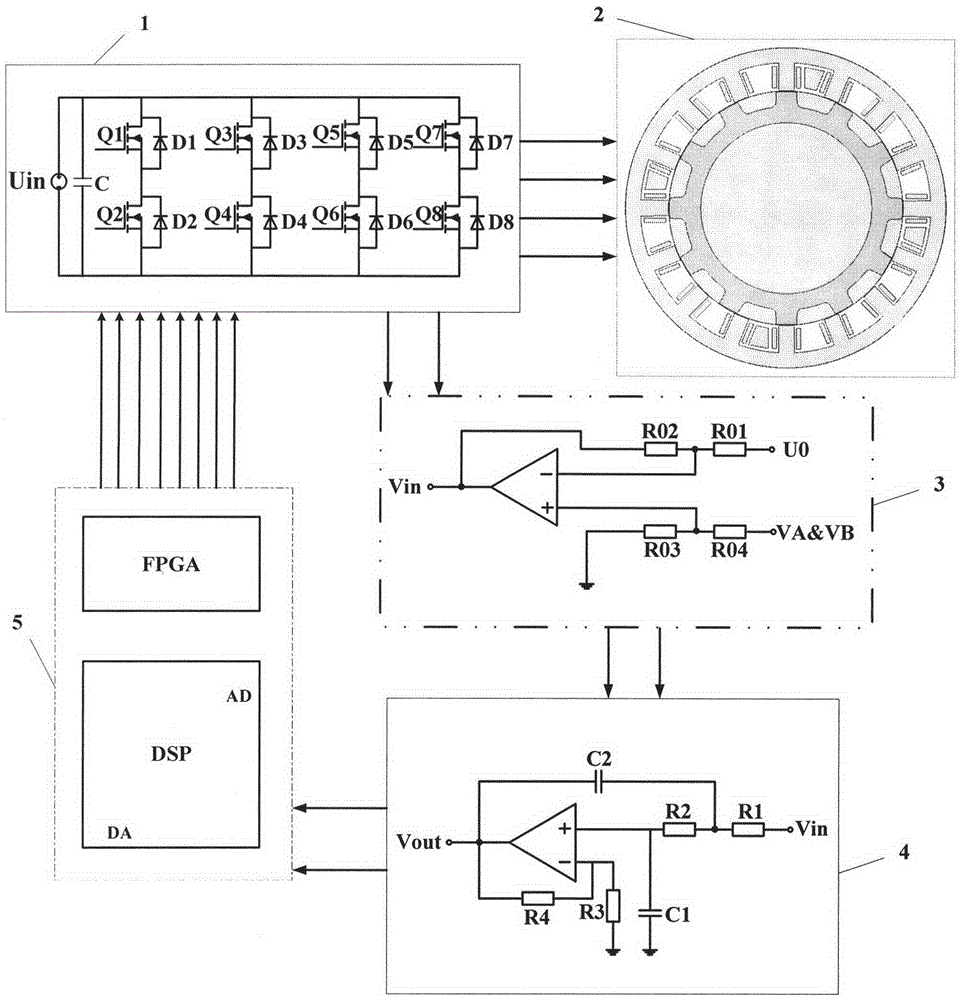
Figure 1 
Figure 2 
Figure 3
Abstract
Description
Technical field
[0001] The invention relates to a position sensorless control method for a four-phase double salient motor, which belongs to motor control technology. Background technique
[0002] With the development of motor design and control technology, accurate detection of rotor position has become one of the research hotspots in the field of motors at home and abroad. There are many kinds of control technologies. The conventional motor position detection technologies include: (1) direct position detection method; (2) conducting phase winding detection method; (3) non conducting phase winding detection method; (4) additional electrical Component detection method; (5) Detection method based on intelligent technology. In these methods, except for the direct position detection method, which directly detects the rotor position through special detection elements such as Hall sensors, the other methods are to find a parameter information that can be obtained to obtain the rotor ...
Examples
Embodiment Construction
[0053] The system structure diagram of this patent is as follows figure 1 As shown, it is mainly composed of five parts: (1) four-phase full-bridge power circuit module; (2) four-phase double salient motor; (3) subtractor module; (4) low-pass filter module; (5) Control module composed of DSP and FPGA.
[0054] Among them, the low-pass filter module includes N (N is a natural number greater than 2) kinds of low-pass filters with different cut-off frequencies. Every three filters with the same cut-off frequency are connected in series to form a three-stage filter, that is, a sixth-order filter pair. The collected back EMF is filtered. The main functions of the control module composed of DSP and FPGA are: (1) Calculate the speed at any time according to the zero-crossing voltage point of the phase A potential waveform; (2) Store a look-up table composed of angles that need to be compensated for different speeds in the same speed range, And select the angle to be compensated accord...