
Double-coated microencapsulation expansion flame retardant natural rubber and preparation method thereof
A technology of microencapsulation and natural rubber, applied in microcapsule preparation, microsphere preparation and other directions, can solve the problems of easy agglomeration, material performance decline, flame retardancy of composite materials and limitation of mechanical properties, etc. Excellent flame retardant performance and remarkable intumescent flame retardant effect
Patent Information
- Authority / Receiving Office
- CN · China
- Current Assignee / Owner
- Publication Date
- 2013-05-08
- Estimated Expiration
- Not applicable · inactive patent
Smart Images
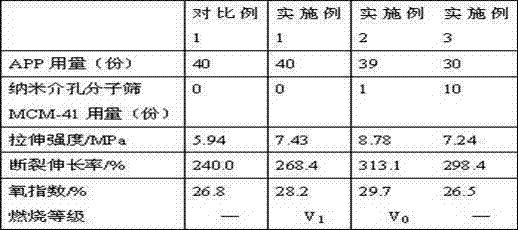
Figure 1
Abstract
Description
technical field
[0001] The invention relates to a rubber and a preparation method thereof, in particular to a double-coated microencapsulated expansion flame-retardant natural rubber and a preparation method thereof. Background technique
[0002] Rubber products are widely used, but natural rubber and most synthetic rubbers are flammable or inflammable, which limits their application in materials requiring flame retardancy. For example, the sheathing of wires and cables, various rubber products used in the electrical industry, various rubber products used in automobiles and airplanes, and rubber sheets used in public places such as shopping malls and hospitals, the importance of flame retardant treatment for them is obvious.
[0003] Intumescent flame retardant is a new type of additive flame retardant that can generate a uniform carbon foam layer on the surface when the polymer is heated, heat insulation, oxygen insulation, smoke suppression, and prevent molten droplets. I...
Examples
Embodiment 1
[0027] Weigh 4.5g of melamine, 7.0g of 37% formaldehyde solution, 0.5g of sodium carbonate and 35.0mL of distilled water into a 500mL three-neck flask equipped with a stirrer, thermometer and reflux condenser, start stirring, raise the temperature to 80°C, and keep warm After 1 hour of reaction, 46.2 g of a colorless and transparent melamine prepolymer aqueous solution was obtained, with a content of about 10%.
[0028] Weigh 40g of APP, 2g of 50% compound dispersant aqueous solution, 100mL of distilled water and 100ml of ethanol into a 500mL beaker, pulverize and disperse with an emulsifier for 30min, then pour into a 500mL three-necked flask, slowly add the above-mentioned melamine prepolymerization under stirring at room temperature 45mL aqueous solution, 1.2g boric acid, 5% hydrochloric acid was added dropwise until the pH was 4-5, then slowly heated to 75°C, and kept for 2 hours, the melamine resin solidified and formed a film on the surface of APP and MCM-41 particles. A...
Embodiment 2
[0031] Weigh 4.5g of melamine, 7.0g of 37% formaldehyde solution, 0.5g of sodium carbonate and 35.0mL of distilled water into a 500mL three-neck flask equipped with a stirrer, thermometer and reflux condenser, start stirring, raise the temperature to 80°C, and keep warm After 1 hour of reaction, 46.2 g of a colorless and transparent melamine prepolymer aqueous solution was obtained, with a content of about 10%.
[0032] Weigh 39g of APP, 1g of nano-mesoporous molecular sieve MCM-41, 2g of 50% compound dispersant aqueous solution, 100mL of distilled water and 100ml of ethanol into a 500mL beaker, pulverize and disperse with an emulsifier for 30min, then pour it into a 500mL three-necked flask, and store at room temperature Slowly add 45mL of the above-mentioned melamine prepolymer aqueous solution and 1.2g of boric acid under stirring, add dropwise 5% hydrochloric acid until the pH is 4-5, then slowly heat to 75°C, keep the temperature for 2 hours, and the melamine resin is in APP...
Embodiment 3
[0035] Weigh 4.5g of melamine, 7.0g of 37% formaldehyde solution, 0.5g of sodium carbonate and 35.0mL of distilled water into a 500mL three-neck flask equipped with a stirrer, thermometer and reflux condenser, start stirring, raise the temperature to 80°C, and keep warm After reacting for 1 hour, 46.2 g of a colorless and transparent melamine prepolymer aqueous solution with a content of about 10% was obtained.
[0036] Weigh 30g of APP, 10g of nano-mesoporous molecular sieve MCM-41, 2g of 50% compound dispersant aqueous solution, 100mL of distilled water and 100ml of ethanol into a 500mL beaker, pulverize and disperse with an emulsifier for 30min, then pour into a 500mL three-necked flask at room temperature Slowly add 45mL of the above-mentioned melamine prepolymer aqueous solution and 1.2g of boric acid under stirring, add dropwise 5% hydrochloric acid until the pH is 4-5, then slowly heat to 75°C, keep the temperature for 2 hours, and the melamine resin is in APP and MCM-41...