

A combined processing method of inferior heavy oil
A technology of combined processing and inferior heavy oil, applied in the petroleum industry, hydrotreating process, processing hydrocarbon oil, etc., can solve the problems of waste of resources and not being used, and achieve the goal of inhibiting coke formation in the process, reducing the amount of addition, and reducing the loss of catalysts. The effect of living risk
Patent Information
- Authority / Receiving Office
- CN · China
- Patent Type
- Patents(China)
- Current Assignee / Owner
- Publication Date
- 2015-09-23
Smart Images
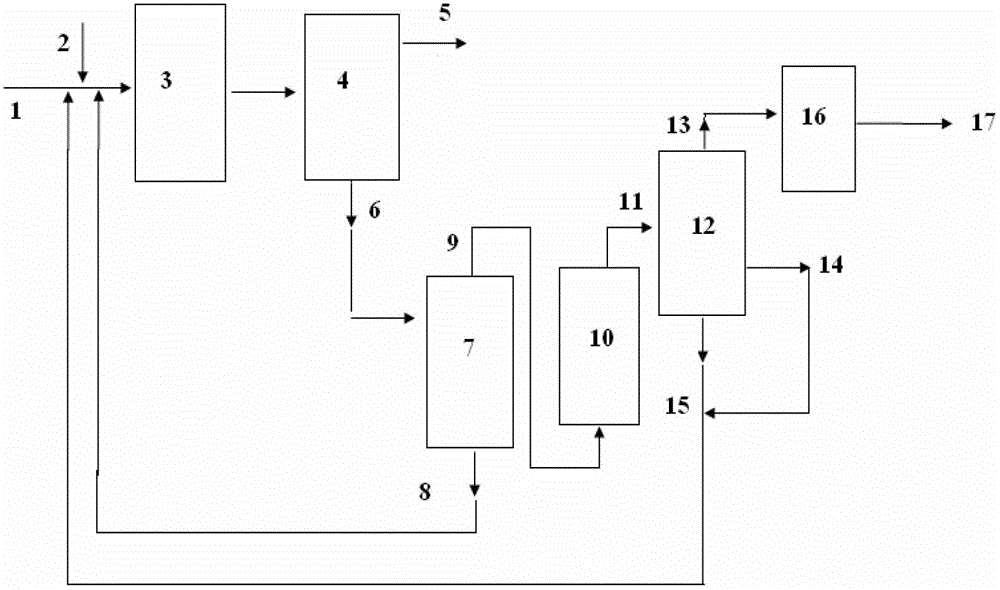
Figure 1
Abstract
Description
technical field
[0001] The invention relates to a processing method for lightening heavy oil, more specifically, relates to a method for processing heavy oil by adopting heavy oil hydrocracking, solvent deasphalting and catalytic cracking processes. Background technique
[0002] Due to the increasingly heavy and inferior quality of crude oil, the difficulty of crude oil processing has increased, and the yield of light oil products has decreased. However, the market demand for high-quality light oil products continues to increase, and environmental protection regulations tend to be stricter. There is an urgent need for refineries to develop effective processing methods for low-quality and heavy feedstock oils.
[0003] Heavy oil processing mainly has two types of processing technology, one is hydrogenation process, including hydrotreating, hydrocracking and hydrofining; the other is decarbonization process, including solvent deasphalting, coking, visbreaking and heavy oil cat...
Examples
preparation example 1
[0061] 43.7g molybdenum naphthenate (Mo accounted for 10.3% by weight), 30.8g tungsten naphthenate (W accounted for 8.78% by weight), 6.2g nickel tetracarbonyl (Ni accounted for 33.73% by weight), 6.5g vanadium hexacarbonyl (V accounted for 23.29% by weight), 25.3g rare earth isooctanoate (La accounted for 4.8% by weight, Ce accounted for 7.1% by weight), 17.7g of vulcanizing agent (DMDS) and 295mL of residue (Kuwait vacuum residue) were sequentially added to a 500mL autoclave , under the conditions of 370°C, 6.0MPa (hydrogen initial pressure), and high-speed stirring (800rpm) for 180min, the product was centrifuged, extracted with toluene, and vacuum-dried to obtain catalyst A. The elemental composition of catalyst A was analyzed by XRF. : C-64.6%, H-7.2%, S-14.2%, N-0.3%, Mo-4.5%, W-2.7%, Ni-2.1%, V-1.5%, La-1.2%, Ce-1.8% .
[0062] Observed under the electron microscope, the average particle diameter of the catalyst A is 0.5 μm, and the average particle diameter of the met...
Embodiment 1
[0067] Example 1 illustrates the effect of the inferior heavy oil combined processing method provided by the present invention.
[0068] a. Mix the residual oil raw material with catalytic cracking heavy cycle oil, oil slurry and deoiled asphalt as a mixed raw material. The mixing weight ratio is: residual oil raw material: catalytic cracking heavy cycle oil: oil slurry: deoiled asphalt = 70:15 : 10: 5, the mixed raw materials enter the liquid-phase fluidized bed hydrogenation reactor for hydrogenation reaction, the catalyst is the same as in Comparative Example 1, and the operating conditions and product properties are shown in Table 2.
[0069] b. Introduce the hydrogenated product obtained in step a into a distillation tower for fractionation into light oil and hydrogenated heavy oil. The cut point is 350°C. The hydrogenated heavy oil (>350°C) enters the solvent extraction tower for solvent extraction and deasphalting. Deasphalted oil and deoiled asphalt were obtained, and ...