
Preparation method of organic vulcanizing agent for hydrogenation catalyst pre-vulcanizing
A technology of hydrogenation catalyst and vulcanizing agent, which is applied in the field of oil refining aids and sulfides with acyclic unsaturated carbon framework, can solve the problems of low conversion rate of raw materials, corrosiveness, low product yield, etc., and achieve high catalyst activity. Effect
Patent Information
- Authority / Receiving Office
- CN · China
- Current Assignee / Owner
- Publication Date
- 2015-11-11
- Estimated Expiration
- Not applicable · inactive patent
Smart Images
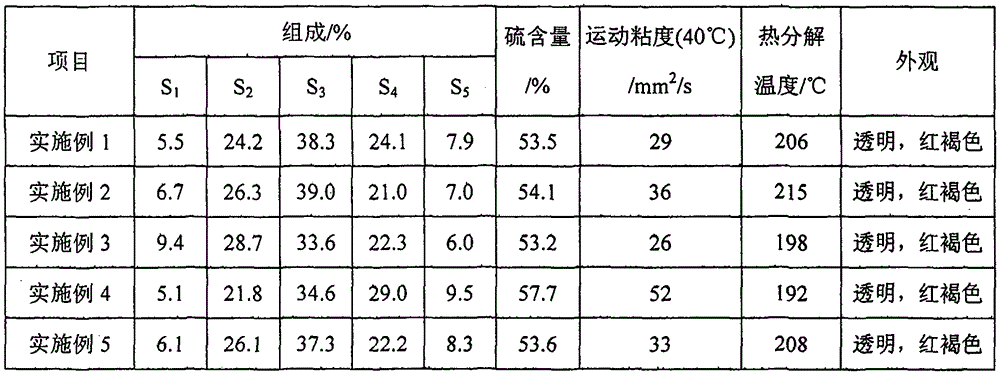
Figure 1
Abstract
Description
technical field
[0001] The invention belongs to the technical field of refining aids in fine chemical industry, in particular relates to a method for synthesizing an organic vulcanizing agent presulfurized by a hydrogenation catalyst, in particular to a method for preparing sulfide butene. It also belongs to the technical field of sulfides of acyclic unsaturated carbon frame. Background technique
[0002] Hydrogenation catalysts are composed of active components in an oxidized state and a carrier. During use, the active components in an oxidized state can only be converted into sulfide forms to have higher activity. Therefore, the hydrogenation catalyst must be presulfurized with a presulfidation agent before use. The vulcanizing agent is easy to decompose during the pre-sulfurization process, and can provide sufficient sulfur to convert the metal oxides in the catalyst into metal sulfides. There are many types of vulcanizing agents, but the most common ones are some organ...
Examples
Embodiment 1
[0014] Add 1200g of sulfur and 5g of catalyst into the autoclave, heat up to 160°C, stir at constant temperature for 1 hour, then pump 1,000g of isobutene into the autoclave with a metering pump, and the pressure of the autoclave rises rapidly after the isobutene is introduced, and the temperature rises to 160°C When it reaches above 3MPa, control the feed rate of isobutylene to ensure that the reaction pressure is between 3-6MPa, stir and react at 160-170°C for 2 hours, then lower the temperature, release the pressure, and filter to obtain 2200g of the additive product.
Embodiment 2
[0016] Add 1200g of sulfur and 5g of catalyst into the autoclave, heat up to 160°C, stir at constant temperature for 1 hour, then, as in Example 1, inject 1000g of 1-butene into the autoclave with a metering pump, and control the reaction pressure to 3 ~6MPa, 160~170°C stirring and reacting for 2 hours, then cooling down, depressurizing and filtering to obtain 2200g of the additive product.
Embodiment 3
[0018] Add 1200g of sulfur and 5g of catalyst into the autoclave, heat up to 160°C, stir at constant temperature for 1 hour, then, as in Example 1, inject 1000g of 2-butene into the autoclave with a metering pump, and control the reaction pressure to 3 ~6MPa, 160~170°C stirring and reacting for 2 hours, then cooling down, depressurizing and filtering to obtain 2200g of the additive product.