
Preparation method of double-crystal-form TiO2 photocatalytic material modified on G (graphene)
A photocatalytic material, graphene technology, applied in chemical instruments and methods, physical/chemical process catalysts, chemical/physical processes, etc., can solve problems such as no titanium dioxide nanocrystals, achieve excellent photocatalytic performance, stable physical and chemical Performance, the effect of improving photocatalytic activity
Patent Information
- Authority / Receiving Office
- CN · China
- Patent Type
- Applications(China)
- Current Assignee / Owner
- Publication Date
- 2015-12-16
- Estimated Expiration
- Not applicable · inactive patent
Smart Images
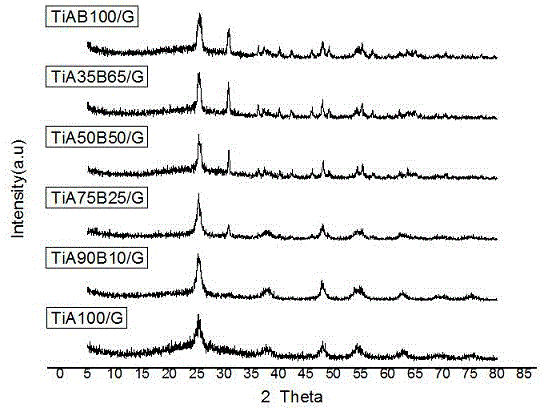
Figure 1 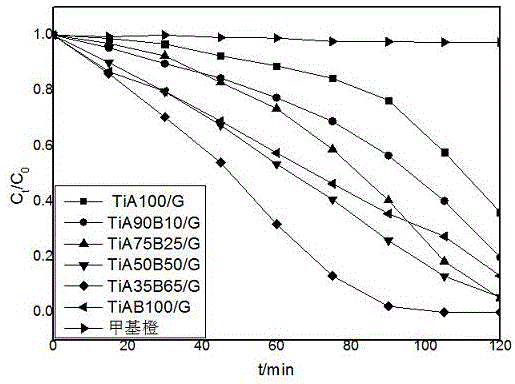
Figure 2
Abstract
Description
technical field
[0001] The invention belongs to the field of preparation of photocatalytic composite materials, in particular to a twin-crystal TiO modified on graphene G 2 Preparation methods of photocatalytic materials. Background technique
[0002] Titanium dioxide is widely used to photolyze water, sterilize and prepare solar sensitized cells, etc. Especially in environmental protection, titanium dioxide as a photocatalyst has shown broad application prospects. Anatase, brookite, and rutile are three naturally occurring polymorphs of titanium dioxide. Among these three polymorphs, anatase has been proven to be the most active, but it can only absorb ultraviolet light , the utilization rate of solar energy is very low; the activity of rutile is low, and brookite has rarely been studied in catalysis, because it has metastability, so it was very difficult to synthesize pure phase brookite in the past. Commercially available anatase-rutile titanium dioxide P25 was demonstr...
Examples
Embodiment 1
[0018] (1) Weigh 0.6g of urea and dissolve it in water, then add 10ml of ammonium dihydroxylactate titanate, then transfer the mixed solution to a volumetric flask and dilute it to 100ml with water. At this time, the mixed solution of urea after constant volume The concentration in is 0.1M;
[0019] (2) Weigh 20 mg of graphene oxide and place it in a beaker, pour 100 ml of the mixed solution obtained in step (1) into the beaker containing graphene oxide, seal the beaker with plastic wrap, and ultrasonicate for 8 hours. The ultrasonic power is 200w to ensure that graphene oxide is dispersed and fully in contact with dihydroxylactate ammonium titanate;
[0020] (3) After ultrasonic treatment, transfer the mixed solution obtained in step (2) to a 250ml polytetrafluoroethylene-lined stainless steel autoclave, seal it and place it in an electric furnace, and react at 160°C for 24h;
[0021] (4) After the reaction in step (3), let the polytetrafluoroethylene-lined stainless steel a...
Embodiment 2
[0024] The amount of urea added in step (1) is 1.5g, and the concentration of urea in the mixed solution after constant volume is 0.25M. Steps (2), (3) and (4) are the same as in Example 1.
[0025] The resulting product is TiO 2 A90B10 / G, take 50mg of this product and use it to degrade 50ml of 10PPm methyl orange solution under simulated sunlight. After 120min, the degradation rate reaches 80.07%.
Embodiment 3
[0027] The amount of urea added in step (1) is 3.0 g, and the concentration of urea in the mixed solution after constant volume is 0.5M. Steps (2), (3) and (4) are the same as in Example 1.
[0028] The resulting product is TiO 2 A75B25 / G, take 50mg of this product and use it to degrade 50ml of 10PPm methyl orange solution under simulated sunlight. After 120min, the degradation rate reaches 94.82%.