
A kind of bisphenol Z-bisphenol AF copolycarbonate binding resin and its preparation method and application
A polycarbonate and bonding resin technology, used in adhesives, instruments, optics, etc., can solve problems such as operator safety and environmental hazards, and achieve the effects of simple and convenient post-processing methods, good film-forming properties, and suitable molecular weight distribution.
Patent Information
- Authority / Receiving Office
- CN · China
- Patent Type
- Patents(China)
- Current Assignee / Owner
- Publication Date
- 2019-05-17
Smart Images
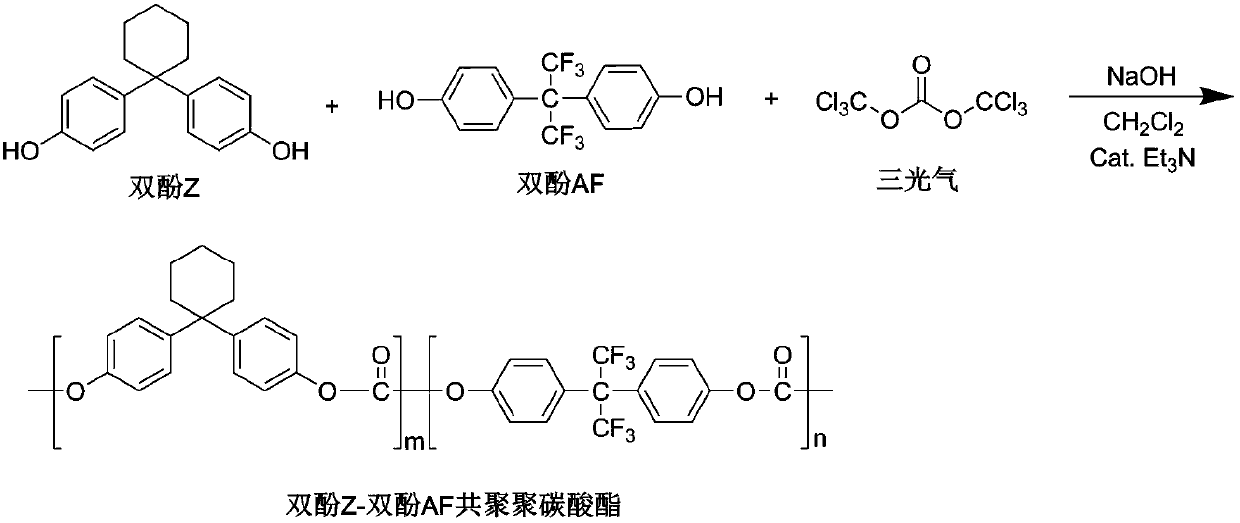
Figure 1 
Figure 2 
Figure 3
Abstract
Description
technical field
[0001] The invention relates to the preparation and application of a novel bisphenol Z and bisphenol AF polymerization to prepare a binary copolycarbonate binder resin, and belongs to the technical field of polymer binder resin preparation. Background technique
[0002] Polycarbonate is a functional resin, the most common of which is bisphenol A polycarbonate, which has colorless transparency, good impact resistance and good adhesion, making it widely used in the fields of organic optoelectronics, information display and recording. have important applications. Functional films such as organic information recording and display usually use bisphenol A polycarbonate as a binder and film-forming agent. The general process is to combine a small molecule compound with carrier transport function with bisphenol A polycarbonate Dissolve in a solvent to form a solution with a certain viscosity, and then form a functional film by solution processing (such as spin coati...
Examples
Embodiment 1
[0029] 2.68g (10mmol) bisphenol Z (1,1'-bis(4-hydroxyphenyl) cyclohexane), 3.36g (10mmol) bisphenol AF (2,2'-bis(4-hydroxyphenyl) Hexafluoropropane) was dissolved in 100 mL of 5% sodium hydroxide aqueous solution with stirring. After adding 0.23g (1mmol) benzyltriethylammonium chloride and 0.03mL (0.2mmol) triethylamine at 25°C, a dichloromethane solution of triphosgene [5.96g (20.1mmol) triphosgene dissolved in In 150mL of dichloromethane], after fully stirring for half an hour, the temperature was raised to 35°C for polycondensation reaction for 3 hours. After the reaction, the water phase was separated with a separatory funnel to obtain a dichloromethane solution containing bisphenol Z-bisphenol AF copolycarbonate. Synthetic route such as figure 1 shown.
[0030] The dichloromethane solution of bisphenol Z-bisphenol A copolycarbonate obtained in the previous step was washed with 0.1M NaOH solution, and then repeatedly washed with deionized water until the aqueous phase w...
Embodiment 2
[0032] 4.83g (18mmol) bisphenol Z (1,1'-bis(4-hydroxyphenyl) cyclohexane), 0.67g (2mmol) bisphenol AF (2,2'-bis(4-hydroxyphenyl) Hexafluoropropane) was dissolved in 100 mL of 5% sodium hydroxide aqueous solution with stirring. After adding 0.23g (1mmol) benzyltriethylammonium chloride and 0.03mL (0.2mmol) triethylamine at 25°C, a dichloromethane solution of triphosgene was added dropwise [6.53g (22mmol) triphosgene was dissolved in 150mL dichloromethane], after fully stirring for half an hour, the temperature was raised to 35°C for polycondensation reaction for 4 hours. After the reaction, the water phase was separated with a separatory funnel to obtain a dichloromethane solution containing bisphenol Z-bisphenol AF copolycarbonate. Synthetic route such as figure 1 shown.
[0033] The dichloromethane solution of bisphenol Z-bisphenol A copolycarbonate obtained in the previous step was washed with 0.1M NaOH solution, and then repeatedly washed with deionized water until the a...
Embodiment 3
[0035] 3.75g (14mmol) bisphenol Z (1,1'-bis(4-hydroxyphenyl) cyclohexane), 2.01g (6mmol) bisphenol AF (2,2'-bis(4-hydroxyphenyl) Hexafluoropropane) was dissolved in 200 mL of 2% sodium hydroxide aqueous solution under stirring. After adding 0.46g (2mmol) benzyltriethylammonium chloride and 0.06mL (0.4mmol) triethylamine at 25°C, a dichloromethane solution of triphosgene was added dropwise [3.56g (12mmol) triphosgene was dissolved in 120mL of dichloromethane], after fully stirring for half an hour, the temperature was raised to 35°C for 2 hours of polycondensation reaction. After the reaction, the water phase was separated with a separatory funnel to obtain a dichloromethane solution containing bisphenol Z-bisphenol AF copolycarbonate. Synthetic route such as figure 1 shown.
[0036]The dichloromethane solution of bisphenol Z-bisphenol A copolycarbonate obtained in the previous step was washed with 0.1M NaOH solution, and then repeatedly washed with deionized water until the...