
Water quality purifying method for riverway
A technology for water purification and river course, applied in chemical instruments and methods, treatment of polluted waterways/lakes/ponds/rivers, water/sewage treatment, etc. The effect of low technical requirements, low investment cost and high processing efficiency
Patent Information
- Authority / Receiving Office
- CN · China
- Current Assignee / Owner
- Publication Date
- 2017-03-29
- Estimated Expiration
- Not applicable · inactive patent
Smart Images
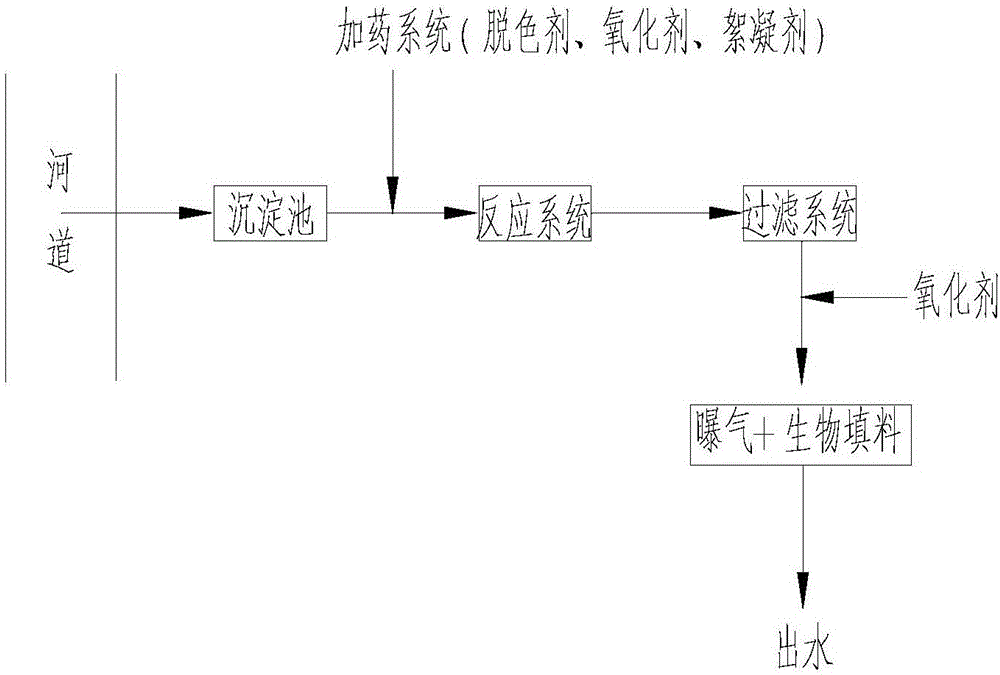
Figure 1
Abstract
Description
technical field
[0001] The invention relates to a water purification method for river courses. Background technique
[0002] In recent years, with the rapid development of economy and society and the rapid growth of population, the river water environment system has been under pressure from various aspects, and serious problems such as reduction of water area, river channel silting, water pollution and eutrophication have generally appeared. According to the latest 2015 China Environmental Status Bulletin, water quality monitoring has been carried out on 967 state-controlled surface water monitoring sections (points) of 423 major rivers and 62 key lakes (reservoirs) across the country, and the water quality is classified as Class I-III, IV-V 64.5%, 26.7%, and 8.8% of the water quality sections were Grade V or worse than Grade V respectively. In addition, especially the black and smelly problem of urban rivers has become increasingly prominent.
[0003] At present, the main...
Examples
Embodiment 1
[0037] Such as figure 1 As shown, the present embodiment provides a water purification method for river courses, comprising the steps of:
[0038] Drain the water in the river channel to the sedimentation tank, and the water taken out is settled in the sedimentation tank;
[0039] Take out the supernatant in the sedimentation tank, and add medicine to the taken out supernatant;
[0040] The supernatant after adding the drug is put into the reaction tank for reaction;
[0041] Filter the river water in the reaction pool;
[0042] Add oxidant to filtered water;
[0043] The filtered water added with oxidant is introduced into the aeration tank provided with biological filler, and the filtered water added with oxidant is aerated and treated with microorganisms in the aeration tank.
[0044] The specific operation steps are as follows:
[0045] Take the river water with raw water quality: COD 85.2mg / L, BOD5 43.6mg / L, NH3-N 11.3mg / L, TN 23.6mg / L, TP6.2mg / L as an example:
[0...
Embodiment 2
[0060] The difference between the water quality purification method used in this example and Example 1 is that the river water flows into the sedimentation tank by itself, and after the river water is settled, it is pumped into the reaction tank with a pump. , set the pipeline mixer, before the river water enters the pipeline mixer, add 30% PAC22mg / L, PAM 0.8mg / L, sodium hypochlorite dosage is 0.5% of the waste water flow; among them, the available chlorine of sodium hypochlorite is 10%.
[0061] The residence time of the river water after dosing in the reaction tank is 30min.
[0062] After the reaction, the river water enters the filter tank, and the filter material is a filter material including microporous ceramic filter material, quartz sand, gravel, anthracite, manganese sand, magnetite filter material, fruit shell filter material, porcelain sand filter material, ceramsite , a mixture of garnet filter material, medical stone filter material, activated alumina ball and zeol...
Embodiment 3
[0067] On the basis of the above embodiments, the aerated and microbially treated river water flows into the reservoir, and the water in the reservoir flows into the downstream of the river after several natural falls.
[0068] The river water in this embodiment finally passes through the reservoir and flows into the downstream of the river after several drops of water. During the process of falling water, the purpose of aeration can also be achieved, and the oxygen content of the river water can be further increased. When the treated river water When it flows into the downstream of the river, it can increase the average oxygen content in the water downstream of the river, which is beneficial to the self-purification of the water downstream of the river.