
Molecular marker for identifying trichotylenchus changlingensis and application thereof
A molecular marker, nematode technology, applied in the determination/inspection of microorganisms, DNA/RNA fragments, recombinant DNA technology, etc., can solve the problems of high technical requirements and poor identification effect, achieve high identification accuracy, simple detection method, Primer-specific effect
Patent Information
- Authority / Receiving Office
- CN · China
- Patent Type
- Applications(China)
- Current Assignee / Owner
- Publication Date
- 2017-11-03
Smart Images
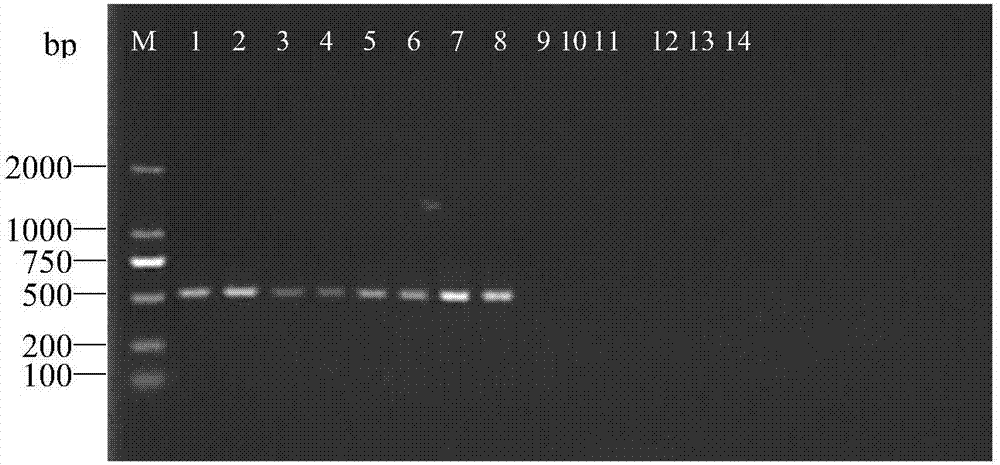
Figure 1 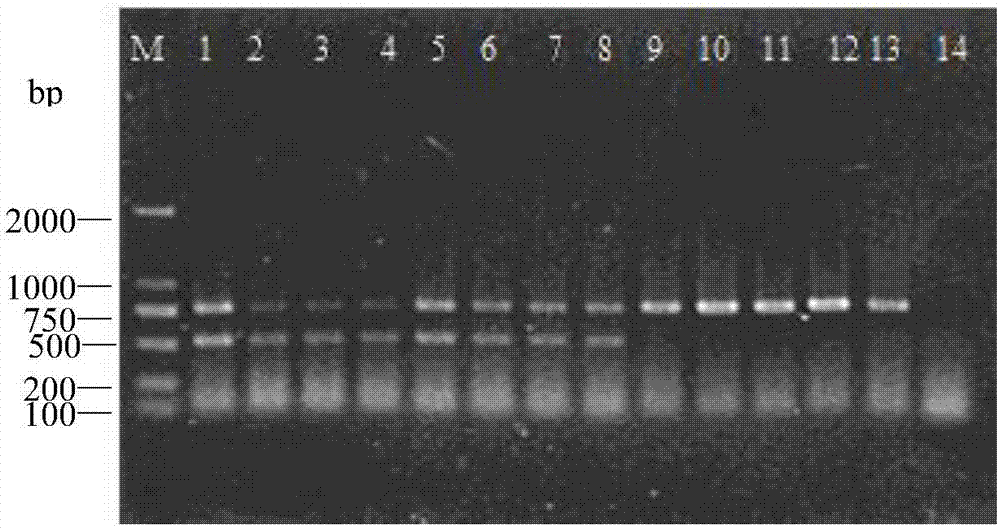
Figure 2 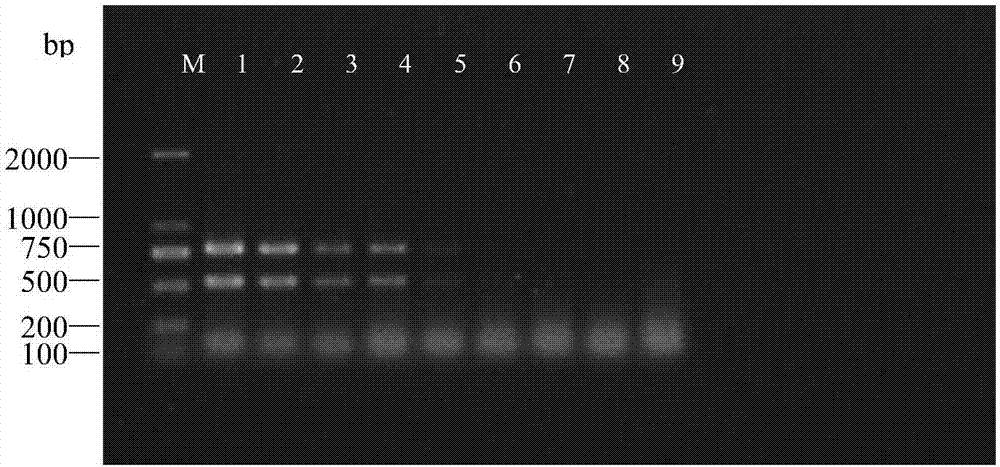
Figure 3
Abstract
Description
technical field
[0001] The invention belongs to the field of plant nematode identification, and in particular relates to a molecular marker used for identifying the nematode elegans nematode method. Background technique
[0002] Trichotylenchus changlingensis is a migratory plant ectoparasitic nematode belonging to the genus Trichotylenchus. The nematode was first found in potato rhizosphere soil in 2011 (Xu CL et al., Nematology, 2011, 13(1):45-49). The nematode can cause yellowing of maize leaves, dwarf plants, cracking of stem bases, shortening of stem nodes and other symptoms (Guo Ning et al. Journal of Plant Protection. 2015, 42(6): 884-8910), which is very harmful to maize.
[0003] There are few researches on C. elegans at home and abroad. The traditional identification method is mainly based on morphological characteristics, but this method has high technical requirements for operators, and must have a high degree of professional skills in nematode taxonomy. This ...
Examples
Embodiment 1
[0045] Example 1. Design of specific primers for C. changling according to the present invention and PCR detection test of primer specificity
[0046] Proceed as follows:
[0047] (1) Test materials and sources
[0048] 1. C. elegans hairpad: 8 HEB1, HEB2, HEB3, SY1, CC1, QD1, ZB1 and XT1 in total.
[0049] 2. Other nematodes: P. elegans C1, D. nematode D1, Root-knot nematode M1, Cyst nematode H1 and Brachypodium nematode P1.
[0050] The above nematodes were preserved in the Institute of Plant Protection, Hebei Academy of Agriculture and Forestry.
[0051] (2) Test method
[0052] (1) Single nematode DNA extraction. The nematodes were washed in sterile deionized water, and a single nematode was picked and placed in 10 μL of lysis buffer (1×PCR Buffer (Mg 2+ ), 1 μg proteinase K), water bath at 65 °C for 1 min, liquid nitrogen treatment for 2 min, after repeated freezing and thawing several times, incubate at 56 °C for 20 min, and heat at 95 °C for 10 min to obtain DNA ex...
Embodiment 2
[0062] Embodiment 2, the double PCR method of the present invention detects the specificity test of C. elegans
[0063] (1) Test material: the same as (1) of Example 1.
[0064] (2) Test method:
[0065] (1). Single nematode DNA extraction. Same as (2) (1) of Example 1.
[0066] (2). Double PCR amplification. Using nematode DNA as a template and TC-F1 / TC-R1 and D2A / D3B as primers, double PCR amplification was performed to obtain the amplified product. The PCR reaction system was 25 μL: 10×Ex Taq Buffer (Mg 2+ ) 2.5μL, 5U / μL Ex Taq polymerase 0.2μL, template DNA 0.5μL, 2.5mmol / L dNTPs Mixture 2μL, primers TC-F1 / TC-R1 0.5μL each, D2A / D3B (10μmol·L -1 ) each 1 μL, and finally make up ddH2O to 25 μL, and set a negative control without template. PCR reaction program: 95°C for 4 min; 94°C for 30s, 62°C for 45s, 72°C for 45s, 35 cycles; 72°C for 10 min; storage at 16°C. The primers D2A and D3B described therein are universal primers in the 28S region, which are used as interna...
Embodiment 3
[0072] Embodiment 3, the detection sensitivity test of the double PCR method of the present invention
[0073] (1) Test materials
[0074] The single nematode DNA was diluted in a concentration gradient of 1 / 4×, 1 / 8×, 1 / 16×, 1 / 32×, 1 / 64×, 1 / 128×, 1 / 256×, and 1 / 512×.
[0075] (2) Test method
[0076] (1). The extraction method of HEB1 single nematode DNA is the same as that in Example 1.
[0077] (2). The double PCR amplification method is the same as that in Example 2.
[0078] (3). Electrophoresis detection is the same as in Example 1.
[0079] result (see image 3 ) single nematode DNA is 1 / 4× (concentration 1 ng / μL) to 1 / 32× (concentration 0.125ng / μL) (see image 3 Swimming lanes 1-4), clear and stable bands can be amplified, that is, detection can be performed at a very low template concentration of 0.125ng / μL, indicating that the double PCR detection method of the present invention has high sensitivity.