
A method for synthesizing trametinib key intermediate
A technology for trametinib and intermediates, which is applied in the field of synthesizing key intermediates of trametinib, can solve the problems of many steps, low yield of one step, low yield of key steps, etc., and achieves the effect of short steps
Patent Information
- Authority / Receiving Office
- CN · China
- Patent Type
- Patents(China)
- Current Assignee / Owner
- Publication Date
- 2021-02-05
Smart Images
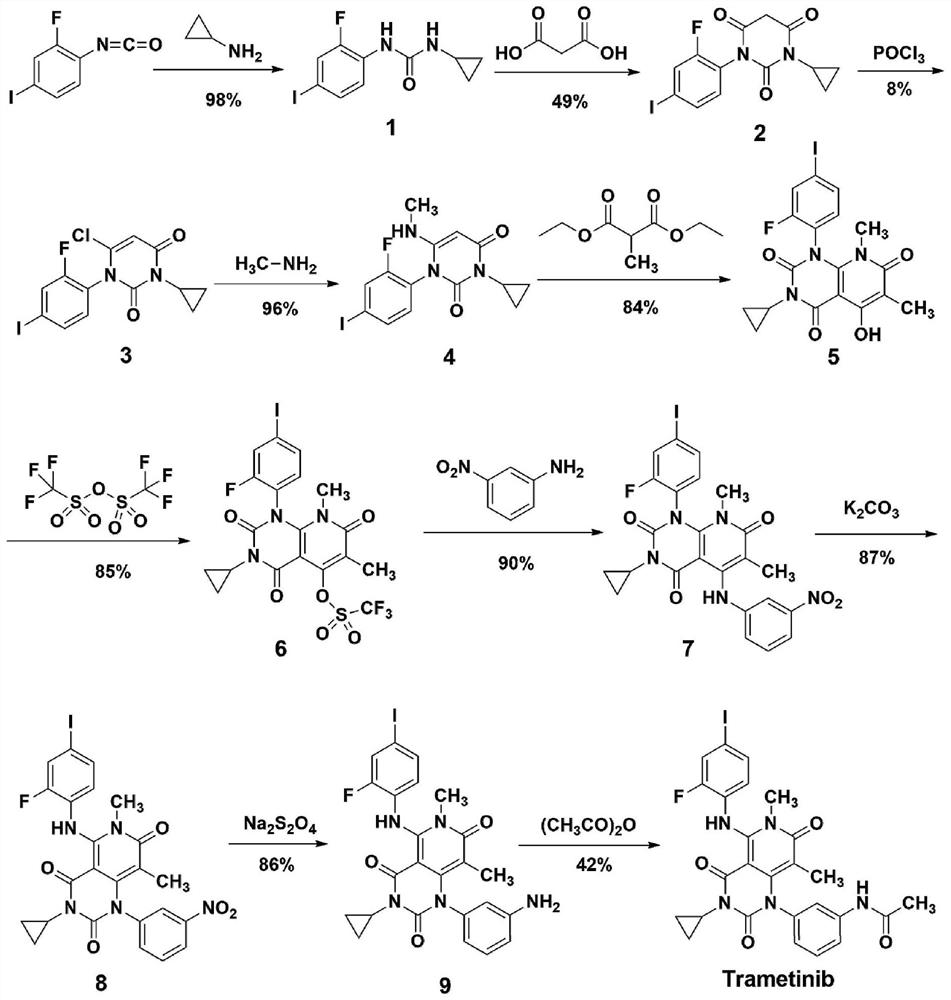
Figure 1 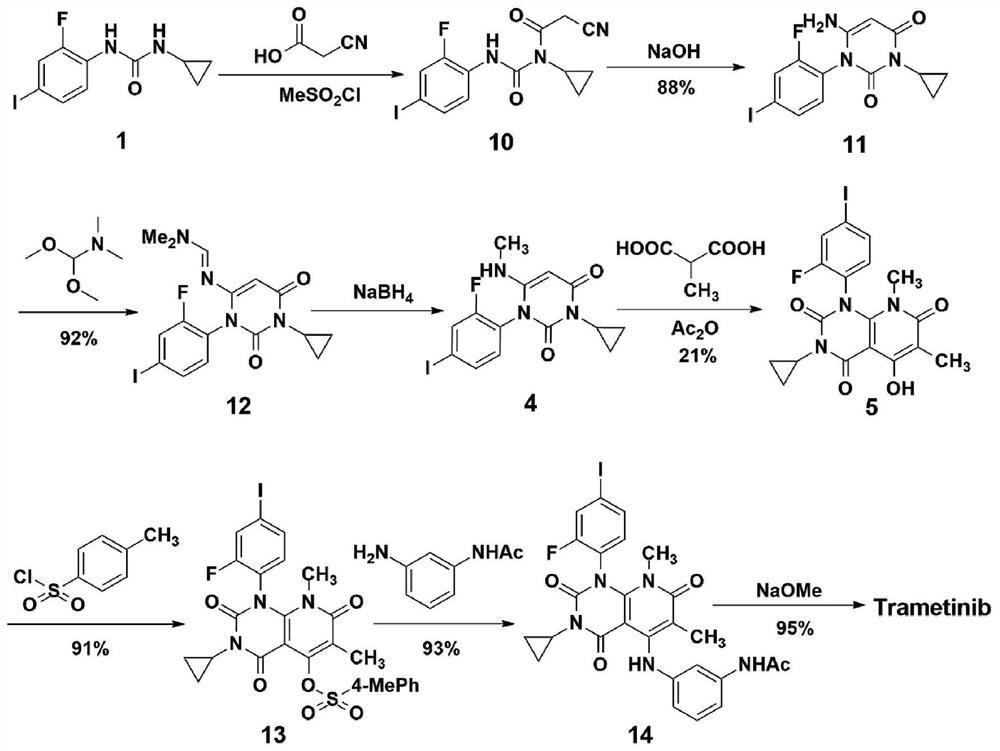
Figure 2 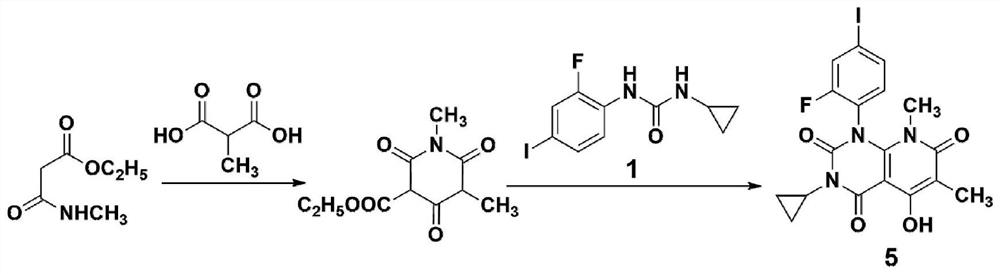
Figure 3
Abstract
Description
technical field
[0001] The invention relates to a synthesis method of trametinib, in particular to a method for synthesizing a key intermediate of trametinib. Background technique
[0002] The Chinese chemical name of Trametinib: N-[3-[3-cyclopropyl-5-[(2-fluoro-4-iodophenyl)amino]-3,4,6,7-tetra Hydrogen-6,8-dimethyl-2,4,7-trioxopyrido[4,3-d]pyrimidin-1(2H)-yl]phenyl]acetamide, developed by GlaxoSmithKline , Trametinib approved by the U.S. FDA on May 29, 2013, was launched in the U.S. under the trade name Mekinist. For the treatment of unresectable or metastatic melanoma with BRAF (murine sarcoma virulence oncogenic homologue B1 gene) V600E or V600K mutation.
[0003] ACS Medicinal Chemistry Letters, 2011,2(4),320-324 reported its synthetic method, as figure 1 Shown: Urea 1 was prepared by using 2-fluoro-4-iodophenylisocyanate and cyclopropylamine, and then cyclized with malonic acid to obtain pyrimidinetrione compound 2, pyrimidinetrione compound 2 and POCl 3 Selective ...
Examples
Embodiment 1
[0033] according to image 3 The shown roadmap prepares the key intermediate of synthetic trametinib:
[0034] S1: At room temperature, oxalyl chloride (13.4mL, 153mmol) was slowly added dropwise to a suspension of methylmalonic acid (9.0g, 76.2mmol) and DMF (2 drops) in dichloromethane (500mL), and reacted at room temperature for 24h , the solution was homogeneous, and slowly added dropwise to a solution of monoethyl malonate (9.2g, 63.4mmol) in dry toluene (100mL). NaOH solution (1mol / L, 100mL), separate the layers, take the solution layer, continue to add NaOH solution (1mol / L, 100mL) to the organic layer, combine the solution layers, wash with dichloromethane (200mL), adjust the pH to 1 with concentrated hydrochloric acid , ethyl acetate (50mL once, 3 times in total) extracted the aqueous layer, combined the ethyl acetate phases, dried, filtered, and concentrated to obtain a crude product, which was directly put into the next step without purification;
[0035] S2: To a ...
Embodiment 2
[0037]S1: At room temperature, slowly add oxalyl chloride (13.4mL, 153mmol) dropwise to a suspension of methylmalonic acid (9.0g, 76.2mmol) and DMF (2 drops) in dichloromethane (450mL), and react at room temperature for 20h , the solution was homogeneous, and was slowly added dropwise to a solution of monoethyl malonate (8.13g, 56mmol) in dry toluene (82mL). solution (0.8mol / L, 82mL), separate the layers, take the solution layer, continue to add NaOH solution (0.8mol / L, 82mL) to the organic layer, combine the solution layers, wash with dichloromethane (164mL), and adjust the pH to 1. Extract the aqueous layer with ethyl acetate (50 mL once, 3 times in total), combine the ethyl acetate phases, dry, filter, and concentrate to obtain a crude product, which is directly put into the next step without purification;
[0038] S2: To a solution of N-(2-fluoro-4-iodophenyl)-N'-cyclopropylurea (17.9g, 56mmol) in THF (280mL), add sodium ethylate (11.4 g, 168mmol), warmed to room temperat...
Embodiment 3
[0040] S1: Slowly add oxalyl chloride (13.4mL, 153mmol) dropwise to a suspension of methylmalonic acid (9.0g, 76.2mmol) and DMF (2 drops) in dichloromethane (540mL) at room temperature, and react at room temperature for 36h , the solution was homogeneous, slowly added dropwise to a solution of monoethyl malonate (11.05g, 76.2mmol) in dry toluene (132mL), after the addition was completed, the reaction was continued at 50°C for 20h, NaOH solution (1.2mol / L, 132mL), separate the layers, take the solution layer, continue to add NaOH solution (0.8mol / L, 82mL) to the organic layer, combine the solution layers, wash with dichloromethane (264mL), adjust the pH with concentrated hydrochloric acid To 1, extract the aqueous layer with ethyl acetate (50 mL once, 3 times in total), combine the ethyl acetate phases, dry, filter, and concentrate to obtain a crude product, which is directly put into the next step without purification;
[0041] S2: To a solution of N-(2-fluoro-4-iodophenyl)-N'...