

A kind of preparation method of fenbendazole
A technology of fenbendazole and preparation process, applied in the field of preparation of fenbendazole, can solve the problem of high production cost, achieve the effects of reduced production cost, mild reaction conditions, and avoidance of the use of thiophenol
Patent Information
- Authority / Receiving Office
- CN · China
- Patent Type
- Patents(China)
- Current Assignee / Owner
- Publication Date
- 2022-07-12
Smart Images
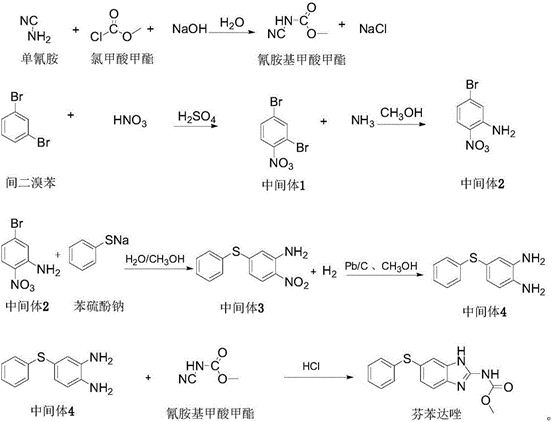
Figure 1
Abstract
Description
technical field
[0001] The invention relates to the preparation of fenbendazole and an intermediate thereof, in particular to a preparation method of fenbendazole. Background technique
[0002] Fenbendazole, also known as benzimidazole, chemical name is 5-phenylthiobenzimidazole-2-carbamic acid methyl ester, is a benzimidazole anthelmintic. It not only has high anthelmintic activity on gastrointestinal nematodes adults and larvae, but also has good effects on reticulate nematodes, fasciola and tapeworms, and has a strong insecticidal egg effect. It has the advantages of maggot spectrum light, low toxicity, good tolerance, wide safety range and good palatability.
[0003] At present, m-dichlorobenzene is often used as the starting material in the selection of synthetic routes at home and abroad, and liquid ammonia needs to be selected as the ammoniation reagent during the ammoniation reaction. The reaction pressure needs to be above 8.0 MPa, and the temperature needs to be a...
Examples
Embodiment 1
[0016] (1) Preparation of methyl cyanamide formate aqueous solution
[0017] 44.0g of cyanamide aqueous solution was cooled to 0-5°C, and 10.93g of methyl chloroformate and 16.03g of sodium hydroxide solution (30%) were added dropwise under stirring. The material was dripped at the same time or the methyl chloroformate was dripped slightly earlier than the sodium hydroxide solution. After the dropwise addition of both materials, the mixture was stirred at 0-5° C. for 2 hours to obtain 70.91 g of an aqueous methyl cyanamide formate solution with a concentration of 14.0%, which was stored at about 0° C. for low temperature for later use.
[0018] (2) Intermediate 1 (2,4-dibromonitrobenzene)
[0019] Dissolve 24.5g m-dibromobenzene into 49.0g concentrated sulfuric acid (98%) at room temperature, cool to 0-5°C, add 9.80g nitric acid (68%) dropwise, and control the temperature at 0-5°C during the dropping process. After the addition was complete, stir at 5-10°C for 2 hours. Afte...
Embodiment 2
[0029] (1) Preparation of methyl cyanamide formate aqueous solution
[0030] 220.0g of cyanamide aqueous solution was cooled to 0-5°C, and 54.65g of methyl chloroformate and 80.15g of sodium hydroxide solution (30%) were added dropwise under stirring. The material was dripped at the same time or the methyl chloroformate was dripped slightly earlier than the sodium hydroxide solution. After the dropwise addition of both materials, the mixture was stirred at 0-5° C. for 2 hours to obtain 355.0 g of an aqueous methyl cyanamide formate solution with a concentration of 14.0%, which was stored at about 0° C. for low temperature for later use.
[0031] (2) Intermediate 1 (2,4-dibromonitrobenzene)
[0032] Dissolve 122.5g m-dibromobenzene into 245.0g concentrated sulfuric acid (98%) at room temperature, cool to 0-5°C, add 49.0g nitric acid (68%) dropwise, control the temperature during the dropwise addition at 0-5°C, dropwise After the addition was complete, stir at 5-10°C for 2 hou...
Embodiment 3
[0042] (1) Preparation of methyl cyanamide formate aqueous solution
[0043] 440.0g of cyanamide aqueous solution was cooled to 0-5°C, and 109.3g of methyl chloroformate and 160.3g of sodium hydroxide solution (30%) were added dropwise under stirring. The material was dripped at the same time or the methyl chloroformate was dripped slightly earlier than the sodium hydroxide solution. After the dropwise addition of both materials, the mixture was stirred at 0-5° C. for 2 hours to obtain 708.0 g of an aqueous methyl cyanamide formate solution with a concentration of 14.0%, which was stored at about 0° C. for low temperature for later use.
[0044] (2) Intermediate 1 (2,4-dibromonitrobenzene)
[0045] Dissolve 245.0g m-dibromobenzene into 490.0g concentrated sulfuric acid (98%) at room temperature, cool to 0-5°C, add 98.0g nitric acid (68%) dropwise, control the temperature in the dropping process at 0-5°C, dropwise After the addition was complete, stir at 5-10°C for 2 hours. ...