
Method of photo-induced catalytic selective synthesis of Z- and E-olefins
A light-induced and selective technology, applied in the field of pharmaceutical and chemical applications, can solve the problems of unfavorable large-scale industrial production, difficulty in obtaining trans-olefins, expensive ammonia borane, etc., achieve good catalytic effect, facilitate post-processing procedures, The effect of maintaining the catalytic effect
Patent Information
- Authority / Receiving Office
- CN · China
- Patent Type
- Applications(China)
- Current Assignee / Owner
- Publication Date
- 2019-09-10
- Estimated Expiration
- Not applicable · inactive patent
Smart Images
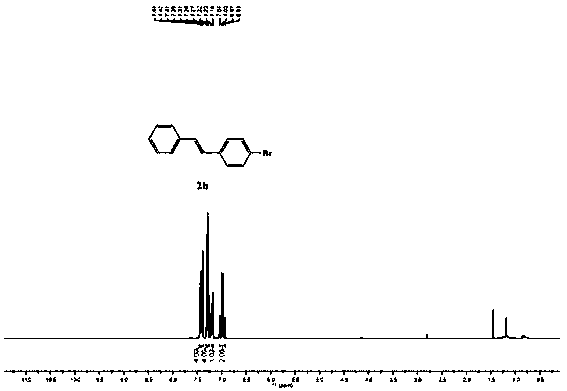
Figure 1 
Figure 2 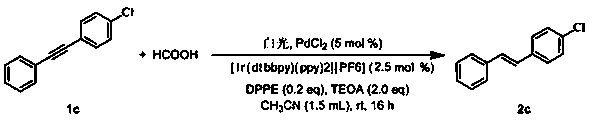
Figure 3
Abstract
Description
technical field
[0001] The invention relates to the technical field of pharmaceutical and chemical applications, in particular to a method for selectively synthesizing Z- and E-alkenes by light-induced catalysis. Background technique
[0002] Olefin compounds are a class of important chemical intermediates and pharmaceutical intermediates in the pharmaceutical and chemical industry, and widely exist in natural products; in the chemical industry, they can be used for catalytic hydrogenation reactions, electrophilic addition reactions, free radical addition reactions, Polymerization reaction, etc., is an extremely important class of organic synthesis reagents; in the field of medicine, it is an important class of drug intermediates, especially trans-olefins are the most widely used. Therefore, olefinic compounds have high application value. Compared with the traditional method, this method is more green, environmentally friendly and economical. It adopts a clean energy photoi...
Examples
Embodiment 1
[0042] Synthesis of (E)-1,2-diphenylethylene:
[0043]
[0044] Add raw material 1a (0.20 mmol), [Ir(dtbbpy)(ppy)2][PF6] (10μmol, 8.4mg), PdCl 2 (0.04 mmol, 7.1 mg), DPPE (0.04 mmol, 15.9 mg), TEOA (0.4 mmol), HCOOH (0.4 mmol) and acetonitrile (1.5 mL), stirred at room temperature under white light for 16 hours in an air atmosphere, added acetic acid Diluted with ester (5 mL), washed with saturated brine (5 mL), dried the organic phase with anhydrous magnesium sulfate, spin-dried and then column chromatographed with (n-hexane) as the eluent to obtain 32 mg of product 2a as a white solid. The rate is 90%. 1 H NMR (400 MHz, CDCl 3 ): 7.49 (d, J =8.0 Hz, 4H), 7.34 (t, J = 8.0 Hz, 4H), 7.26 – 7.22 (m, 2H), 7.09 (s, 2H); 13 CNMR (100 MHz, CDCl 3 ) 137.4, 128.8, 127.7, 126.6.
Embodiment 2
[0046] Synthesis of (E)-1-bromo-4-styrylbenzene:
[0047]
[0048] Add raw material 1b (0.20 mmol), [Ir(dtbbpy)(ppy)2][PF6] (10 μmol, 8.4 mg), PdCl2 (0.04 mmol, 7.1 mg), DPPE (0.04 mmol, 15.9 mg) in the reaction flask in sequence , TEOA (0.4mmol), HCOOH (0.4mmol) and acetonitrile (1.5 mL), in air atmosphere, under white light irradiation, stirred at room temperature for 16 hours, added ethyl acetate (5 mL) to dilute, washed with saturated brine (5 mL), The organic phase was dried with anhydrous magnesium sulfate, spin-dried and then column chromatographed with (n-hexane) as the eluent to obtain 42 mg of product 2b as a white solid with a yield of 81%. 1 H NMR (400 MHz, CDCl 3 ): 7.48 – 7.43(m, 4H), 7.35 – 7.31 (m, 4H), 7.23 (d, J =8.0 Hz, 1H), 7.07 (dd, J = 24.0,12.0 Hz, 2H); 13 C NMR (100 MHz, CDCl 3 ) 137.1, 136.4, 131.9, 129.6, 128.9, 128.1, 128.1, 127.6, 126.7, 121.5.
Embodiment 3
[0050] Synthesis of (E)-1-chloro-4-styrylbenzene:
[0051]
[0052] Add raw material 1c (0.20 mmol), [Ir(dtbbpy)(ppy)2][PF6] (10 μmol, 8.4 mg), PdCl2 (0.04 mmol, 7.1 mg), DPPE (0.04 mmol, 15.9 mg) in the reaction flask in sequence , TEOA (0.4mmol), HCOOH (0.4mmol) and acetonitrile (1.5 mL), in air atmosphere, under white light irradiation, stirred at room temperature for 16 hours, added ethyl acetate (5 mL) to dilute, washed with saturated brine (5 mL), The organic phase was dried with anhydrous magnesium sulfate, spin-dried and then column chromatographed with (n-hexane) as the eluent to obtain 36 mg of product 2c as a white solid with a yield of 84%. 1 H NMR (400 MHz, CDCl 3 ):7.50 (d, J =8.0 Hz, 2H), 7.44 (d, J = 8.0 Hz, 2H), 7.38-7.25 (m, 5H), 7.07 (dd, J = 20.0,16.0 Hz, 2H); 13 C NMR (100 MHz, CDCl 3 ) d 137.1, 136.0, 133.3, 129.5, 129.0, 128.9, 128.0, 127.8, 127.5, 126.7.