
An artificial rapid infiltration system that improves the treatment capacity of nitrogen and phosphorus pollutants in rainwater through medium modification
A technology of artificial rapid infiltration and pollutant treatment, which is applied in the direction of water pollutants, water/sewage treatment, runoff/rainwater treatment, etc. Determine the range of process parameters, low removal efficiency of pollutants such as nitrogen and phosphorus, etc., to achieve the effect of small footprint, simple structure, and improved adsorption effect
Patent Information
- Authority / Receiving Office
- CN · China
- Patent Type
- Patents(China)
- Current Assignee / Owner
- Publication Date
- 2022-03-11
Smart Images
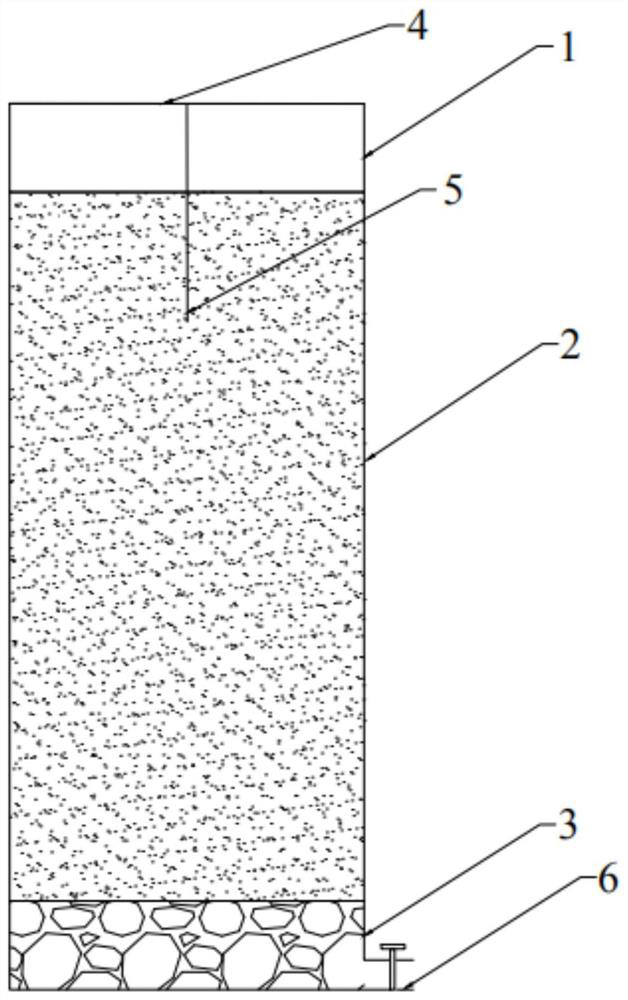
Figure 1
Abstract
Description
technical field
[0001] The invention relates to the technical field of sewage treatment, in particular to an artificial rapid infiltration system for improving the treatment capacity of pollutants such as nitrogen and phosphorus in rainwater through media modification. Background technique
[0002] Constructed rapid infiltration system (CRI for short) is a type of land treatment, which refers to the process of putting sewage on the surface of artificially constructed infiltration media in a controlled manner to make it infiltrate downward. It experiences different physical, chemical and biological effects, and finally achieves the purpose of purifying sewage. It is based on the research and summary of various types of land treatment and rapid infiltration systems, aiming at the common shortcomings of traditional sewage land treatment systems such as low hydraulic load and small treatment capacity per unit area. The advantages of the constructed wetland system, a new type of...
Examples
Embodiment 1
[0029] according to figure 1The structure diagram of the artificial rapid infiltration system is prepared, the device is PVC plastic, the whole is a cylinder, the height is 130cm, the length and width are both 60cm, and the medium layer 2 is 85cm, the overflow layer 1 is 25cm, and the water outlet layer 3 is 20cm , there is a water distribution pipe on the surface of the medium layer and 30cm from the surface. The medium layer is evenly mixed with soil, river sand, vermiculite and limestone with a particle size of less than 2cm. The ratio of soil and river sand is 1:1. The doping amount of stone is 15% of the total volume of soil and river sand, the doping amount of limestone is 8% of the total volume of soil and river sand, and the particle size of the pebbles filled in the drainage layer is 2-4 cm.
[0030] The initial concentrations of COD, ammonia nitrogen, TP, and TN in the wastewater were determined to be 173-185 mg / L, 7-8 mg / L, 0.3-0.4 mg / L, and 7.8-9.5 mg / L, respective...
Embodiment 2
[0032] With the embodiment 1, the difference is that the vermiculite added is modified vermiculite, and the modification method: the natural vermiculite is sieved with 2 mm, and the HNO of 1 mol / L is used. 3 Stir and soak for 2 hours, take out and rinse, remove soluble impurities, dry in an oven to constant weight, and then take 10g of the pretreated vermiculite and chitosan, and set it according to the mass ratio of chitosan and vermiculite as 1:40. In a beaker, add 100 ml of 1 mol / L NaOH solution, stir for 24 hours, soak in distilled water, rinse until pH is constant, and dry in an oven to constant weight before use.
[0033] The average effluent concentrations of COD, ammonia nitrogen, TP and TN in the sewage at the detected drainage site were 15.29 mg / L, 0.81 mg / L, 0.018 mg / L and 4.21 mg / L, respectively.
Embodiment 3
[0035] Same as Example 2, the difference is that only the water inlet pipe is set on the surface of the medium layer, and the water outlet is set on the drainage layer. 0.0141mg / L, 6.06mg / L.