
Modification method of ZSM-11 molecular sieve catalyst for reaction for preparing ethylene through ethanol dehydration
A ZSM-11, ethanol dehydration technology, applied in molecular sieve catalysts, chemical instruments and methods, physical/chemical process catalysts, etc., to achieve the effect of improving stability
Patent Information
- Authority / Receiving Office
- CN · China
- Patent Type
- Applications(China)
- Current Assignee / Owner
- Publication Date
- 2020-03-13
Smart Images
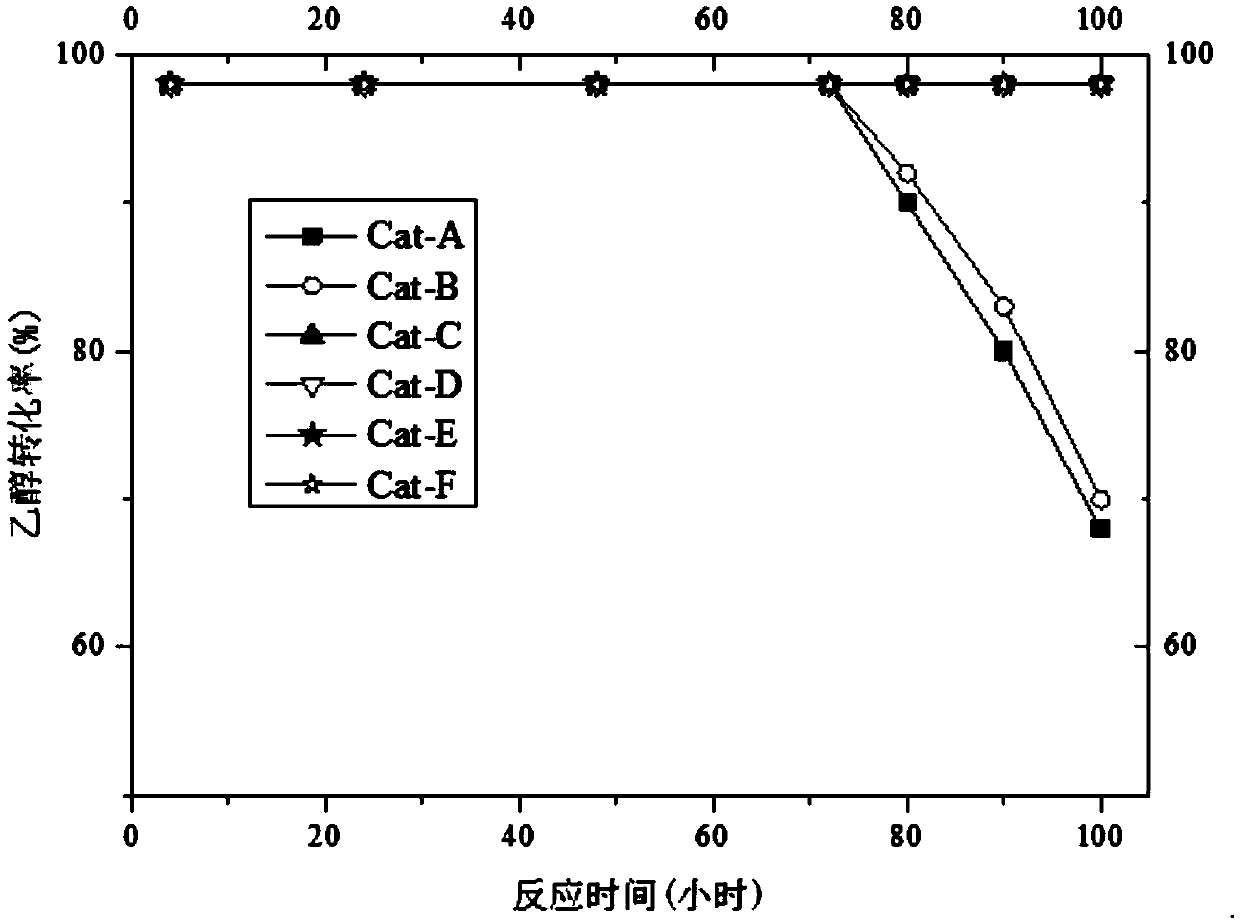
Figure 1
Abstract
Description
technical field
[0001] The invention belongs to the field of molecular sieve catalysts, and in particular relates to a modification method of a ZSM-11 molecular sieve catalyst used in the reaction of ethanol dehydration to ethylene. Background technique
[0002] Ethylene is an important basic raw material for organic chemical products. There are several routes for ethylene production: (1) producing ethylene by cracking light oil, ethane, propane, etc.; (2) using methanol as raw material to produce ethylene by MTO; (3) using ethanol as raw material to produce ethylene by catalytic dehydration vinyl. At present, most ethylene is produced through (1) and (2) routes, but petroleum and coal are non-renewable resources, so it is an inevitable trend to use renewable biomass ethanol to produce ethylene, which is in line with the sustainable development strategy. Especially with the rapid development of biotechnology and the breakthrough of non-grain bio-ethanol production technolo...
Examples
Embodiment 1
[0021] Mix 9.4g ZSM-11 molecular sieve (dry basis 85%) with 6.8g silica sol (dry basis 30%), extrude, dry at 120°C for 3 hours, roast at 540°C for 3 hours, and then use 0.8mol / l nitric acid The ammonium solution was exchanged at 80°C, dried at 120°C, and roasted at 520°C for 2 hours to obtain sample A. 5g sample A is placed in the 100ml autoclave, then adding 25ml concentration is 0.13mol / L (CH 3 ) 3 PO 4 Solution, seal the autoclave and place it in a rotary oven to rotate continuously, the number of revolutions is 10 revolutions / min, the treatment temperature is 170°C, and the time is 3 hours. The catalyst Cat-C was obtained after calcination at ℃ for 3 hours. Gained catalyst Cat-C detects through XRF, the Na in this catalyst 2 O is less than 0.05wt%, P content is 2wt%.
Embodiment 2
[0023] Mix 5.9g ZSM-11 molecular sieve (dry basis 85%) with 16.6g silica sol (dry basis 30%), extrude, dry at 80°C for 10 hours, roast at 600°C for 2 hours, and then use 0.5mol / l nitric acid The ammonium solution was exchanged at 90°C, dried at 120°C, and roasted at 520°C for 2 hours to obtain sample B. 5g sample B is placed in 100ml autoclave, then add 20ml concentration and be 0.08mol / L (CH 3 ) 3 PO 4 Solution, seal the autoclave and place it in a rotary oven to rotate continuously, the number of revolutions is 5 revolutions / min, the treatment temperature is 180°C, and the time is 1 hour. Then the processed sample is transferred to an open beaker, dried at 100°C for 5 hours, and dried at 450°C. The catalyst Cat-D was obtained after calcination at ℃ for 8 hours. Gained catalyst Cat-D is detected by XRF, and the Na in the catalyst 2 O is less than 0.05wt%, P content is 1wt%.
Embodiment 3
[0025] Mix 10.6g ZSM-11 molecular sieve (dry basis 85%) with 3.4g silica sol (dry basis 30%), extrude, dry at 95°C for 8 hours, roast at 500°C for 6 hours, and then use 1.0mol / l nitric acid The ammonium solution was exchanged at 70°C, dried at 120°C, and roasted at 520°C for 2 hours to obtain sample C. 5g sample C is placed in the 100ml autoclave, and then adding 50ml concentration is 0.10mol / L (CH 3 ) 3 PO 4Solution, seal the autoclave and place it in a rotary oven to rotate continuously, the number of revolutions is 8 revolutions / min, the treatment temperature is 160°C, and the time is 4 hours, then transfer the processed sample to an open beaker, dry at 110°C for 8 hours, and dry at 580 Catalyst Cat-E was prepared after calcination at °C for 4 hours. Gained catalyst Cat-E is detected by XRF, and the Na in the catalyst 2 O is less than 0.05wt%, P content is 3wt%.