
Inducer for high-speed centrifugal pump and working method thereof
A high-speed centrifugal and inducer technology, which is applied in the field of inducers, can solve the problems that the inducer cannot meet the stability of the liquid flow at the inducer outlet at the same time, and achieve the effects of improving internal flow conditions, increasing the outlet head, and reducing wake vortices
Patent Information
- Authority / Receiving Office
- CN · China
- Current Assignee / Owner
- Publication Date
- 2020-10-13
Smart Images
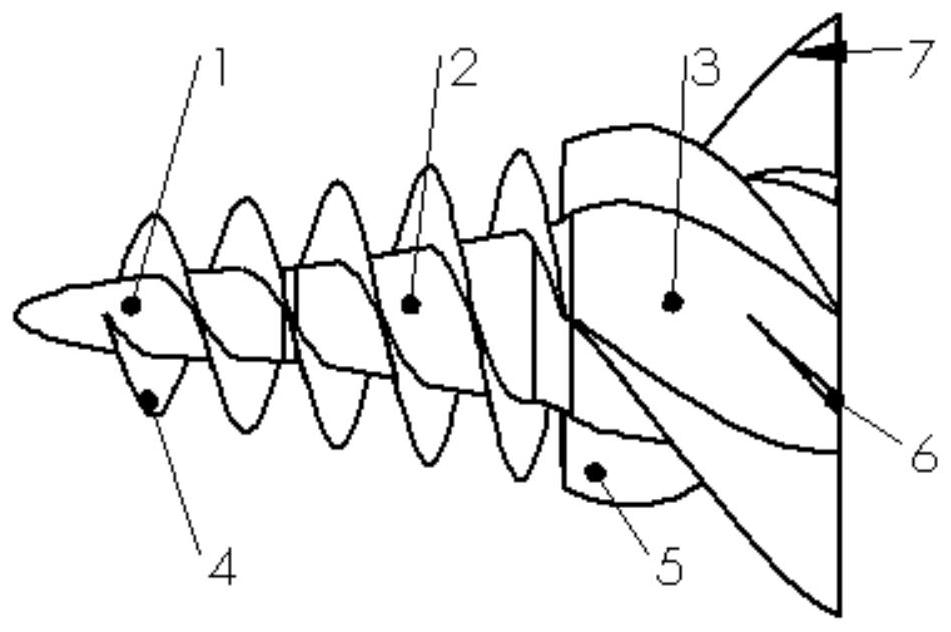
Figure 1 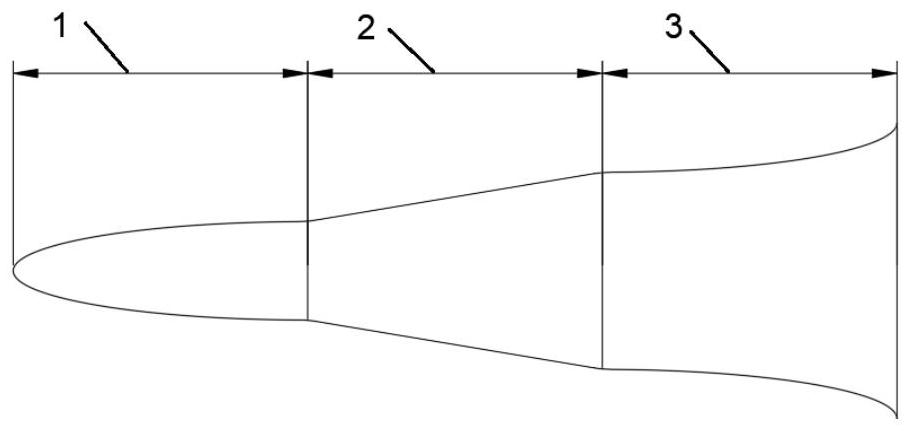
Figure 2 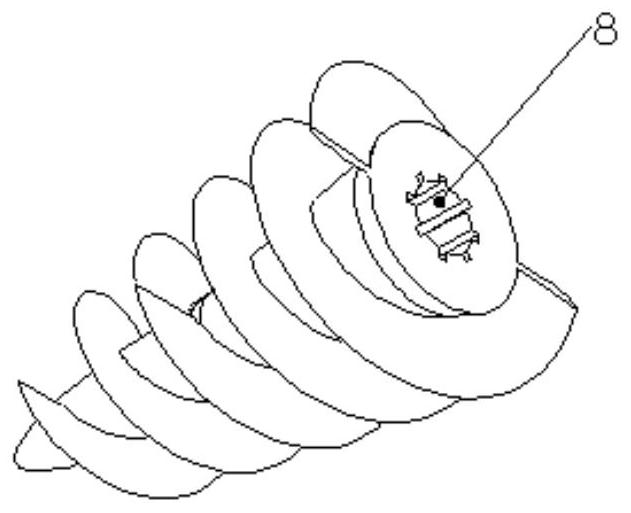
Figure 3
Abstract
Description
technical field
[0001] The invention belongs to the field of fluid machinery, and in particular relates to an inducer for reducing the cavitation phenomenon of a high-speed centrifugal pump and a working method thereof. Background technique
[0002] High-speed centrifugal pumps are widely used in oil refining, petrochemical, chemical industry and aerospace technology and other fields. However, high-speed centrifugal pumps are prone to cavitation during operation. The cavitation phenomenon has a great impact on the performance of the centrifugal pump. Cavitation can cause spots and cracks on the surface of the blade, and even gradually fall off in a spongy shape; when cavitation occurs, noise will be emitted, which will cause the pump body to vibrate; cavitation When the phenomenon is serious, it can lead to complete inability to output liquid.
[0003] At present, the inducer is one of the most effective methods to improve the cavitation performance of centrifugal pumps. I...
Examples
Embodiment Construction
[0021] The present invention will be further described below in conjunction with accompanying drawing.
[0022] Such as figure 1 , 2 As shown in and 5, an inducer for a high-speed centrifugal pump is composed of a nonlinear variable curvature hub one 1, a linear hub two 2, a nonlinear variable curvature hub three 3, a main blade 4, a long tail splitter blade 5 and a short tail splitter blade 6 components; the nonlinear variable curvature hub 1 and the linear hub 2 2 are integrally formed; the linear hub 2 2 and the nonlinear variable curvature hub 3 3 are fixed; the nonlinear variable curvature hub 1 is based on a quarter convex ellipse The rotating body whose generatrix and curvature radius gradually increases along the direction from the nonlinear variable curvature hub 1 to the linear hub 2 2, the linear hub 2 2 is a rotating body with the oblique line as the generatrix, and the nonlinear variable curvature hub 3 3 is a quarter A rotating body whose inner concave ellipse ...