
Method for determining diffusion coefficient and distribution coefficient of sink material
A technology of diffusion coefficient and distribution coefficient, applied in the field of indoor environment inspection, can solve the problems of low test accuracy, multiple model solutions, long test time, etc.
Patent Information
- Authority / Receiving Office
- CN · China
- Patent Type
- Applications(China)
- Current Assignee / Owner
- Publication Date
- 2020-10-27
- Estimated Expiration
- Not applicable · inactive patent
Smart Images
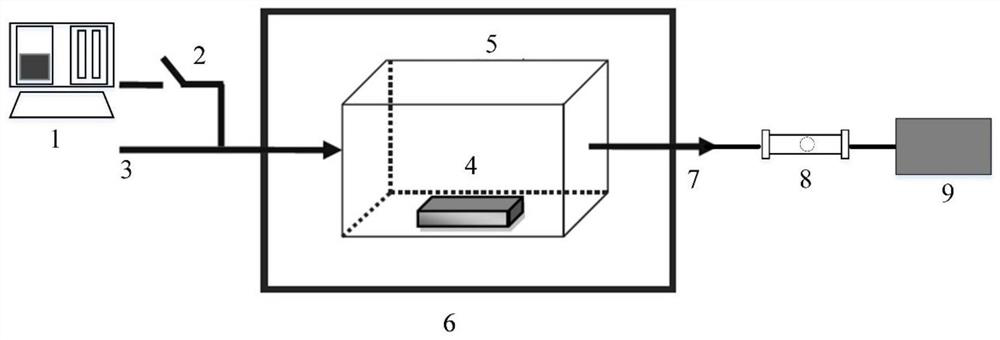
Figure 1 
Figure 2 
Figure 3
Abstract
Description
[0001] Technical field
[0002] The invention belongs to the technical field of indoor environment inspection, and particularly relates to the measurement of the diffusion coefficient and distribution coefficient of volatile organic compounds (VOC) in indoor sink materials. Background technique
[0003] Volatile organic compounds (VOC) released from materials such as indoor building materials and furniture are one of the important reasons for poor indoor air quality, and significantly affect people's health, living comfort and work efficiency. When the indoor VOC concentration is higher than the VOC concentration on the surface of the material, the material begins to absorb VOC, which is called a sink material. Typical indoor sink materials are carpets, ceilings, etc. When the original pollution source is moved out of the room or the ventilation rate increases, the concentration of VOC in the indoor air will decrease. At this time, the sink material will re-release the adsorbe...
Examples
Embodiment Construction
[0018] The method proposed by the present invention can quickly and accurately measure the VOC diffusion coefficient D in the sink material m and distribution coefficient K are two key adsorption parameters. The method is described in detail in conjunction with the accompanying drawings and examples as follows:
[0019] Experimental test systems such as figure 1 As shown, the sink material 4 to be tested is placed in the direct flow chamber 5. During the experiment, the VOC gas 1 with a constant concentration is mixed with the pure air 3 through the valve 2, and then passes into the direct flow chamber 5, and is absorbed by the sink material 4 in the environmental chamber 5. After the process, it is discharged from the air outlet 7, and 6 is a control chamber, which is used to control the temperature and relative humidity of the direct current cabin 5; the direct current cabin used in the experiment is a 50L stainless steel rectangular cabin designed in accordance with the AST...