
Preparation method of catalyst for methanol fuel cell
A methanol fuel cell and catalyst technology, applied in fuel cells, battery electrodes, electrochemical generators, etc., can solve the problems of difficult large-scale industrial production of proton membrane fuel cells, low practical utilization efficiency of precious metals, and high cost of catalysts. Effect of improved tolerance, improved pore size, and high tolerance
Patent Information
- Authority / Receiving Office
- CN · China
- Current Assignee / Owner
- Publication Date
- 2020-12-04
Smart Images
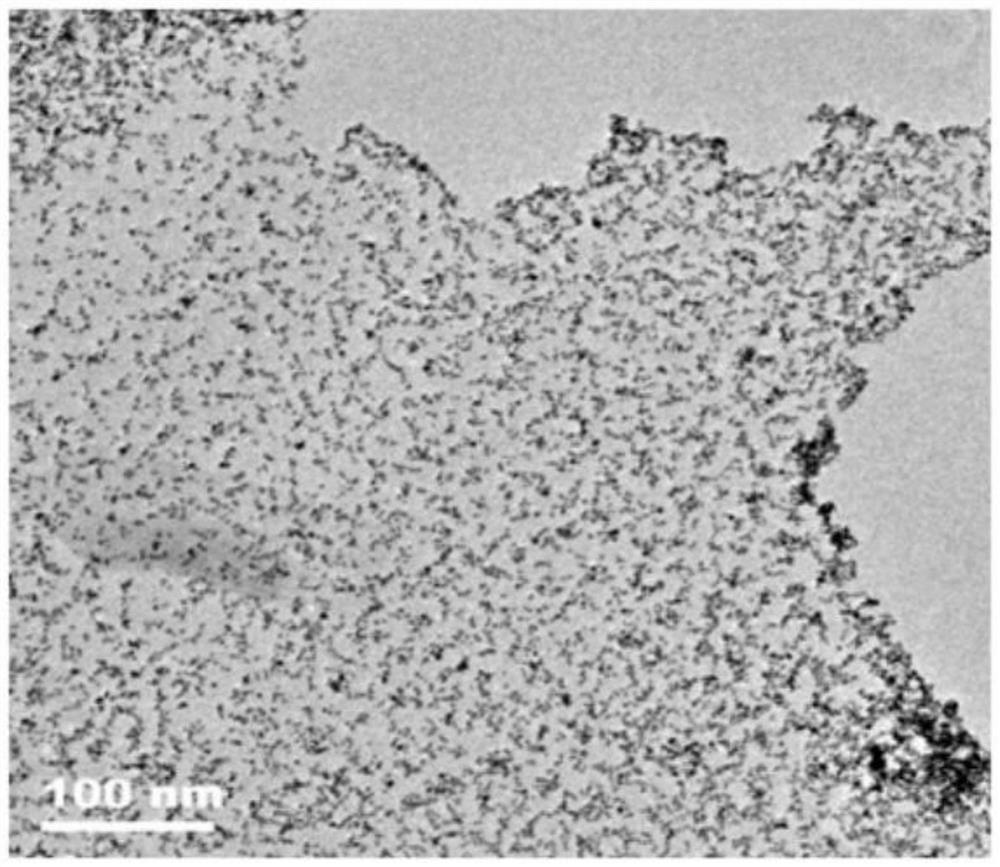
Figure 1
Abstract
Description
technical field
[0001] The invention belongs to the technical field of fuel cells, and in particular relates to a catalyst for methanol fuel cells and a preparation method thereof. Background technique
[0002] At present, with the shortage of traditional fossil energy, environmental pollution is becoming more and more serious. As a new power generation technology, the fuel cell does not go through the Carnot cycle, has a high energy conversion rate and is environmentally friendly, and has become the focus of current research.
[0003] So far, proton membrane fuel cells have become an efficient energy supply for cars and other portable devices. Pt-based catalysts are still the best catalysts in PEMFC, but the high price of metal platinum is the main reason why proton membrane fuel cells are difficult to produce on a large scale. Therefore, metals of other transition elements are added to form binary or ternary metal alloys to reduce the oxygen adsorption bond energy and re...
Examples
Embodiment 1
[0021] A kind of catalyst that methanol fuel cell is used is prepared by following method:
[0022] Step 1: Dissolving 1 mol of porphyrin in acetonitrile, adding 1 mol of ferric chloride to dissolve it, heating to 60° C. and stirring for 4 hours, cooling and crystallizing to form a non-noble metal porphyrin complex;
[0023] Step 2: Dissolve 7g of ZIF8 in methanol to form a dispersion; dissolve 1g of cobalt chloride in methanol to form a solution, and slowly add the solution to the dispersion, first react at room temperature for 1 hour, and then heat up to 120°C React for 2 hours, after the reaction is over, cool to room temperature, and filter to obtain Co / Zn-MOFs;
[0024] Step 3: Disperse 5g of graphene in methanol, sonicate for 5 minutes, add 1g of Co / Zn-MOFs obtained in step 2, continue to sonicate for 10 minutes, in an inert atmosphere, heat up to 800°C for 6 hours, then cool to After room temperature, 2 g of the non-noble metal porphyrin complex obtained in step 1 was ...
Embodiment 2
[0027] A kind of catalyst that methanol fuel cell is used is prepared by following method:
[0028] Step 1: Dissolving 1.4 mol of porphyrin in acetonitrile, adding 1 mol of ferric chloride to dissolve it, heating to 65° C. and stirring for 4 hours, cooling and crystallizing to form a non-noble metal porphyrin complex;
[0029] Step 2: Dissolve 7g ZIF8 in methanol to form a dispersion; dissolve 1.4g of cobalt chloride in methanol to form a solution, and slowly add the solution to the dispersion, first react at room temperature for 1 hour, then heat up to 120 ℃ for 2.5 hours. After the reaction, cool to room temperature and filter to obtain Co / Zn-MOFs;
[0030] Step 3: Disperse 6g of graphene in methanol, sonicate for 8 minutes, add 1g of Co / Zn-MOFs obtained in Step 2, continue to sonicate for 12 minutes, in an inert atmosphere, heat up to 850°C for 7 hours, then cool to After room temperature, 2.4 g of the non-noble metal porphyrin complex obtained in step 1 was added, ultraso...
Embodiment 3
[0033] A kind of catalyst that methanol fuel cell is used is prepared by following method:
[0034] Step 1: Dissolving 1.8 mol of porphyrin in acetonitrile, adding 1 mol of ferric chloride to dissolve it, heating to 70° C. and stirring for 4.5 hours, cooling and crystallizing to form a non-noble metal porphyrin complex;
[0035] Step 2: Dissolve 7g ZIF8 in methanol to form a dispersion; dissolve 1.6g of cobalt chloride in methanol to form a solution, and slowly add the solution to the dispersion, first react at room temperature for 1 hour, then heat up to 120 ℃ for 3 hours, after the reaction, cooled to room temperature, and filtered to obtain Co / Zn-MOFs;
[0036] Step 3: Disperse 6.5g graphene in methanol, sonicate for 10 minutes, and add 1g of Co / Zn-MOFs obtained in step 2, continue to sonicate for 15 minutes, in an inert atmosphere, heat up to 900°C for 8 hours, then cool After reaching room temperature, 3 g of the non-noble metal porphyrin complex obtained in step 1 was a...