
Method for detecting food-borne pathogenic bacteria based on double signals of DNA Walker driven by chain substitution triggered by nucleic acid conformation
A technology of food-borne pathogenic bacteria and chain substitution, which is applied in the directions of microorganism-based methods, biochemical equipment and methods, and microorganism determination/inspection, etc. Easy to operate and avoid false positives
Patent Information
- Authority / Receiving Office
- CN · China
- Patent Type
- Applications(China)
- Current Assignee / Owner
- Publication Date
- 2021-04-09
Smart Images
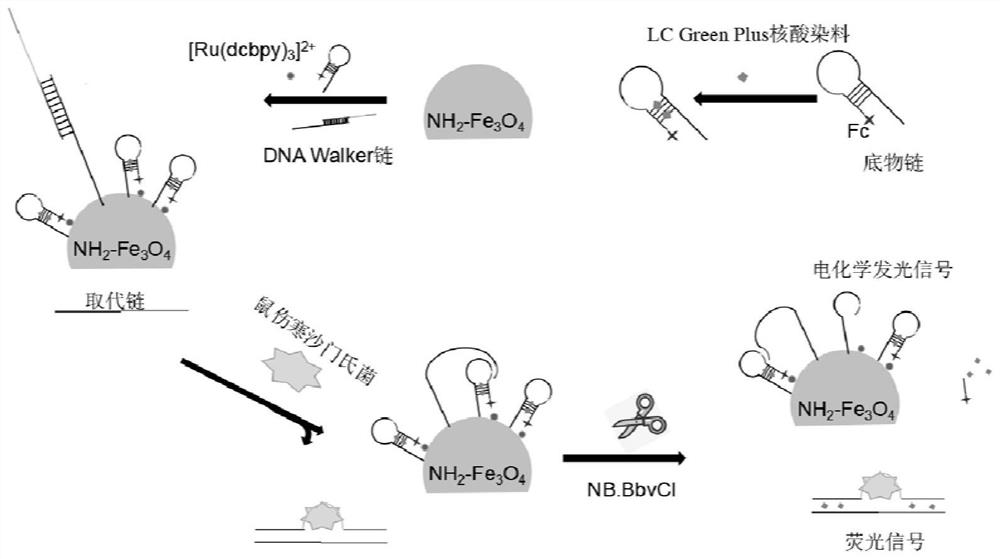
Figure 1 
Figure 2 
Figure 3
Abstract
Description
technical field
[0001] The invention relates to a method for detecting Salmonella typhimurium, in particular to a method for detecting food-borne pathogenic bacteria based on double-signal detection of nucleic acid conformation-triggered strand substitution-driven DNA Walker. Background technique
[0002] Salmonella typhimurium is a common anaerobic Gram-negative bacterium widely distributed in the environment, where it can be transmitted to humans through contaminated poultry, eggs, milk, fish and meat products. Enteritis caused by Salmonella typhimurium is estimated to cause 1 million deaths each year. As people's awareness of food safety increases, the development of fast, efficient, simple and specific detection methods for Salmonella typhimurium has become an inevitable trend in the field of food safety and sanitation inspection.
[0003] DNA Walker is a dynamic DNA walker that imitates natural molecular motion. Nucleic acid can move along the track assembled by DNA. I...
Examples
Embodiment 1
[0033] A dual-signal detection method for Salmonella typhimurium based on nucleic acid conformation-initiated strand displacement-driven DNA Walker, such as figure 1 shown, including the following steps:
[0034] (1) After mixing equal volumes of 15 μmol / L DNA Walker swing arm chain solution and 15 μmol / L protection probe solution containing the aptamer of Salmonella typhimurium to be tested, place it at 95 ℃ for 8-12 minutes to deform Slowly lower to room temperature to form a protected DNA Walker chain solution; wherein the solvents of the swing arm chain solution and the protection probe solution are oligonucleotide stock solutions; the sequence of the Salmonella typhimurium aptamer is TATGGCGGCGTCACCCGACGGGGACTTGACATTATGACAG; the corresponding protection probe The sequence of the needle is: 5'-CTTCAAGGCTAACATGGTATGGCGGCGTCACCCGACGGGGACTTGACATTATGACAGGAGGCAAGTGATCCGG-3'; the sequence of the DNA Walker swing arm strand is: 5'-NH 2 -TTTTTTTTTTTTTTTTTTTTTTTTTTTTTTTTTTTTTTTTGA...
Embodiment 2
[0043] With above-mentioned embodiment 1, its difference is:
[0044] (1) After mixing equal volumes of 10 μmol / L DNA Walker swing arm strand solution and 10 μmol / L protection probe solution containing the aptamer of Salmonella typhimurium to be tested, the oligonucleotide stock solution is pH=7 containing 1 mM EDTA and 10mM MgCl 2 •6H 2 30 mM Tris-HCl buffer solution of O;
[0045] (2) Add 3 µL of a nucleic acid dye capable of intercalating between double strands (LC Green Plus nucleic acid dye) into 500 µL of 8 µM hairpin substrate strand solution, shake at room temperature for 4-6 min;
[0046] (3) Mix 1 mL of 10 mg / mL aminated ferric oxide and 50 µL of glutaraldehyde, stir at room temperature for 50 min, suspend in 2 mL of oligonucleotide stock solution after magnetic cleaning, and then add fully mixed Uniformly mix 50 µL of 10 µM protected DNA Walker strand solution and 500 µL of 8 µM hairpin substrate strand mixture, react at 35 °C for 20 min, and dilute to 2 mL with ...
Embodiment 3
[0049] With above-mentioned embodiment 1, its difference is:
[0050] (1) After mixing equal volumes of 20 μmol / L DNA Walker swing arm strand solution and 20 μmol / L protection probe solution containing the aptamer of Salmonella typhimurium to be tested, the oligonucleotide stock solution is pH=9 containing 3 mM EDTA and 13 mMMgCl 2 •6H 2 50 mM Tris-HCl buffer solution of O;
[0051] (2) Add 5 µL of nucleic acid dye (LC Green Plus nucleic acid dye) capable of intercalating between double strands to 600 µL of 5 µM hairpin substrate strand solution, shake at room temperature for 4-6 min;
[0052] (3) Mix 2 mL of 5 mg / mL Fe3O4 and 100 µL of glutaraldehyde, stir at room temperature for 70 min, suspend in 5 mL of oligonucleotide stock solution after magnetic cleaning, and then add fully mixed Uniformly mix 60 µL 5 µM protected DNA Walker strand solution and 600 µL 5 µM hairpin substrate strand mixture, react at 38°C for 40 min, and dilute to 5 mL with oligonucleotide stock soluti...