

Application of TRPV1 in screening or preparing medicine for preventing, relieving and/or treating liver diseases
A technology for liver diseases and drugs, applied in the field of gene function and application, can solve the problems that have not yet been seen in relevant research reports.
Patent Information
- Authority / Receiving Office
- CN · China
- Patent Type
- Applications(China)
- Current Assignee / Owner
- Publication Date
- 2022-02-18
Smart Images
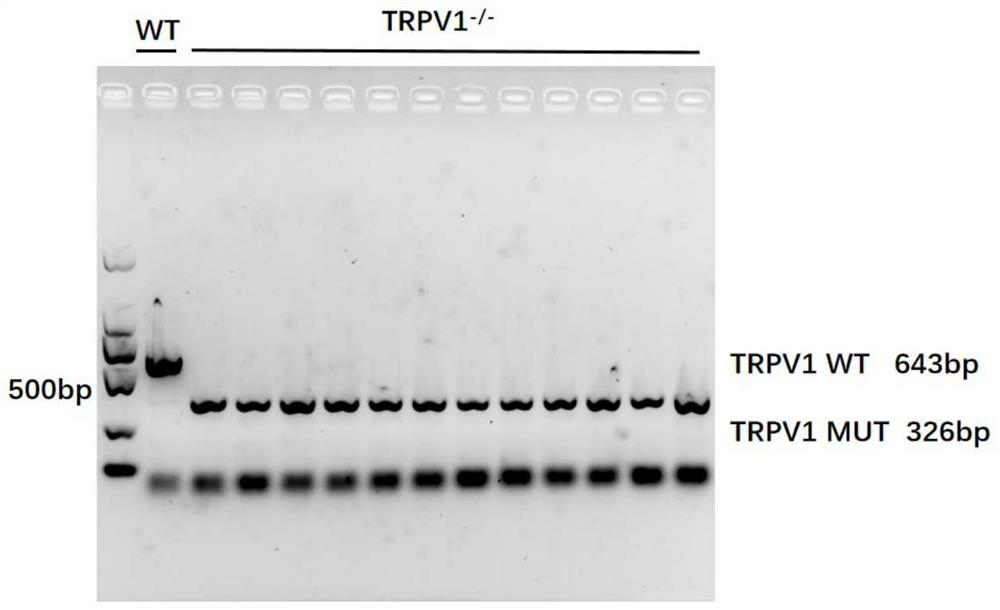
Figure 1 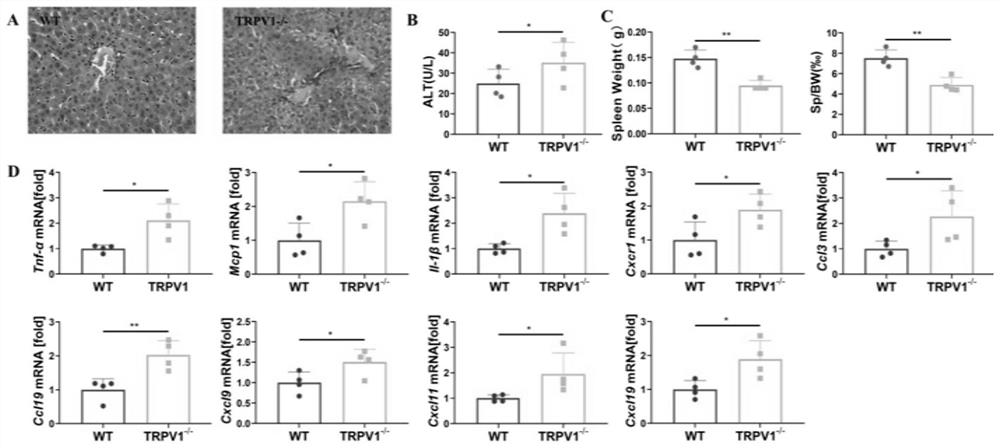
Figure 2 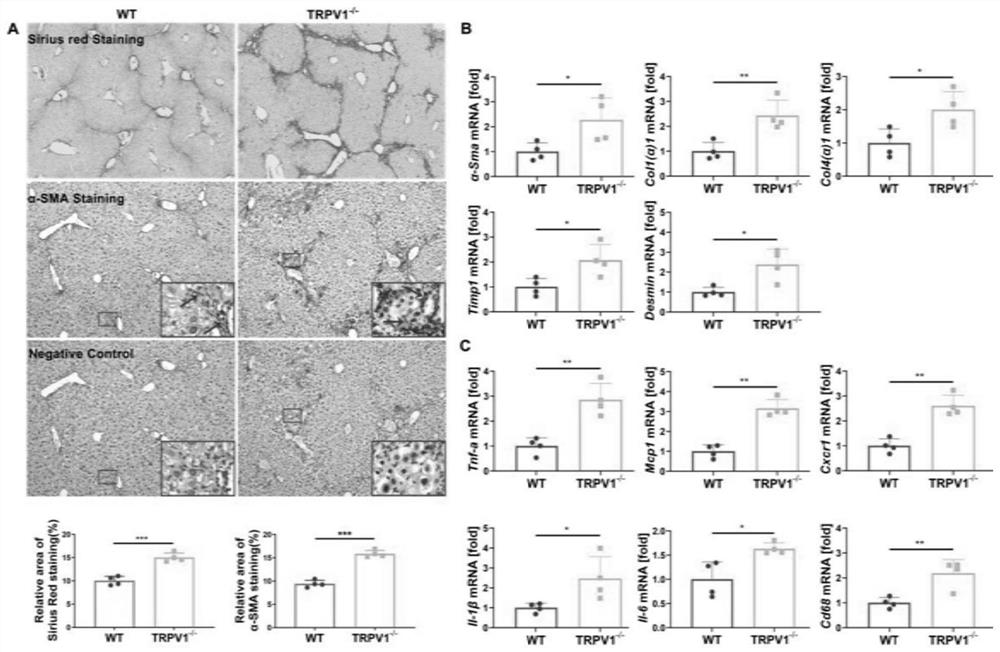
Figure 3
Abstract
Description
technical field
[0001] The present invention relates to the field of gene function and application, in particular to the application of TRPV1 in screening or preparing drugs for preventing, alleviating and / or treating liver diseases. Background technique
[0002] The liver is an organ in the body whose main function is metabolism. It has very complex physiological and biochemical functions, including deoxidation, storage of glycogen, and synthesis of secreted proteins. Common liver diseases include viral hepatitis, non-alcoholic fatty liver disease, alcoholic fatty liver, autoimmune liver disease, etc. Liver damage caused by these diseases can lead to liver fibrosis, and even progress to liver cirrhosis and liver cancer. It is an important cause of disease and seriously threatens the health of human body.
[0003] With the change of people's living habits, the incidence of fatty liver disease has been increasing year by year in recent years. With the progress of the disease...
Examples
Embodiment 1
[0093] Example 1. TRPV1 knockout aggravates acute liver injury
[0094] (1) Experimental process
[0095] Construct the acute liver injury model of TRPV1 knockout mice: 4 8-week-old male C57 / BL wild-type mice served as WT group (control group), 4 same-week-old male TRPV1 - / - Mice as TRPV1 - / - group (TRPV1 knockout group).
[0096] The mice in the two groups were intraperitoneally injected with lipopolysaccharide LPS (10 mg / kg mouse body weight), and sacrificed 18 hours later. The body weight and spleen weight of the mice were weighed, and the spleen-to-body ratio was calculated. Serum and liver were collected for relevant tests: mouse liver function test and expression of inflammatory factors.
[0097] (2) Experimental results
[0098] The result is as figure 2 As shown, compared with WT group, TRPV1 - / - The spleen weight of mice in the group was significantly reduced, and the ratio of spleen to body was significantly reduced ( figure 2 C), the serum liver function (...
Embodiment 2
[0100] Example 2, TRPV1 knockout aggravates liver fibrosis
[0101] (1) Experimental process
[0102] Construction of TRPV1 knockout mouse model of liver fibrosis: 4 8-week-old male C57 / BL mice as WT group, 4 same-week-old male TRPV1 - / - Mice as TRPV1 - / - Group. intraperitoneal injection of CCl 4 (10%CCl 4 , 0.04ml / only), 3 times a week for 6 consecutive weeks. 72 hours after the last injection, the animals were sacrificed, and the liver and serum were collected for related testing: pathological testing of Sirius red staining and expression of α-SMA; PCR testing of expression of inflammatory factors and fibrosis indicators.
[0103] (2) Experimental results
[0104] The result is as image 3 As shown, Sirius red staining showed that the fibrous septa in the liver tissue of mice in the WT group were narrow and arranged loosely and discontinuously, while TRPV1 - / - In the group, hyperplastic collagen fibers separated the liver lobules to form thicker intervals, and the st...
Embodiment 3
[0106] Example 3, TRPV1 overexpression relieves liver fibrosis
[0107] (1) Experimental process
[0108] To construct a mouse liver fibrosis model with TRPV1 overexpression: 12 8-week-old male C57 / BL mice were randomly divided into control group (LV-Con) and overexpression group (LV-SMA-TRPV1). 6 only. Two groups of mice were injected with 10% CCl 4 Olive oil, 0.04ml / mouse, 3 times a week, for 6 consecutive weeks; mice were injected with CCl 4 Two weeks after modeling, mice in the LV-SMA-TRPV1 group were injected with TRPV1 lentivirus (LV-SMA-TRPV1) through the tail vein; mice in the LV-Con group were injected with the same volume and amount of control virus (LV-Con). Last injection of CCl 4 The olive oil was sacrificed 72 hours later, and relevant tests were carried out: detection of mouse liver function and pathological changes; immunohistochemical detection of α-SMA expression; PCR detection of expression of fibrosis indicators and inflammatory factors.
[0109] (2) E...