
Device and method for rapidly constructing quinolone compound library
A technology for quinolones and compound libraries, which is applied in the field of devices for rapid construction of quinolones compound libraries. It can solve the problems of low yield, large pollution of three wastes, and long reaction time, and achieve simple reagent switching, accelerated research progress, and fast and efficient reactions. Effect
Patent Information
- Authority / Receiving Office
- CN · China
- Patent Type
- Applications(China)
- Current Assignee / Owner
- Publication Date
- 2022-06-24
Smart Images
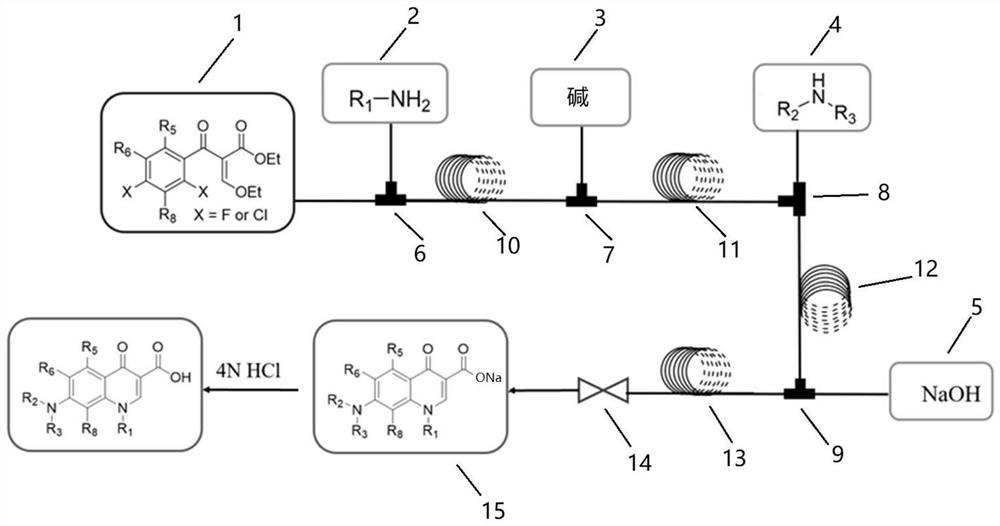
Figure 1 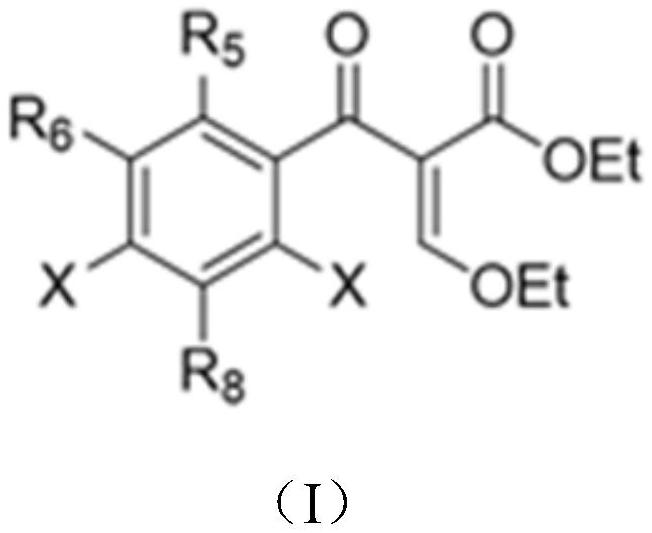
Figure 2 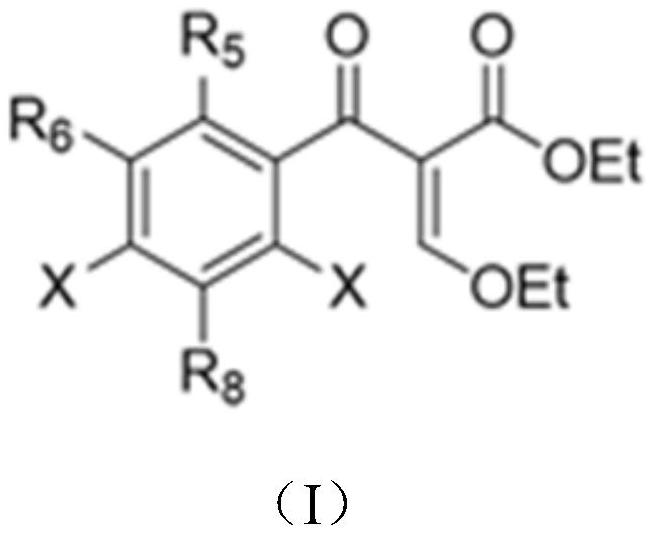
Figure 3
Abstract
Description
technical field
[0001] The invention relates to a device and method for rapidly constructing a library of quinolone compounds. Background technique
[0002] Continuous flow chemistry technology is a technology that uses pumps to provide power to carry out chemical reactions in microchannels in a continuous flow mode. Continuous flow chemistry technology has been transformed from a niche academic application research to a recognized industrial technology with broad application prospects in the pharmaceutical field. Several cases of rapid synthesis of multiple drugs or molecules have been reported based on continuous flow chemistry techniques. For example, in 2016, the research group of Jamison and Jensen of the Massachusetts Institute of Technology developed a continuous flow drug synthesis platform system with compact structure and flexible assembly configuration (Science, 2016, 352, 61-67.), which can be completed every day. Continuous synthesis of 1,000 doses of diphenhy...
Examples
Embodiment 1
[0062] Because the first feed pump, the second feed pump and the fourth feed pump in the synthesis process need to change different reaction reagents, a multi-channel electromagnetic selector valve is connected to these three pumps respectively, and all pre-prepared The reagents are respectively connected to different positions of the multi-channel electromagnetic selection valve, and the multi-channel electromagnetic selection valve is used to complete the switching of the reagents.
[0063] First, a series of primary amines (cyclopropylamine, ethylamine, 2,4-difluoro) were selected from ethyl 3-ethoxy-2-(2,4,5-trifluorobenzoyl)acrylate Aniline, etc.) and secondary amines (piperazine, N-methylpiperazine, 2-methylpiperazine, 2,6-dimethylpiperazine, 3-aminopyrrolidine, tetrahydropyrrole, piperidine, etc.) to construct A library of quinolones.
[0064] A total of 70 compounds are to be synthesized in this project, and 70 synthesis cycles are required. The operation process of ...
Embodiment 2
[0069] ethyl 3-ethoxy-2-(2,6-dichloro-5-fluoronicotinoyl)acrylate and 3-ethoxy-2-(2,4,5-trifluoro-3-chlorobenzene, respectively formyl) ethyl acrylate as the starting material, a series of primary amines (cyclopropylamine, ethylamine, 2,4-difluoroaniline, etc.) and secondary amines (piperazine, N-methylpiperazine, 2-methyl piperazine, 2,6-dimethylpiperazine, 3-aminopyrrolidine, tetrahydropyrrole, piperidine, etc.) to construct a library of quinolone compounds. According to the method of Example 1, a total of 140 quinolones were synthesized, and the automatically synthesized compounds were as follows:
[0070]
[0071]
Embodiment 3
[0073] Using 3-ethoxy-2-(2,3,4,5-tetrafluorobenzoyl) ethyl acrylate as the starting material and dimethyl sulfoxide as the solvent, S-(+)-2- Aminopropanol is a primary and a series of secondary amines (N-methylpiperazine, piperazine, piperidine, 1-[(3S)-3-pyrrolidine]-piperidine, cis-7-azabicyclo[ 3.3.0] octane, etc.) to construct a library of quinolone compounds. According to the method of Example 1, 9 quinolones including levofloxacin were synthesized, and the automatically synthesized compounds were as follows:
[0074]
[0075] The mass spectrometry characterization data of the compounds in the examples are as follows:
[0076]
[0077]
[0078]
[0079]
[0080]
[0081]
[0082]