
Laser bar and cavity integrating method and structure
A technology of lasers and laser crystals, which is applied to lasers, laser components, phonon exciters, etc., can solve the problems of wide application limitations of lasers, poor ability to resist mechanical structure deformation and mechanical vibration, and affect the working characteristics of lasers. Strong resistance to thermal change of mechanical structure, strong resistance to air disturbance, and small temperature rise at both ends
Patent Information
- Authority / Receiving Office
- CN · China
- Patent Type
- Applications(China)
- Current Assignee / Owner
- Publication Date
- 2004-01-07
- Estimated Expiration
- Not applicable · inactive patent
Smart Images
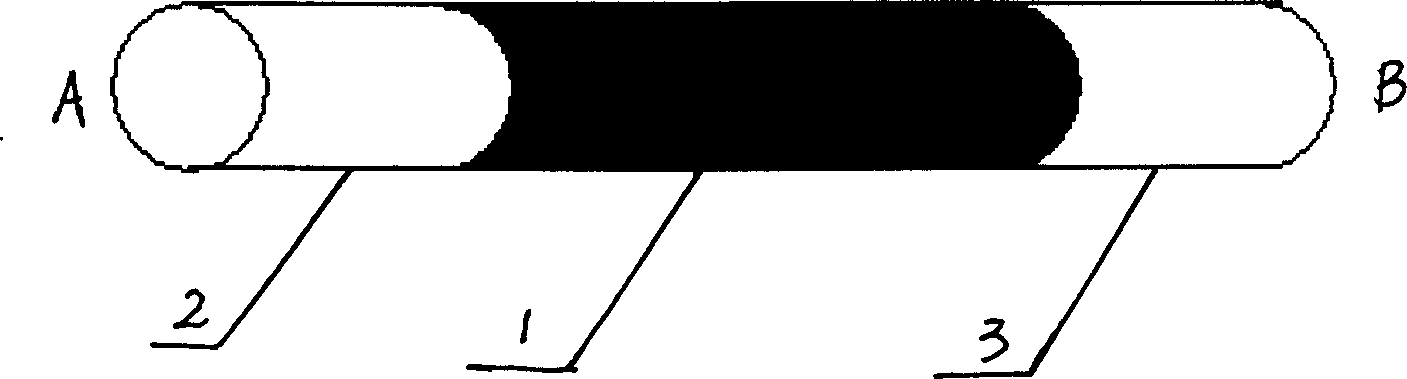
Figure 1 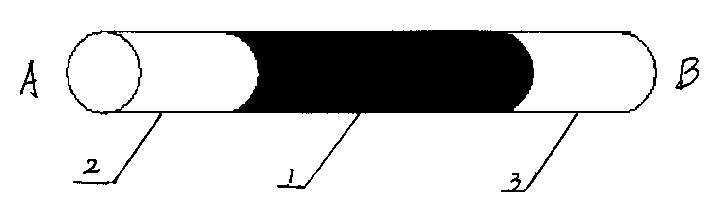
Figure 2
Abstract
Description
technical field
[0001] The invention relates to the field of all-solidification lasers, in particular to a laser with an integrated rod and cavity. Background technique
[0002] Optical resonator and laser working substance are the most important components of laser. A working substance is a material capable of producing stimulated light. A resonant cavity is an optical cavity in which photons can oscillate back and forth and realize frequency selection and mode limitation.
[0003] The optical cavity of a traditional solid-state laser is mainly composed of a total reflection mirror and a partial reflection mirror. Usually, the two reflectors are separated from the laser working substance, or one of the reflectors is separated from the laser working substance, and one end of the laser rod is coated to become a reflective mirror of the resonant cavity.
[0004] When such a laser is working, it is necessary to adjust the resonator. Since the parallelism of the resonator mi...
Examples
Embodiment Construction
[0026] See Figure 1. The present invention includes a laser rod 1 doped with laser-activated ions, the crystal of which is Nd:YAG or Yb:YAG, and the two ends of the laser rod 1 are respectively bonded at high temperature with the same matrix crystal YAG rods 2 and 3 that are not doped with laser-activated ions. , forming two end caps that are optically machined and then coated. The end face of the A end cap is coated with a total reflection film for emitting laser light L to the laser itself, and an anti-reflection film for the pump light P is coated on the end face of the B end cap. Rear endoscopy and anterior endoscopy.