
Light path interchange device based on total reflection
A technology of total reflection and optical path, applied in the field of nanometer measurement, to achieve the effect of no energy loss
Patent Information
- Authority / Receiving Office
- CN · China
- Patent Type
- Applications(China)
- Current Assignee / Owner
- Publication Date
- 2012-06-27
- Estimated Expiration
- Not applicable · inactive patent
Smart Images
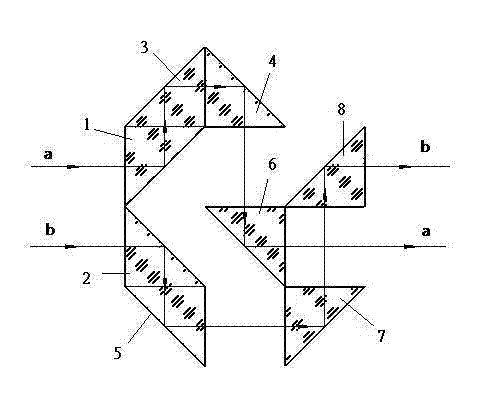
Figure 1 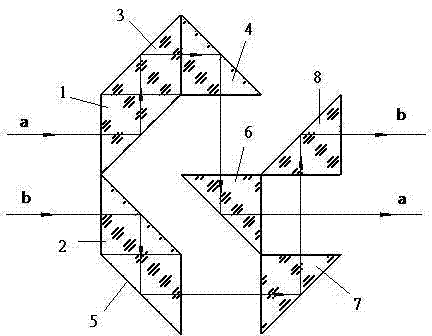
Figure 2
Abstract
Description
technical field
[0001] The invention relates to an optical path structure for laser interferometry, and belongs to the field of nanometer measurement, in particular to an optical path interchange device based on total reflection. Background technique
[0002] One of the most promising sciences of the 21st century. It involves scientific research and industrial fields such as microelectronics, optics, materials science, mechanics, biology and life sciences. Its purpose is to research, develop and process materials, devices and systems with critical dimensions close to or less than 100nm, so as to obtain A product with the required functionality and performance.
[0003] At present, there are two main categories of nanometer measurement methods: non-optical measurement methods represented by scanning probe microscopes and optical measurement methods represented by various laser interferometers. Non-optical nanometer measurement methods represented by scanning probe microscop...
Examples
Embodiment Construction
[0014] see figure 1 , the invention discloses an optical path interchange device based on total reflection. As shown in the picture: it consists of 8 isosceles right-angle prisms with the same specifications. Wherein: each right-angled side of the first prism 1 and the second prism 2 extends on the same vertical straight line, and the hypotenuse of the first prism 1 and the second prism 2 is at an angle of 90 degrees; the other side of the first prism 1 The right angle side completely coincides with the right angle side of the third prism 3, and the hypotenuse of the third prism 3 is parallel to the hypotenuse of the first prism 1, and the right angle side of the fourth prism 4 coincides completely with another right angle side of the third prism 3 , and the hypotenuse of the fourth prism 4 and the hypotenuse of the third prism 3 form an angle of 90 degrees; the other right-angle side of the second prism 2 coincides completely with the right-angle side of the fifth prism 5, a...