
Additive and subtractive manufacturing process for producing implants with homogeneous body substantially free of pores and inclusions
a manufacturing process and homogeneous body technology, applied in the field of additive and subtractive manufacturing methods for fabricating medical implants, can solve the problems of cell remodeling, reduced surface area available for contact and frictional stabilization, and inability to form bone, so as to enhance bone growth or bone fusion
Patent Information
- Authority / Receiving Office
- US · United States
- Patent Type
- Patents(United States)
- Current Assignee / Owner
- Publication Date
- 2018-10-30
Smart Images
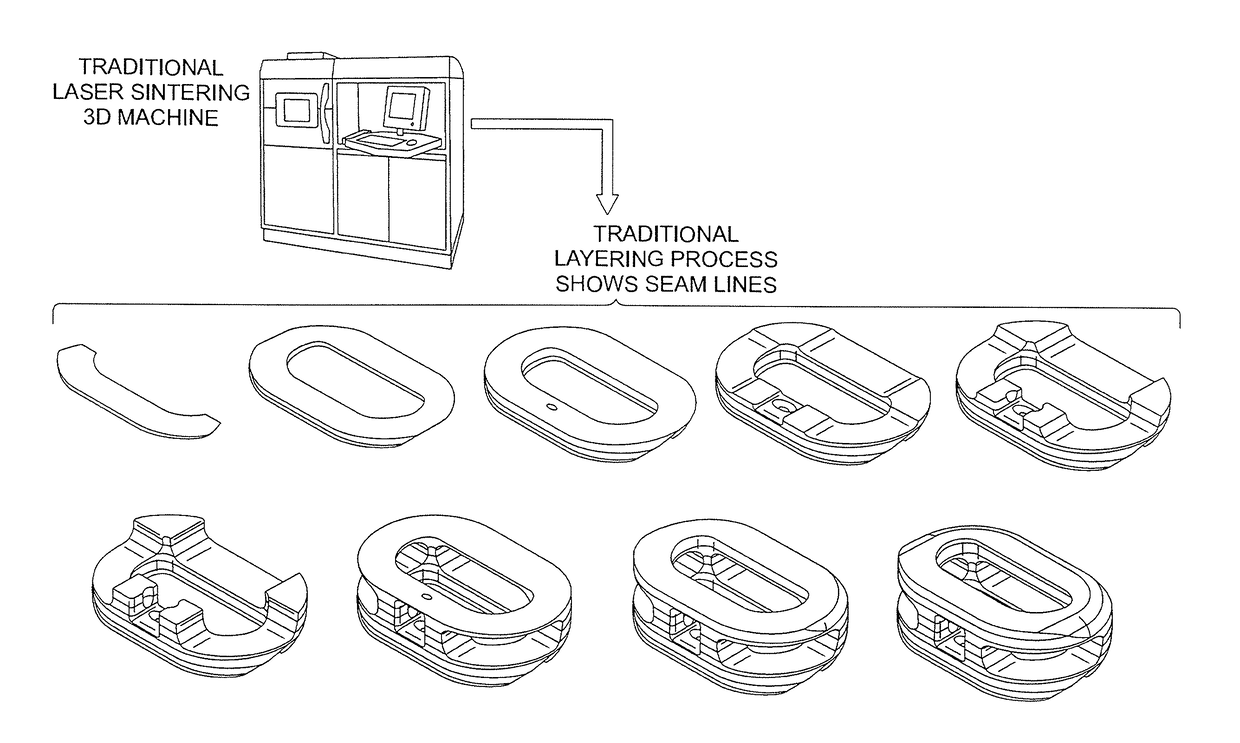
Figure 1 
Figure 2 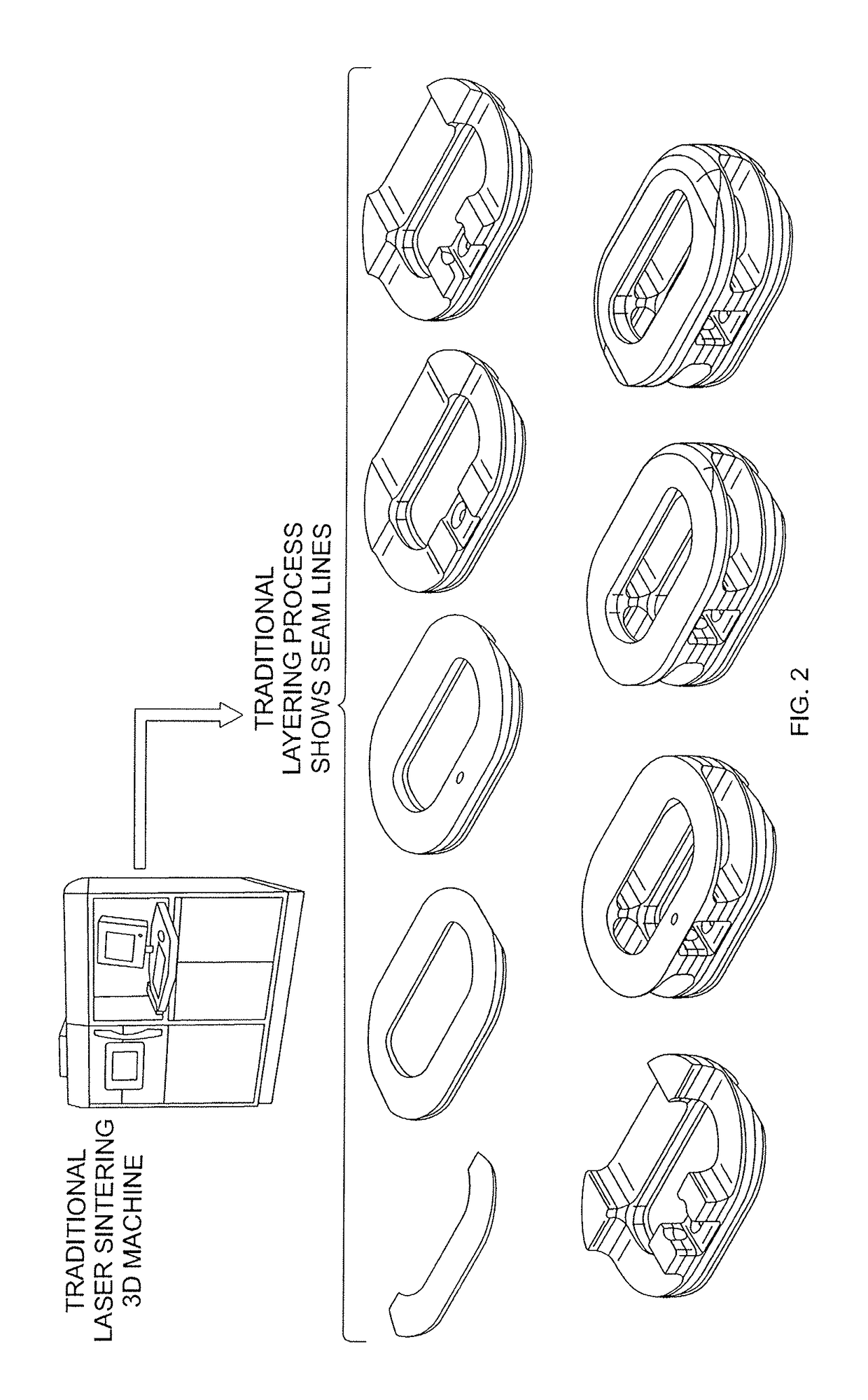
Figure 3
Abstract
Description
CROSS REFERENCE TO RELATED APPLICATIONS
[0001] This application claims priority to U.S. Patent Application No. 62 / 002,243 filed May 23, 2014, the contents of which are incorporated by reference herein, in their entirety and for all purposes.FIELD OF THE INVENTION
[0002] The invention relates generally to combination additive-subtractive manufacturing methods for fabricating medical implants that, though produced in layers, have a homogeneous body and unitary crystal structure and are substantially free of pores and substantially free of inclusions, as well as implants prepared from these processes. The medical implants are well-suited for integration with bone, including through a bone growth-inducing surface topography produced by the subtractive manufacturing techniques.BACKGROUND OF THE INVENTION
[0003] Various publications, including patents, published applications, technical articles and scholarly articles are cited throughout the specification. Each of these cited publications is in...
Examples
Embodiment Construction
[0032]Various terms relating to aspects of the present invention are used throughout the specification and claims. Such terms are to be given their ordinary meaning in the art, unless otherwise indicated. Other specifically defined terms are to be construed in a manner consistent with the definition provided herein.
[0033]As used herein, the singular forms “a,”“an,” and “the” include plural referents unless expressly stated otherwise.
[0034]The terms “subject” or “patient” are used interchangeably. A subject may be any animal, including mammals such as companion animals, laboratory animals, and non-human primates. Human beings are preferred.
[0035]It is believed that non-porous structures with textured surfaces stimulate bone growth and bone fusion, and enhance implant integration, and that load forces from compression and tension stimulate bone growth (FIG. 1). Accordingly, it is desired that the surface texture of metallic implants is intentionally designed, including the texture-fea...