
Process and apparatus for producing carbon monoxide
a carbon monoxide and process technology, applied in the direction of cold treatment separation, liquefaction, lighting and heating apparatus, etc., can solve the problems of increased recirculation and compression of recycle streams, no independent control of reboiling amount, and need for larger compressors, so as to reduce the amount of reflux flow and save capital and operation costs. , the effect of reducing the amount of reflux
Patent Information
- Authority / Receiving Office
- US · United States
- Patent Type
- Patents(United States)
- Current Assignee / Owner
- Publication Date
- 2021-10-05
Smart Images
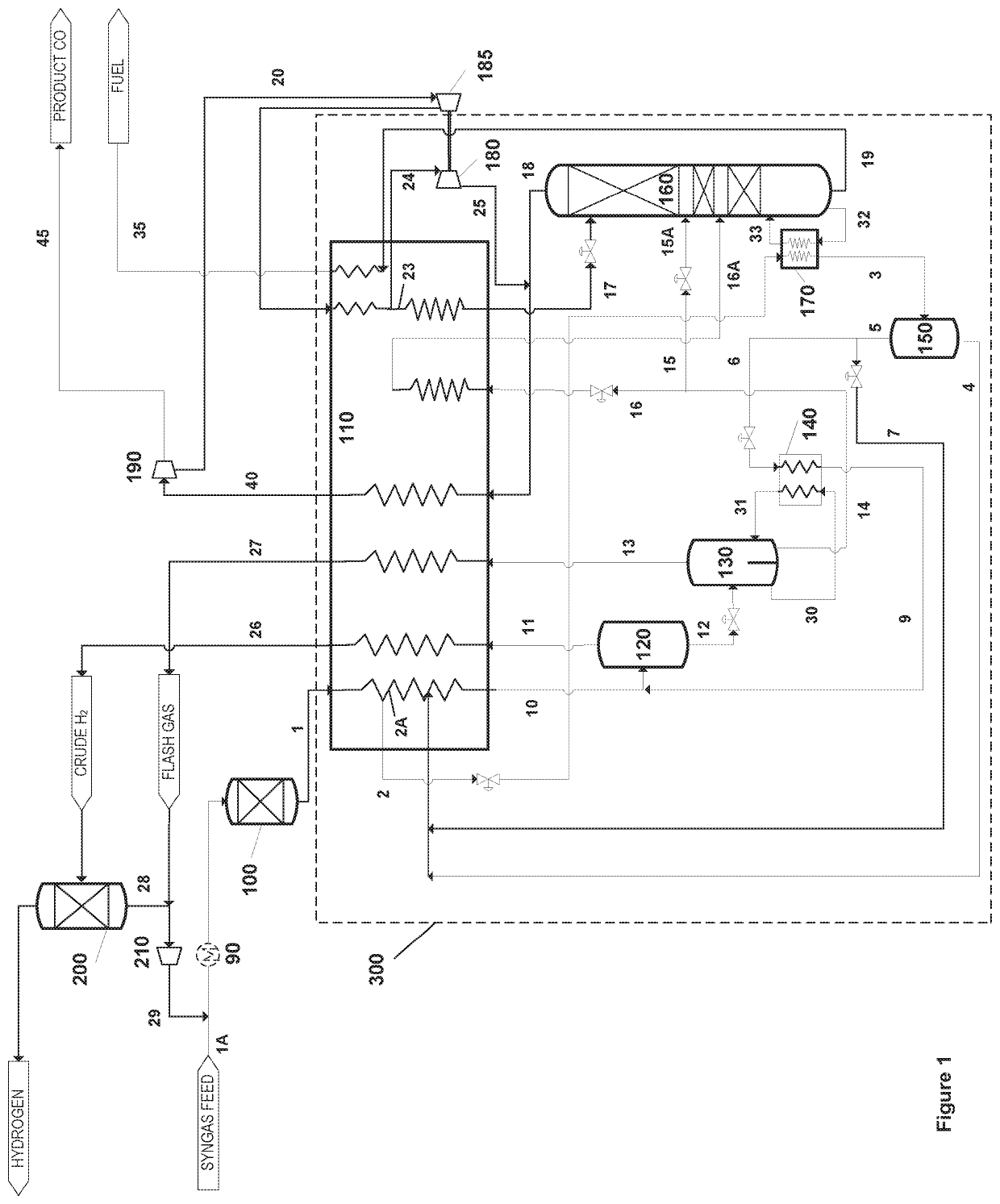
Figure 1 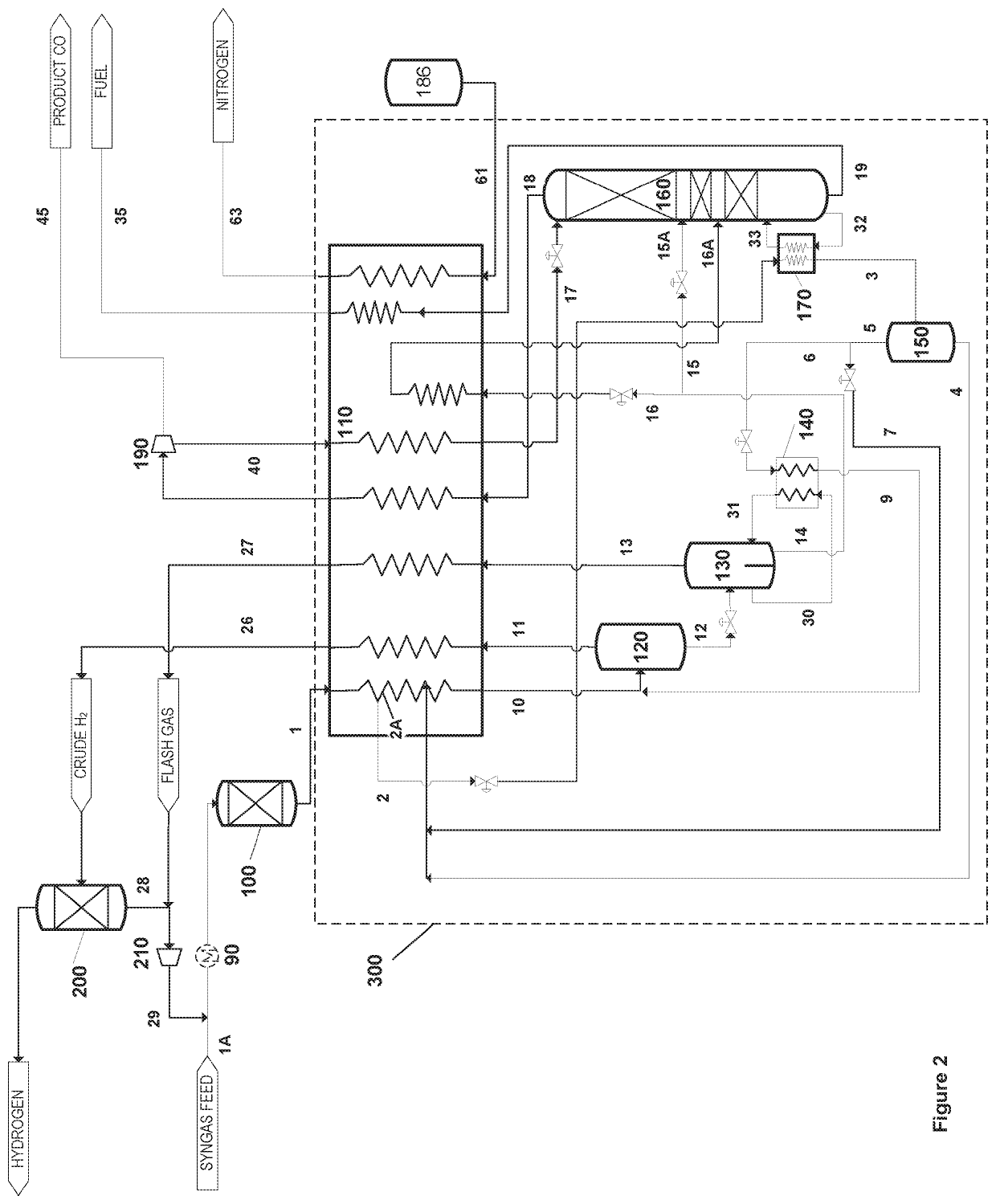
Figure 2 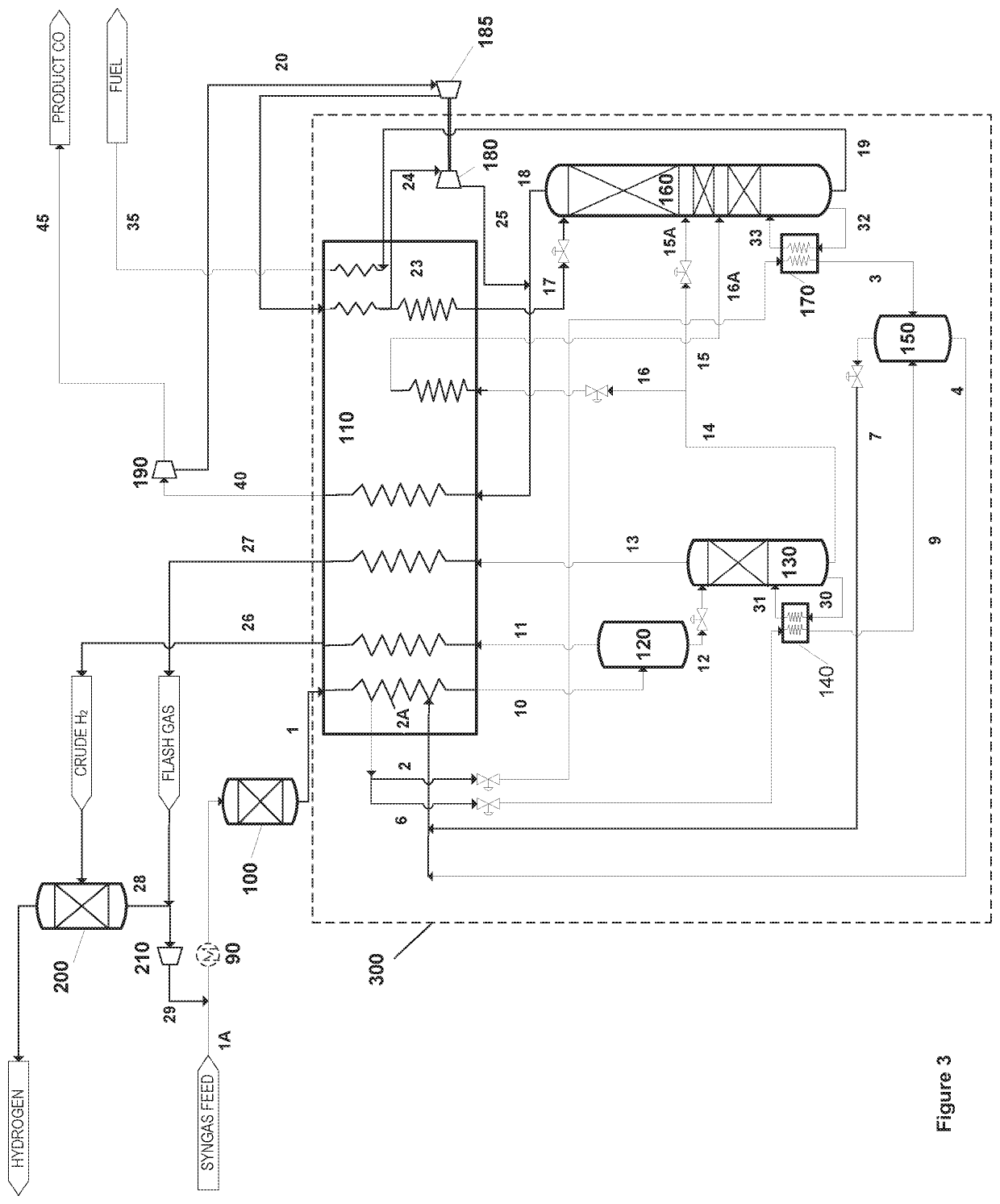
Figure 3
Abstract
Description
FIELD OF THE INVENTION
[0001] The present invention relates to a method of separating carbon monoxide from a synthesis gas containing hydrogen, carbon monoxide, methane, water, and carbon dioxide. More specifically, the invention is directed to a method of separating carbon monoxide from syngas mixtures with low methane content by cryogenic means where a partial condensation cycle is generally employed, and more specifically towards providing reboiler duties for a separator or distillation column used for removing hydrogen from carbon monoxide and a separate distillation column used for separating carbon monoxide and methane.BACKGROUND OF THE INVENTIONDescription of Related Art
[0002] Hydrocarbons such as natural gas, naphtha, liquefied petroleum gas (LPG) can be catalytically converted with steam to obtain a synthesis gas (i.e., a mixture of hydrogen (H2) and carbon monoxide (CO), methane (CH4), water (H2O) carbon dioxide (CO2) commonly referred to as “syngas”). This so-called steam me...
Examples
example 1
[0053]Process simulations were carried out in accordance with the embodiment shown in FIG. 2 to demonstrate precise control of the reboiling duty in hydrogen separation reboiler 140, thus avoiding the possibility of excess reboiling in this separation. Optimal reboiling results in a reduction of the hydrogen rich vapor stream 13 from this separation and reduces loss of CO in hydrogen rich vapor from hydrogen removal column 130. Optimal reboiling also results in a lower temperature of the hydrogen depleted liquid 14 from this separation. As stream 14 is used to provide a portion of the cooling at the cold end of the primary heat exchanger 110, lower temperatures leads to lower temperature in stream 10, thereby reducing CO losses into the crude hydrogen stream 11 exiting from high pressure separator 120. Any decrease in amounts of CO in crude hydrogen 26 and flash gas 27 increases percent per pass CO recovery. Lower CO in the crude hydrogen 26 allows for smaller hydrogen purification ...
example 2
[0054]Process simulations were carried out to in accordance with the embodiment shown in FIG. 2 to demonstrate precise control of the reboiling duty in CO / CH4 column reboiler 170. The analysis shows that by decreasing reboiling duty by 5% lowers the temperature of partially vaporized stream 33 by 4.5° K. The purity of methane rich-stream 19 decreases from 92% CH4 (by vol.) to 86.5% CH4 (by vol.). The concentration of CO in stream 19 increases from 7.8% (by vol.) to 13.3% (by vol.). Since CO present in stream 19 represents loss of CO to fuel stream 35, the overall recovery of CO in product CO stream 45 decreases by 0.5%.