
Process of producing overhead transmission conductor
Patent Information
- Authority / Receiving Office
- US · United States
- Current Assignee / Owner
- Publication Date
- 2005-01-13
- Estimated Expiration
- Not applicable · inactive patent
Smart Images
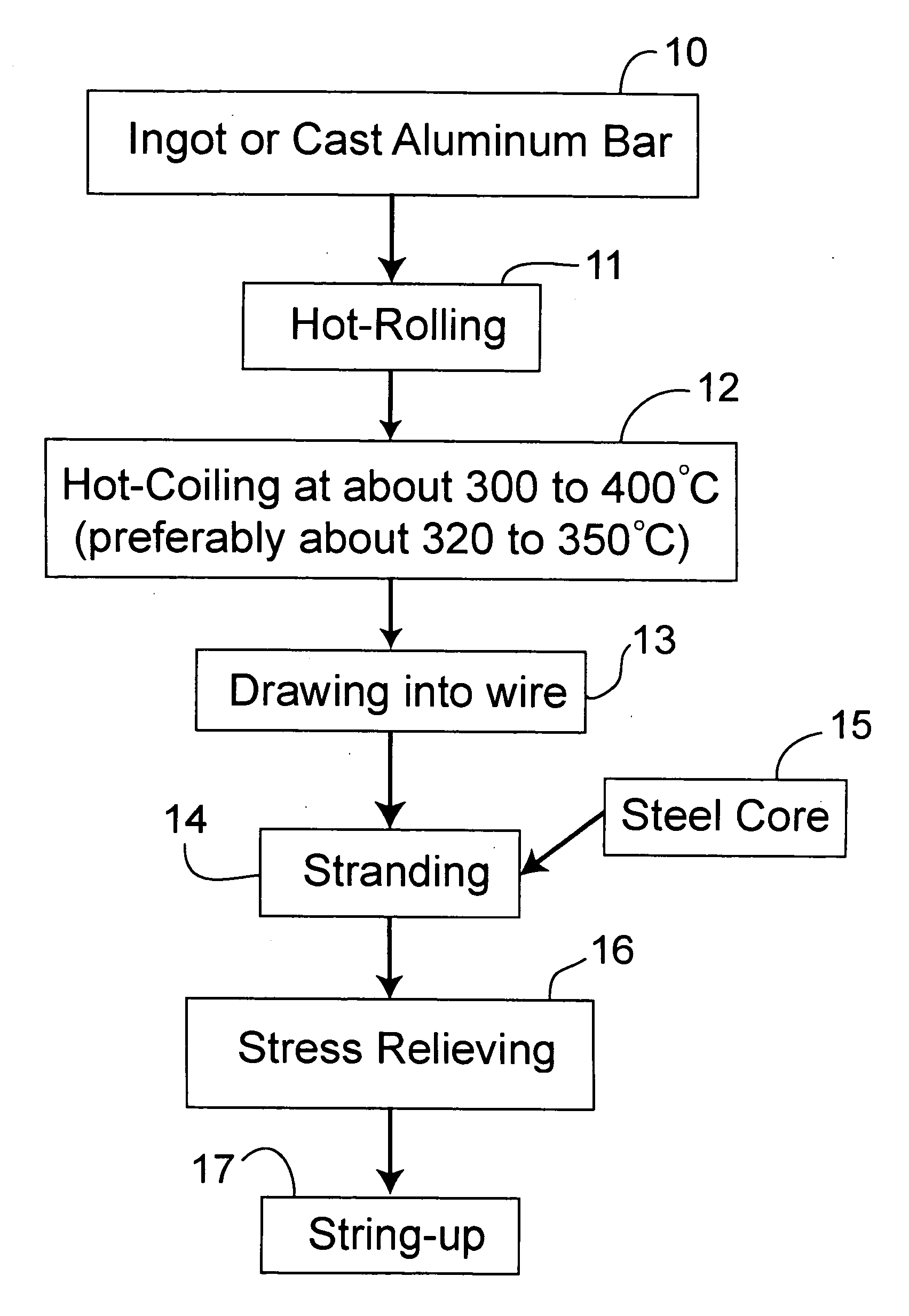
Figure 1 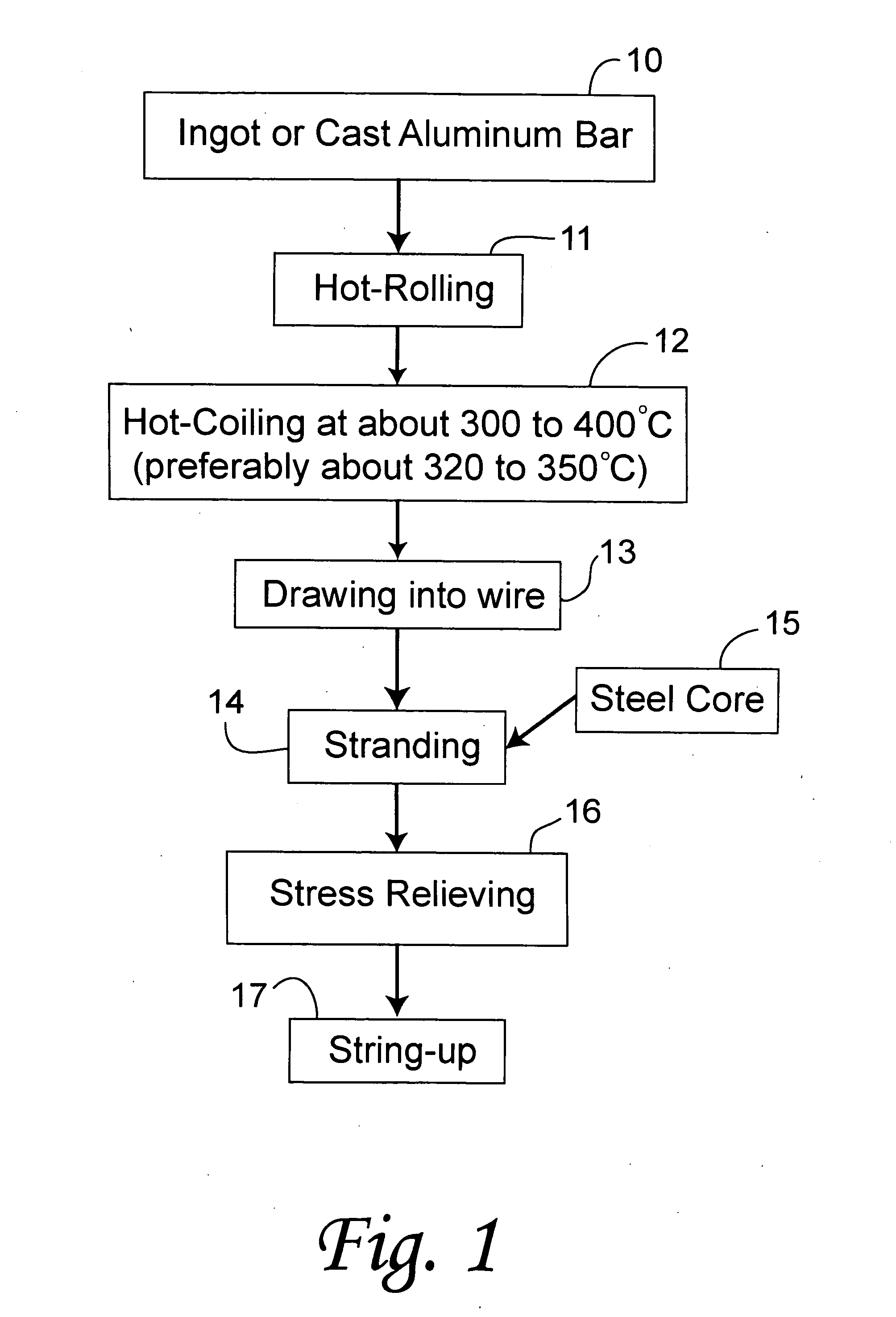
Figure 2
Abstract
Description
FIELD OF THE INVENTION The present invention relates to the manufacture of overhead transmission conductors, preferably so-called “aluminum conductor steel supported” cables (ACSS). BACKGROUND OF THE INVENTION Aluminum is a metal which offers a good compromise between electrical conductivity, mechanical strength, weight and cost. As such, the use of aluminum wire or cable as an electrical conductor has increased significantly in recent times. There are many possible applications where aluminum wire or cable could be used only if certain physical and mechanical properties are achieved. One of the most important applications is an overhead transmission conductor. Steel reinforced aluminum cable (ACSR) or aluminum conductor steel supported (ACSS) for use as overhead transmission conductors have been developed for decades. For example, U.S. Pat. No. 3,813,481 discloses a steel supported aluminum overhead conductor (SSAC). According to this patent, conventional 61% IACS (International...
Examples
example 1
Coiling
The aluminum rod employed in this test was LaPoint Continuous Cast AA1350 of 9.5 mm R 1.0—Coil Numbers 12438, 44, 53, 54, 49 The rod produced was “Hot Coiled” at a temperature above 300° C. and had an actual Tensile Strength of 86 to 102 MPa.
Drawing
The rod was wire drawn and rolled at 800 meters / mm 13 die Vaughn Drawbench and was spooled on 25 inch bobbins. After drawing, wire 2.7 to 3.3% Elong., the tensile strength was 120 to 141 MPa.
Stranding Set-Up Normal for producing electrical cable Approx. 10,000 feet produced
Batch Anneal (Higher than Originally Planned Due to Variable Tensile Rod) 320° C. first Hour; 300° C. for approx. 24 hrs, until T / C @285° C. for 2 hrs.
The finished conductor was in compliance with specifications.
example 2
The rod employed was Hot Coiled 1350 Aluminum 9.5 mm Rod having an electrical conductivity of 62.5 to 62.8% IACS Actual.
The rod was produced under the following conditions:
ActualBar TemperatureCoiling TempEmulsion Temp 500° C.297-300° C.52-54° C.485-500° C.291-295° C. 49° C.
The Actual Tensile Strength was 70 to 78 MPa.
Rolling Practice No. L1350-1
Entry Bar Temperature 500° C.+ / −15° C.
Emulsion Temperature 53 + / −2° C.
Diameter: 9.6 + / −0.2 mm
RollValve Position by Roll Stand NumberStand #1234567-1415Rolls33456788Guides33457880
Casting Practice # C1350-3Casting Speed RPM2.80 + / − .05Exit Bar Temperature 600 + / − 15° C.Furnace Metal Temperature 715 + / − 15° C.Metal Temperature before Casting Wheel 685 + / − 20° C.
Cooling Water on Casting WheelPressurePressureFlowModel AModel BSectionliters / min.Nominal KpaNominal Kpa255 + / − 535 + / − 5 23 + / − 5 3105 + / − 5 145 + / − 10 155 + / − 10 5———6240 + / − 1040 + / − 5 7120 + / − 5 130 + / − 5 8135 + / − 5 90 + / − 10
The finished conductor was in compliance...