
Carotenoid ether analogs or derivatives for controlling C-reactive protein levels
a technology of c-reactive protein and carotenoid ether, which is applied in the field of synthesis and use of carotenoid analogs or derivatives, can solve the problems of ischemia, the lack of oxygenated blood supply to a particular, and the leading cause of cvd deaths in the world, so as to improve the expression of connexin 43, inhibit the proliferation rate of carcinogen-initiated cells, and improve the effect of proliferation and propagation
Patent Information
- Authority / Receiving Office
- US · United States
- Patent Type
- Applications(United States)
- Current Assignee / Owner
- Publication Date
- 2005-03-03
- Estimated Expiration
- Not applicable · inactive patent
Smart Images

Figure 1 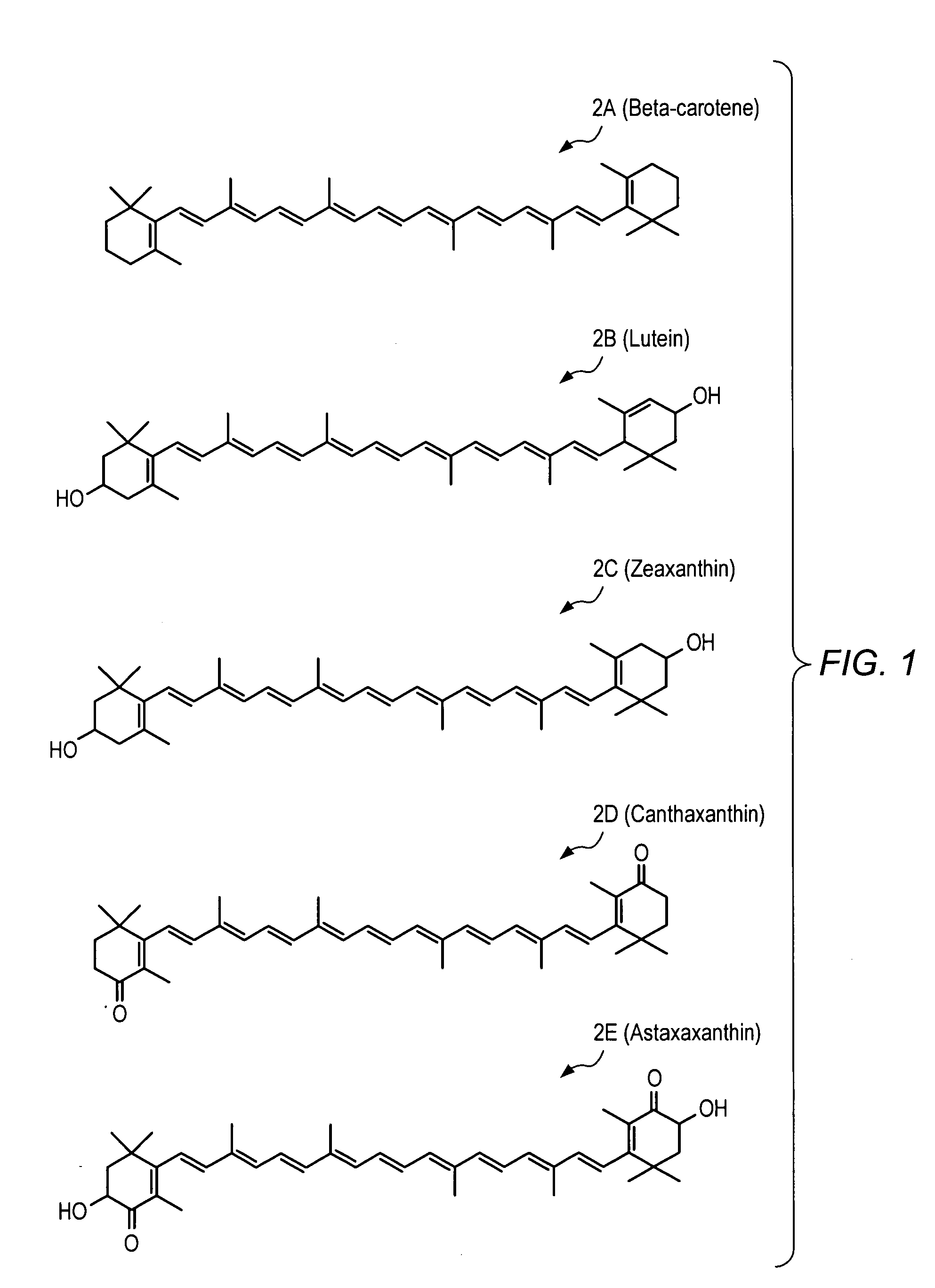
Figure 2 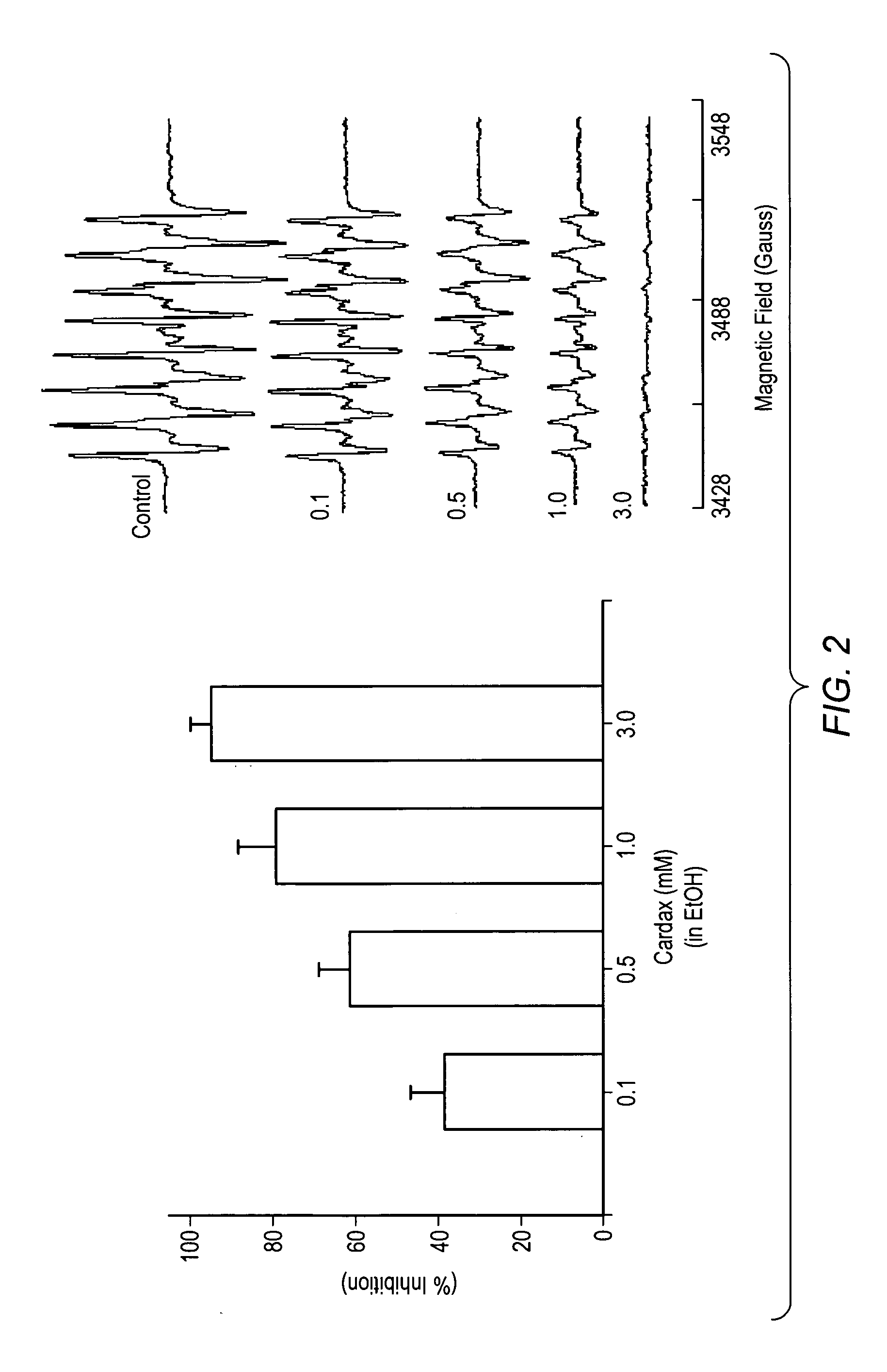
Figure 3
Abstract
Description
BACKGROUND OF THE INVENTION 1. Field of the Invention The invention generally relates to the fields of medicinal and synthetic chemistry. More specifically, the invention relates to the synthesis and use of carotenoid analogs or derivatives. 2. Description of the Relevant Art Cardiovascular disease (CVD), and specifically coronary artery disease (CAD), remains the leading cause of death in the United States and worldwide. CVD is a leading cause of mortality and morbidity in the world. Small to moderate reductions in cardiovascular risk, which lead to decreased emergency department visits and hospitalizations for acute coronary syndromes, can yield substantial clinical and public health benefits. Extensive research with antioxidants has shown that they are effective therapeutic agents in the primary and secondary prevention of cardiovascular disease. CVD remains the leading cause of death for all races in the U.S.; now, approximately 60 million Americans have some form of CVD. L...
Examples
example 1
Synthesis of XV (the Disuccinic Acid ester of Astaxanthin (Succinic acid mono-(4-{18-[4-(3-carboxy-propionyloxy)-2,6,6-trimethyl-3-oxo-cyclohex-1-enyl]-3,7,12,16-tetramethyl-octadeca-1,3,5,7,9,11,13,15,17-nonaenyl}-3,5,5-trimethyl-2-oxo-cyclohex-3-enyl)ester))
To a solution of astaxanthin 2E (6.0 g, 10.05 mmol) in DCM (“dichloromethane”) (50 mL) at room temperature was added DIPEA (“N,N-diisopropylethylamine”) (35.012 mL, 201 mmol), succinic anhydride (10.057 g, 100.5 mmol), and DMAP (“4-(dimethylamino)pyridine”) (0.6145 g, 5.03 mmol). The reaction mixture was stirred at room temperature for 48 hours, at which time the reaction was diluted with DCM, quenched with brine / 1M HCl (60 mL / 10 mL), and then extracted with DCM. The combined organic layers were dried over Na2SO4 and concentrated to yield astaxanthin disuccinate (XV) (100%) HPLC retention time: 10.031 min., 82.57% (AUC); LRMS (ESI) m / z (relative intensity): 798 (M++2H) (52), 797 (M++H) (100); HPLC retention time: 10.595 min.,...
example 2
Synthesis of XVI (the Disodium Salt of the Disuccinic Acid ester of Astaxanthin (Succinic acid mono-(4-{18-[4-(3-carboxy-propionyloxy)-2,6,6-trimethyl-3-oxo-cyclohex-1-enyl]-3,7,12,16-tetramethyl-octadeca-1,3,5,7,9,11,13,15,17-nonaenyl}-3,5,5-trimethyl-2-oxo-cyclohex-3-enyl)ester))
Disuccinic acid ester of astaxanthin XV (2 g, 2.509 mmol) and 200 mL ethanol were stirred at room temperature under nitrogen in a 500 mL round-bottom flask. Sodium ethoxide (340 mg, 5.019 mmol, Acros #A012556101) was added as a solid in a single portion and the solution was allowed to stir overnight. The following day, the precipitate was filtered off and washed with ethanol followed by methylene chloride to afford a purple solid, the disodium salt of the disuccinic acid ester of astaxanthin, XVI [1.41 g, 67%] and was placed on a high vacuum line to dry. 1H-NMR (Methanol-d4) δ 6.77-6.28 (14H, m), 5.53 (2H, dd, J=12.6, 6.8), 2.68-2.47 (8H, m), 2.08-1.88 (22H, m), 1.37 (6H, s), 1.24 (6H, s); 13C NMR (CDCl3...
example 3
Synthesis of the BocLys(Boc)OH ester of Astaxanthin (XXI)
HPLC: Column: Waters Symmetry C18 3.5 micron 4.6 mm×150 mm; Temperature: 25° C.; Mobile phase: (A=0.025% TFA in H2O; B=0.025% TFA in MeCN), 95% A / 5% B (start); linear gradient to 100% B over 12 min, hold for 4 min; linear gradient to 95% B / 5% A over 2 min; linear gradient to 95% A / 5% B over 4 min; Flow rate: 2.5 mL / min; Detector wavelength: 474 nm.
To a mixture of astaxanthin 2E (11.5 g, 19.3 mmol) and BocLys(Boc)OH (20.0 g, 57.7 mmol) in methylene chloride (500 mL) were added 4-dimethylaminopyridine (DMAP) (10.6 g, 86.6 mmol) and 1,3-diisopropylcarbodiimide (“DIC”) (13.4 g, 86.7 mmol). The round-bottomed flask was covered with aluminum foil and the mixture was stirred at ambient temperature under nitrogen overnight. After 16 hours, the reaction was incomplete by HPLC and TLC. An additional 1.5 equivalents of DMAP and DIC were added to the reaction and after 2 hours, the reaction was complete by HPLC. The mixture was then c...