
4-(Methyl sulfonyl amino) phenyl analogues as vanilloid antagonist showing excellent analgesic activity and the pharmaceutical compositions comprising the same
a vanilloid antagonist and phenyl analogue technology, applied in the field of new drugs, can solve the problems that the initial acute pain associated with capsaicin treatment has proven to be the limit of toxicity, and achieve the effects of suppressing inflammation, reducing the risk of side effects, and reducing side effects
Patent Information
- Authority / Receiving Office
- US · United States
- Patent Type
- Applications(United States)
- Current Assignee / Owner
- Publication Date
- 2006-11-16
- Estimated Expiration
- Not applicable · inactive patent
Smart Images
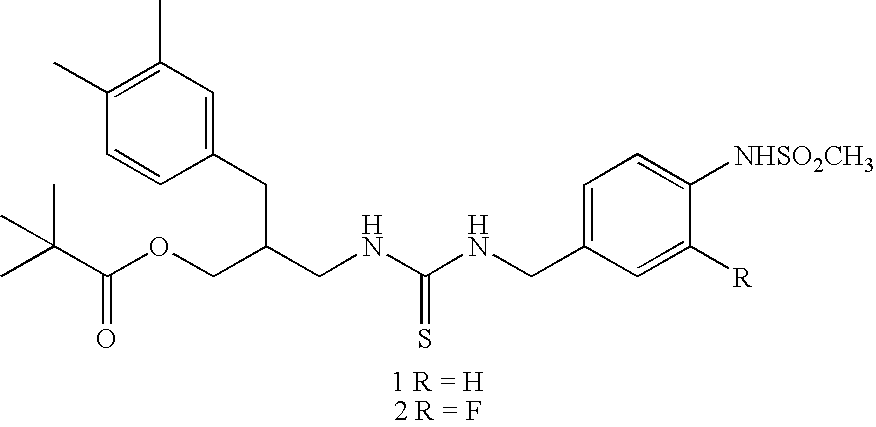
Figure 1 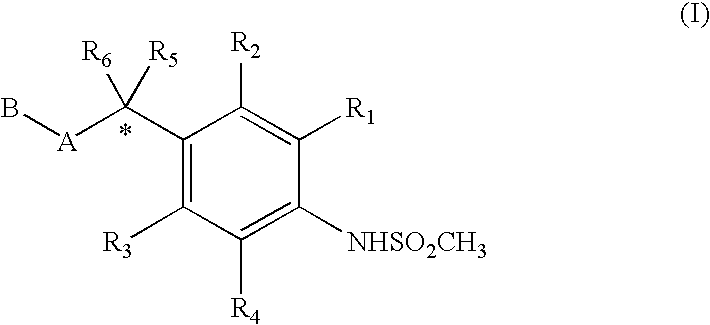
Figure 2 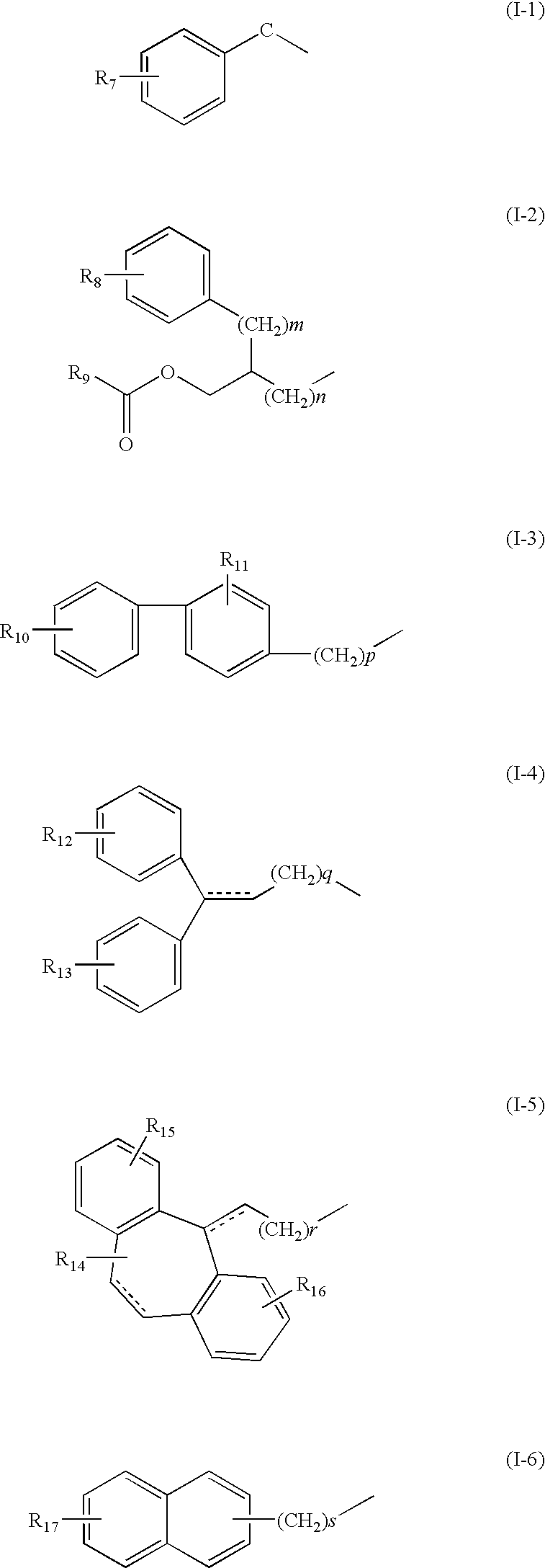
Figure 3
Abstract
Description
TECHNICAL FIELD
[0001] The present invention relates to novel 4-(methylsulfonylamino)phenyl analogues as vanilloid antagonist showing excellent analgesic activity and the pharmaceutical compositions comprising the same. BACKGROUND ART
[0002] The vanilloid receptor (VR1) is a member of the transient receptor potential (TRP) superfamily. Members of this family are non-voltage activated cation channel proteins that play critical roles in processes ranging from sensory physiology to vasorelaxation and male fertility. They share structural similarities such as six transmembrane segments and an oligmeric structure (Montell, C. et al., Cell, 108, p595, 2002). The vanilloid or capsaicin receptor (VR1 or TRPV1) has been cloned from dorsal root ganglia (DRG) of the rat, the human, the chicken, the guinea pig, and the rabbit (Szallasi, A. et al., Pharmacol. Rev., 51, p159, 1999; Caterina, M. J. et al., Nature, 389, p816, 1997; Hayes, P. et al., Pain, 88, p205, 2000; Jordt et al., Cell, 108, p4...
Examples
example 1
Preparation of N-(4-tert-butylbenzyl)-2-[3-fluoro-4-(metylsulfonylamino)phenyl]propionamide (1-51, KJ-372)
Step 1-1. Preparation of ethyl 2-(3-fluoro-4-nitrophenylpropionate (1-1, SU-654)
[0123] To a stirred solution of potassium t-butoxide (20 mmol) in DMF (20 mL) was added a mixture of 2-fluoro-nitrobenzene (10 mmol) and ethyl-2-chloropropionate (10 mmol) at 0° C. dropwise. After being stirred for 10 min at 0° C., the mixture was quenched by 1 N HCl solution, diluted with water and extracted with diethyl ether several times. The combined organic layers were washed with water and brine, dried over MgSO4, and concentrated in vacuo. The residue was purified by flash column chromatography on silica gel using EtOAc:hexanes (1:10) as eluant to afford ethyl 2-(3-fluoro-4-nitrophenyl)propionate (1-1, SU-654).
[0124] 68% yield, yellow oil
[0125]1H NMR (CDCl3) δ 8.02 (dd, 1H, J=7.8, 8.0 Hz), 7.2-7.3 (m, 2H), 4.14 (m, 2H), 3.78 (q, 1H, J=7.1 Hz), 1.52 (d, 3H, J=7.1 Hz), 1.22 (t, 3H, J=7.08 H...
example 2
Preparation of N-(4-tert-Butylbenzyl)-2-[3-chloro-4-(methylsulfonylamino)phenyl]propionamide (1-52 KMJ-470)
[0139] Through similar procedure to that in Example 1 excepting using 2-chloro-nitrobenzene as a starting material, N-(4-tert-Butylbenzyl)-2-[3-chloro-4-(methylsulfonylamino)phenyl]propionamide having following physicochemical properties was synthesized:
[0140] 68% yield, white solid, mp=126-129° C.
[0141]1H NMR (CDCl3) δ 7.60 (d, 1H, J=8.2 Hz), 7.43 (d, 1H, J=2 Hz), 7.34 (bd, 2H), 7.24 (dd, 1H, J=8.2, 2 Hz), 7.14 (bd, 2H), 6.75 (bs, 1H), 5.68 (bt, 1H), 4.38 (ddd of AB, 2H), 3.50 (q, 1H, J=7.1 Hz), 3.01 (s, 3H), 1.52 (d, 3H, J=7.1 Hz), 1.30 (s, 9H)
[0142] MS (AB) m / z 423 (MH+)
example 3
Preparation of N-(4-tert-Butylbenzyl)-2-[3-bromo-4-(methylsulfonylamino)phenyl]propionamide (1-53 SH-173)
[0143] Through similar procedure to that in Example 1 excepting using 2-bromo-nitrobenzene as a starting material, N-(4-tert-Butylbenzyl)-2-[3-bromo-4-(methylsulfonylamino)phenyl]propionamide having following physicochemical properties was synthesized:
[0144] 76% yield, white solid, mp=66-67° C.
[0145]1H NMR (CDCl3) δ 7.55-7.6 (m, 2H), 7.33 (d, 2H, J=8.1 Hz), 7.27 (dd, 1H, J=1.8, 8.6 Hz), 7.12 (d, 2H, J=8.1 Hz), 6.80 (bs, 1H), 5.91 (bt, 1H), 4.36 (ddd of AB, 2H), 3.50 (q, 1H, J=7.1 Hz), 2.98 (s, 3H), 1.50 (d, 3H, J=7.1 Hz), 1.29 (s, 9H)
[0146] MS (FAB) m / z 467 (MH+)