
Diagnosis and treatment for immunoglobulin E (IgE) implicated disorders
a technology of immunoglobulin and implicated disorders, applied in the field of diagnosis and treatment of immunoglobulin e (ige) implicated disorders, can solve the problems of ineffective mono-ige, and inability to detect and treat large protein molecule of mono-ige, etc., and achieve the effect of lowering the free ige in serum
Patent Information
- Authority / Receiving Office
- US · United States
- Patent Type
- Applications(United States)
- Current Assignee / Owner
- Publication Date
- 2008-04-03
- Estimated Expiration
- Not applicable · inactive patent
Smart Images
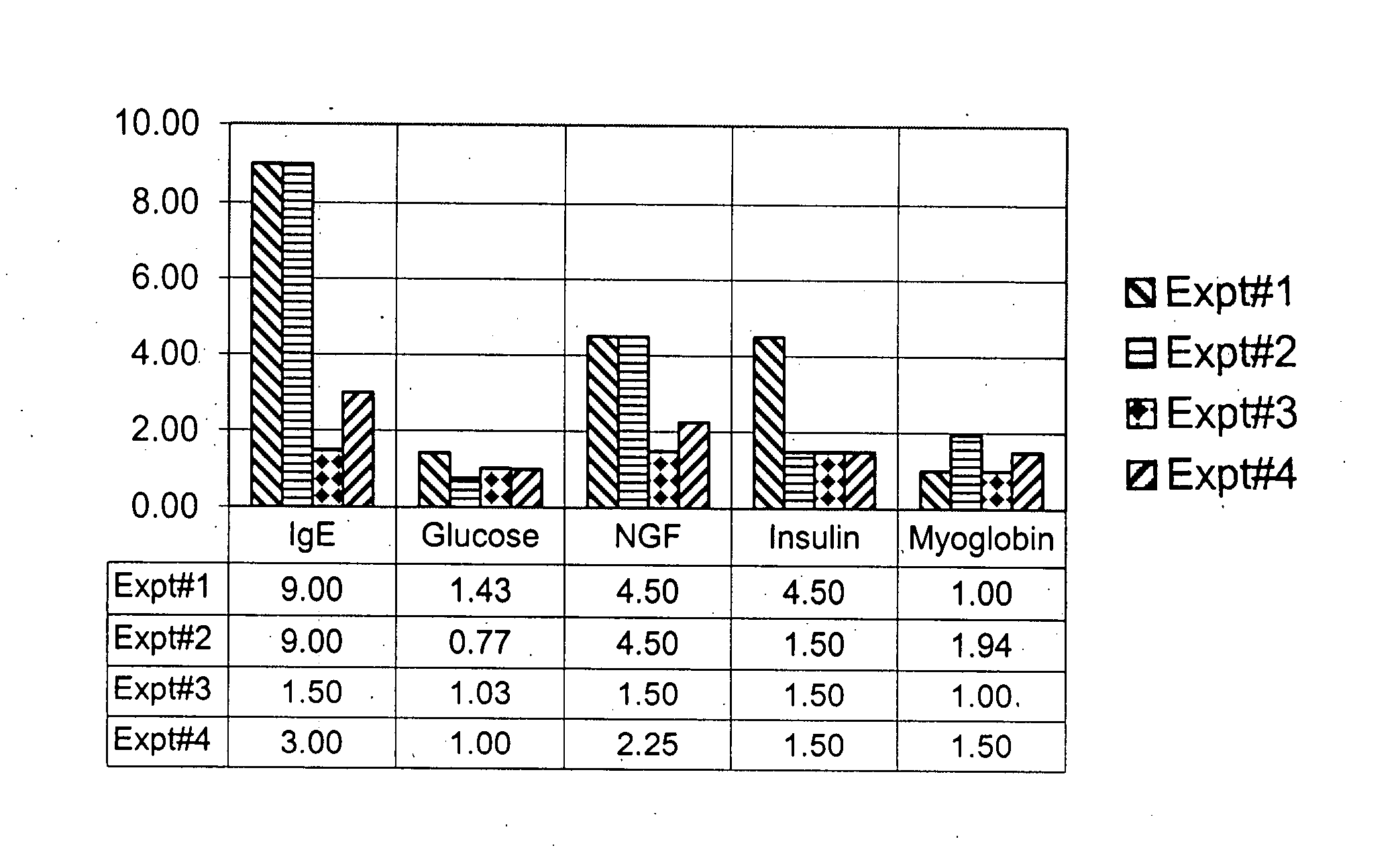
Figure 1 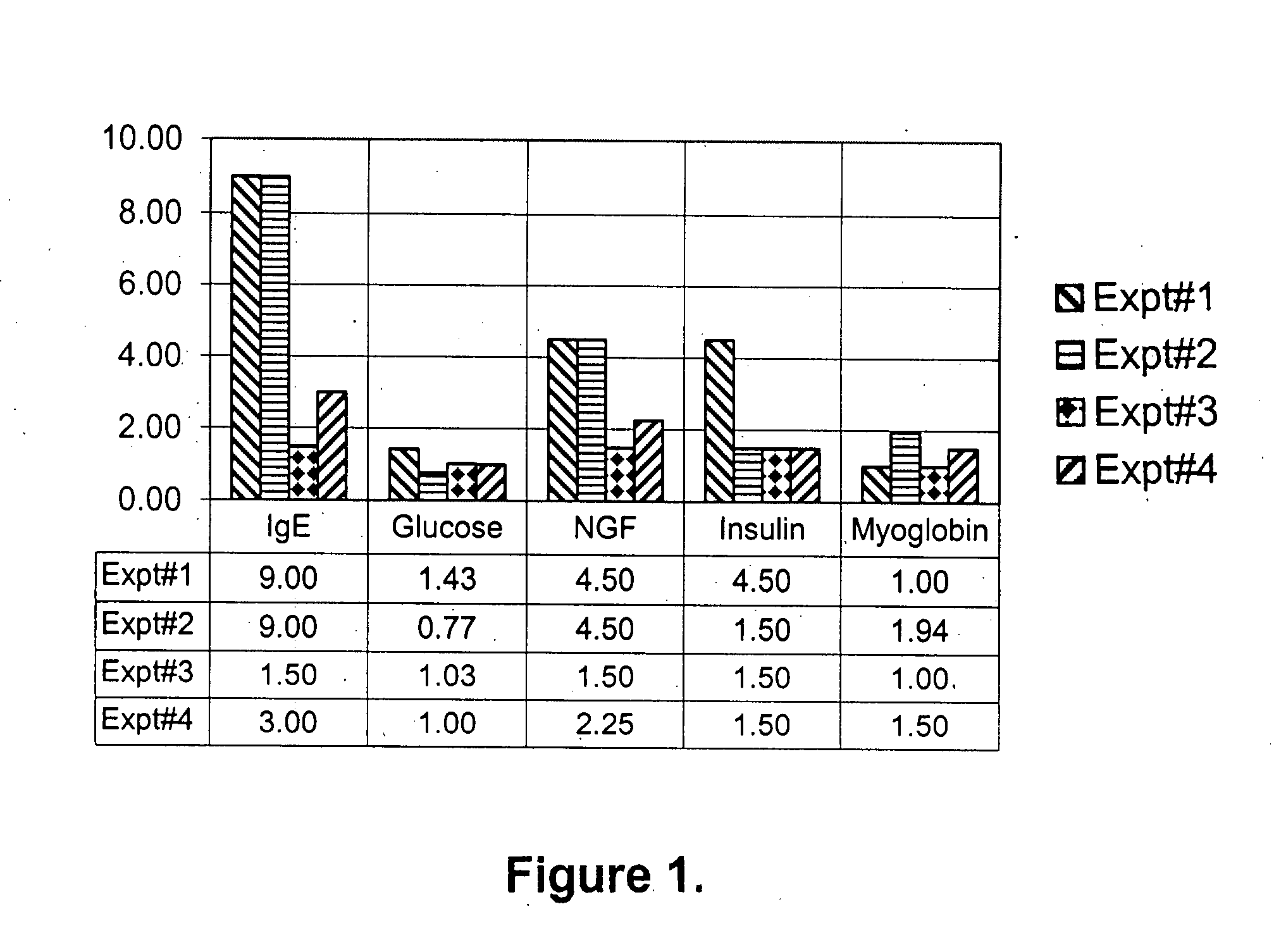
Figure 2
Abstract
Description
CROSS REFERENCE TO RELATED APPLICATIONS
[0001] This application is a continuation in part of application Ser. No. 10 / 047,945 fed Jan. 14, 2002, now ______ and / or a continuation in part of application Ser. No. 11 / 710,738 filed Feb. 24, 2007, now ______ which was a division of application Ser. No. 10 / 047,945 filed Jan. 14, 2002, now ______.SPECIFICATION
[0002] 1. Field of the Invention
[0003] In one aspect, this invention relates to the introduction of use of saliva as a non-invasive source for detection and assay of endogenously present proteins, for example, nerve growth FACTOR (NGF) myoglobin, Insulin, adenosine deaminase (ADA), a most importantly immunoglobulin E (IgE). In another aspect, the invention relates to the treatment of human disorders characterized by elevated fee IgE levels by the administration of a peptide to reduce the level.
[0004] 2. Discussion of Prior Art
[0005] U.S. Pat. No. 5,714,341, issued Feb. 3, 1998 discloses at col. 5; lines 15-34 “The method of the inve...
Examples
experiment 1
[0031] The pool of several human salivas was split into two parts. To one part equal volume of PBS was added and to the second part equal volume-containing 1 mg / ml of LT-10 was added. The mixtures were incubated at 37 ° C. for one hour. IgE levels were assayed in both mixtures by usual ELISA test using anti-IgE. It was revealed that free IgE level was much reduced in the mixture of saliva and LT-10, in comparison to the mixture of saliva and PBS. This shows the binding of LT-10 to free IgE in saliva, the bound IgE is not detected by anti-IgE by ELISA test.
experiment 2
[0032] 1 placed one ml of water in my mouth and kept it for 15 minutes, after which the mixture with saliva and water was collected Likewise I placed one ml of LT-10 containing 1 mg / ml and the mixture of saliva and LT-10 was collected. IgE levels were assayed in both mixtures by usual ELISA test. It was revealed that IgE level was much reduced in the mixture of saliva and LT-10, in comparison to the mixture of saliva and water. This shows that the binding of LT-10 to IgE in saliva in mouth.
experiment 3
[0033] A serum pool from allergy patients was divided into a first tube and a second tube. PBS was added to the first tube, and LT-10 solution was added to the second, the serum concentration in both tubes being the same. After incubation, both tubes were analyzed for IgE concentration by using anti-IgE. The concentration of free IgE in the tube treated with LT-10 was lower than in the untreated tube.