
Shapeable electrosurgical scalpel
a scalpel and electrosurgical technology, applied in the field of shapeable electrosurgical scalpels, can solve the problems of not being able to assist the surgeon in making the smallest cut, the tools provided for the surgeon to remove the tissue are not well suited for performing the procedure, and the surgeon cannot achieve the effect of minimizing the invasiveness of the surgical procedure, and reducing the risk of infection
Patent Information
- Authority / Receiving Office
- US · United States
- Patent Type
- Applications(United States)
- Current Assignee / Owner
- Publication Date
- 2009-03-26
- Estimated Expiration
- Not applicable · inactive patent
Smart Images
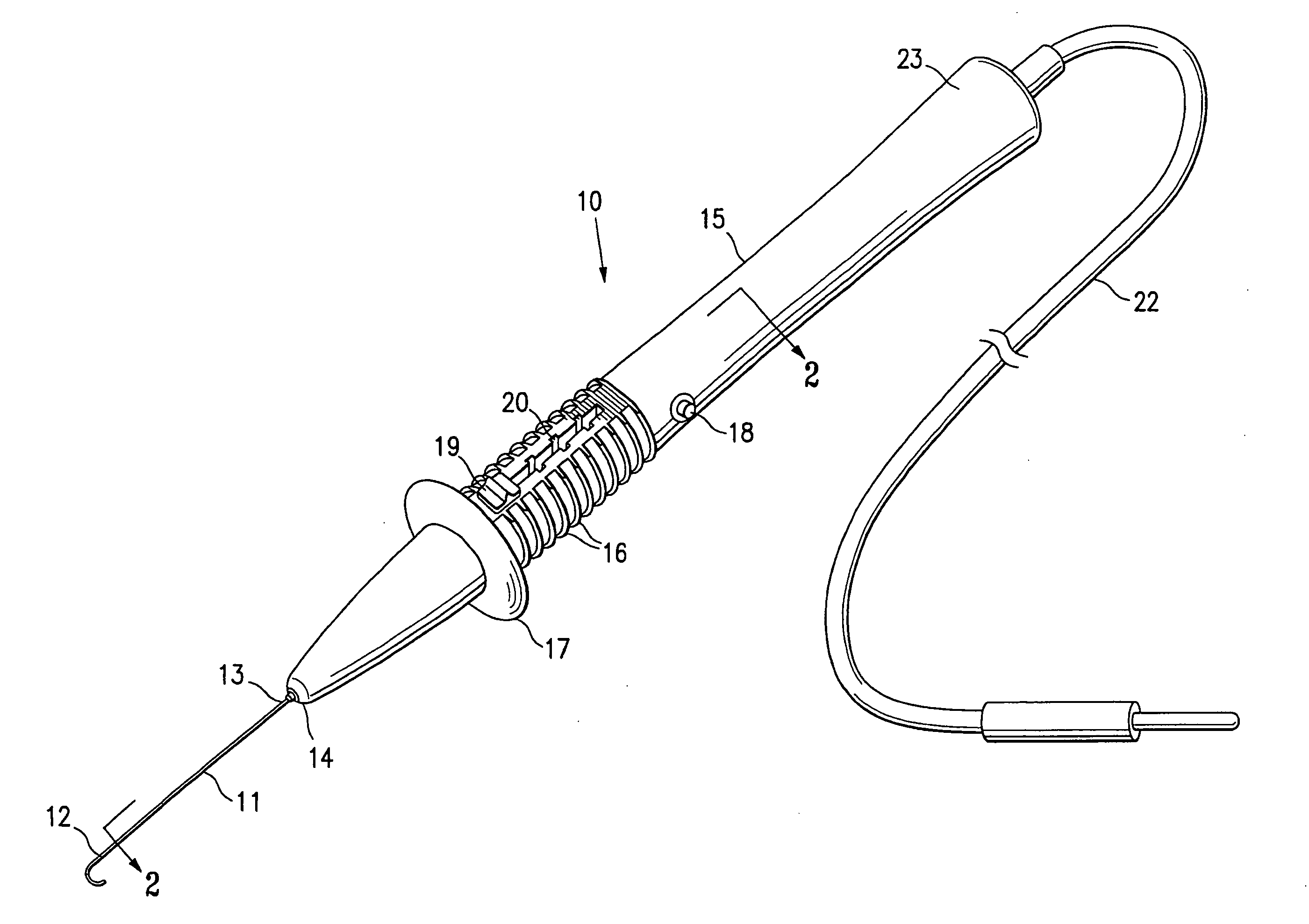
Figure 1 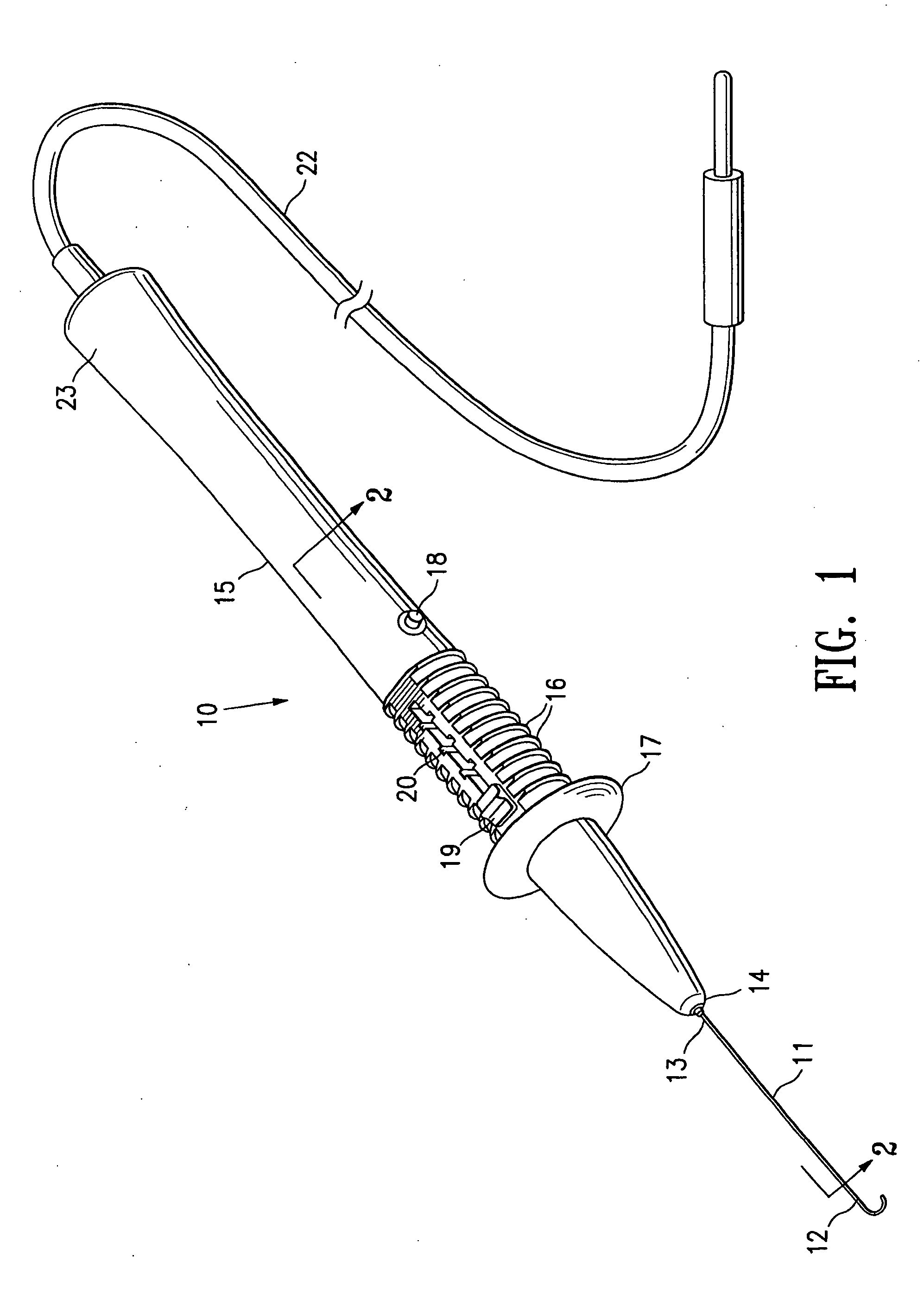
Figure 2 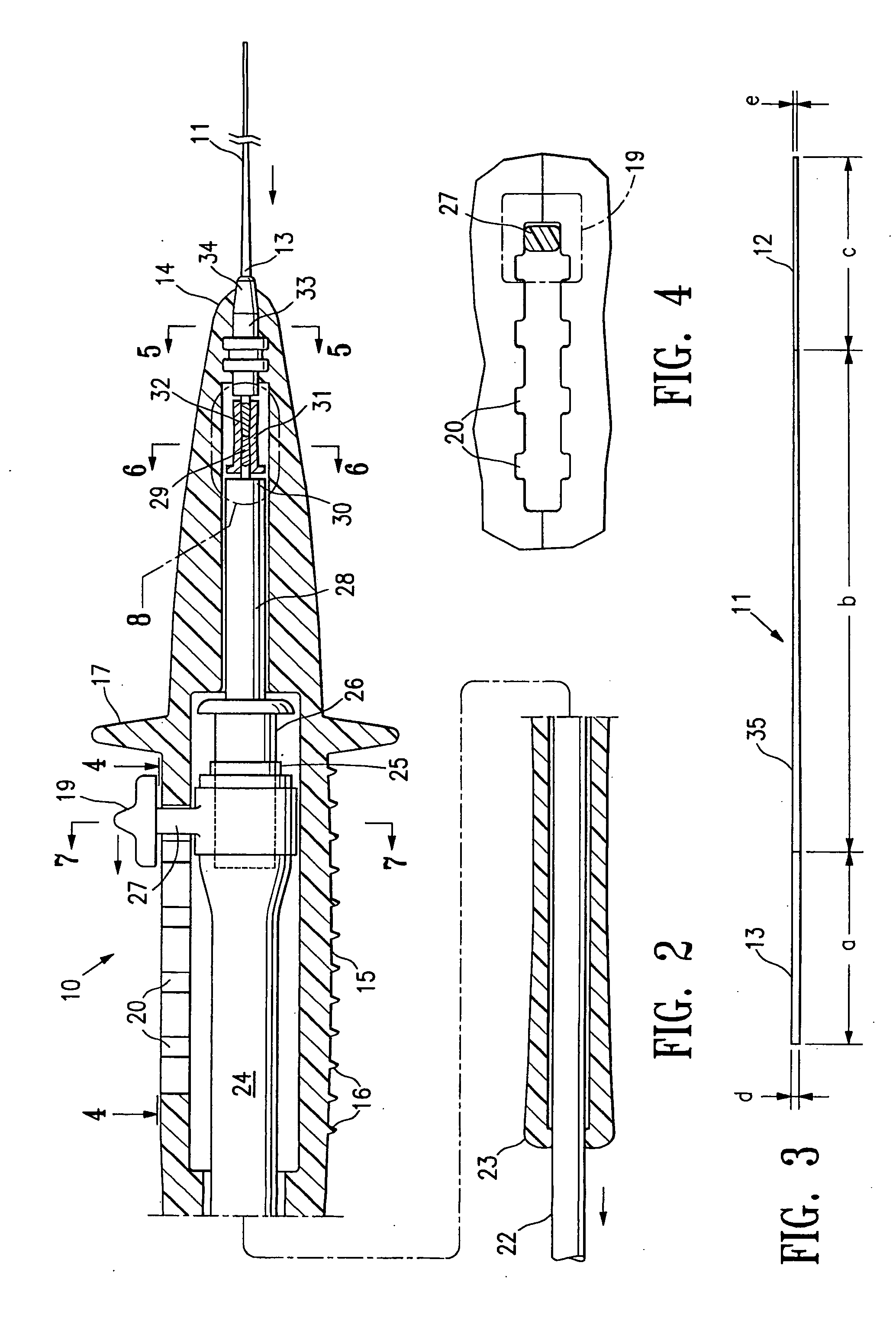
Figure 3
Abstract
Description
RELATED APPLICATIONS
[0001] This application is continuation of copending application Ser. No. 10 / 446,507, filed May 27, 2003, which is a continuation of application Ser. No. 09 / 725,265, filed Dec. 29, 2000, which is a continuation-in-part of copending U.S. application Ser. No. 09 / 337,666, filed Jun. 22, 1999, all of which are incorporated herein by reference and from all which priority is claimed.BACKGROUND OF THE INVENTION
[0002] Surgical lesion removal has traditionally been performed using a variety of surgical tools and techniques, some of which are specially adapted for a particular procedure. For example, large lesion removal from, e.g., the human breast, is typically attempted through an open incision using an ordinary surgical knife or scalpel. While the use of scalpels is widely accepted, they are not designed to minimize the invasiveness of a surgical procedure. During a surgical procedure, it is usually necessary to form an incision which is much larger than the lesion which...
Examples
Embodiment Construction
[0036]FIGS. 1-8 depict an electrosurgical cutting device 10 embodying various features of the invention which generally has a cutting electrode 11 with a free or exposed distal portion 12 and a proximal portion 13 which is secured within the distal end 14 of handle 15. The exterior of handle 15 is provided with ridges 16 configured for gripping by the physician or other operator to allow control of the device during operation and a radially extending flange 17 to protect the hand of the operator during operation of the electrosurgical device. The handle 15 is provided with a button type switch 18 for switching an RF electrode power source (not shown) to an active or “on” position or to an inactive or “off” position. A switching function may also be provided for alternative modes such as for coagulation. As best shown in FIGS. 2 and 4, the handle 15 may be provided with a thumb slide 19 to allow axial translation of an electrode assembly within the handle with detents 20 being provid...