
Sinus tarsi implant
a technology of tarsi and implants, which is applied in the field of enhancing and correcting skeletal mechanics of medical devices, can solve the problems of direct or ultimate fracture, significant deleterious effects on the bony structure, and anatomical mal-alignment, and achieves accurate placement, less trauma, and increased mechanical retention
Patent Information
- Authority / Receiving Office
- US · United States
- Patent Type
- Patents(United States)
- Current Assignee / Owner
- Publication Date
- 2006-04-25
Smart Images
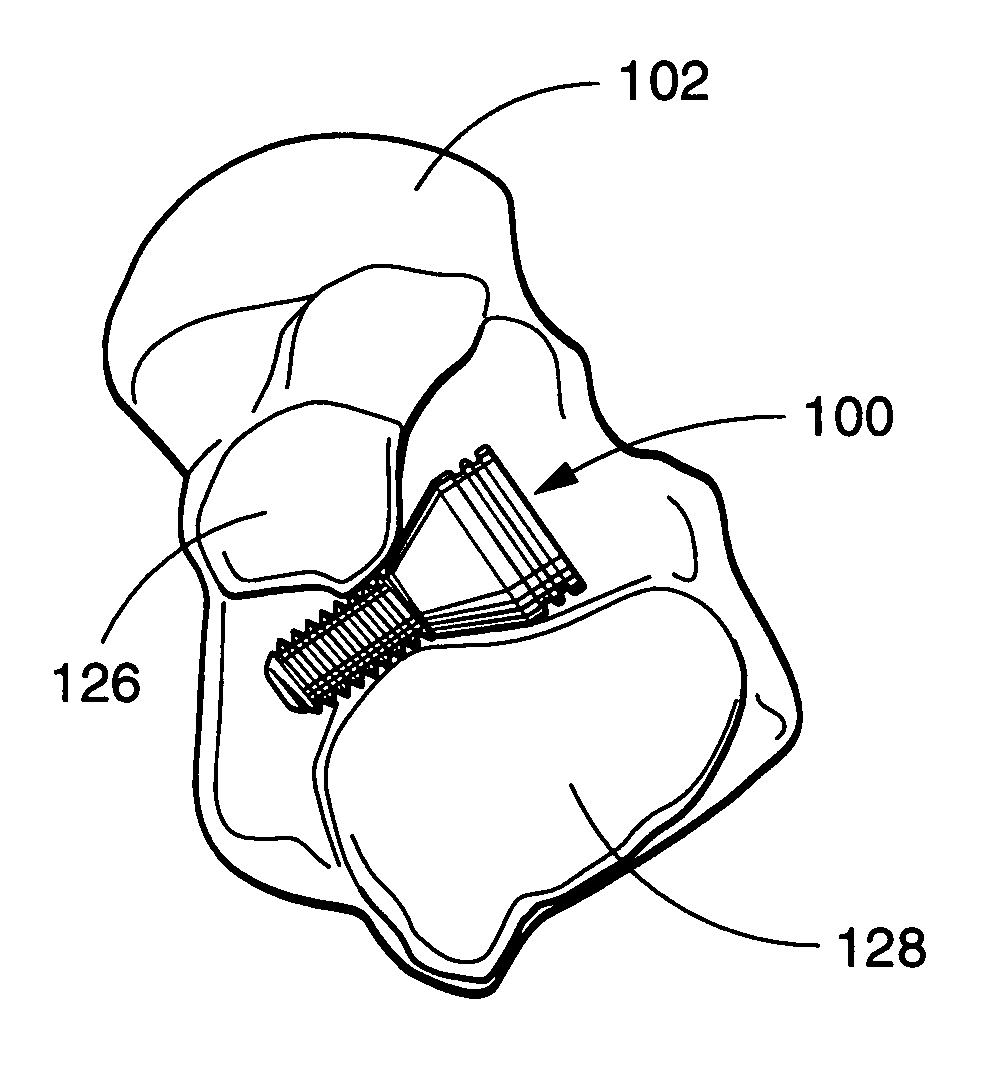
Figure 1 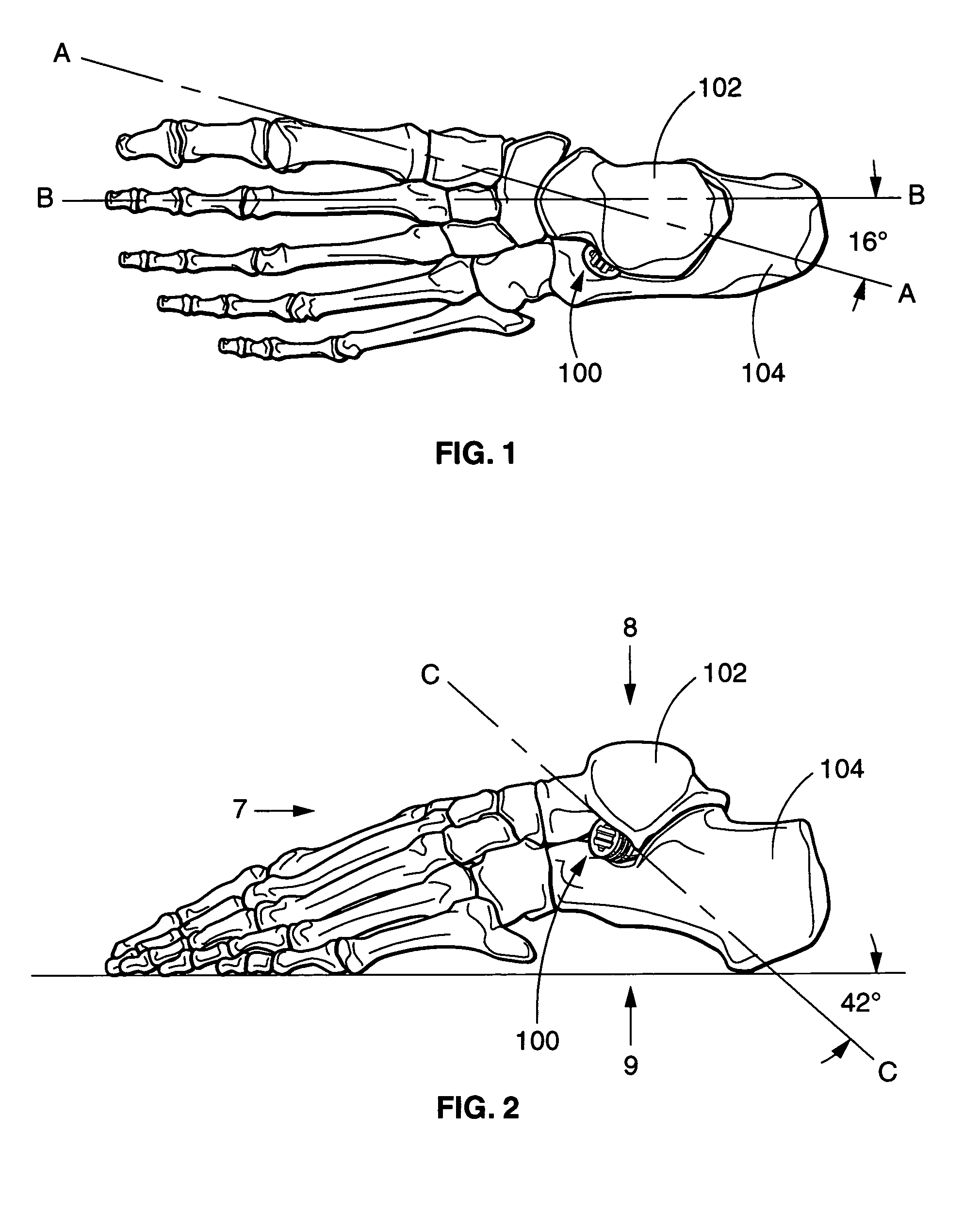
Figure 2 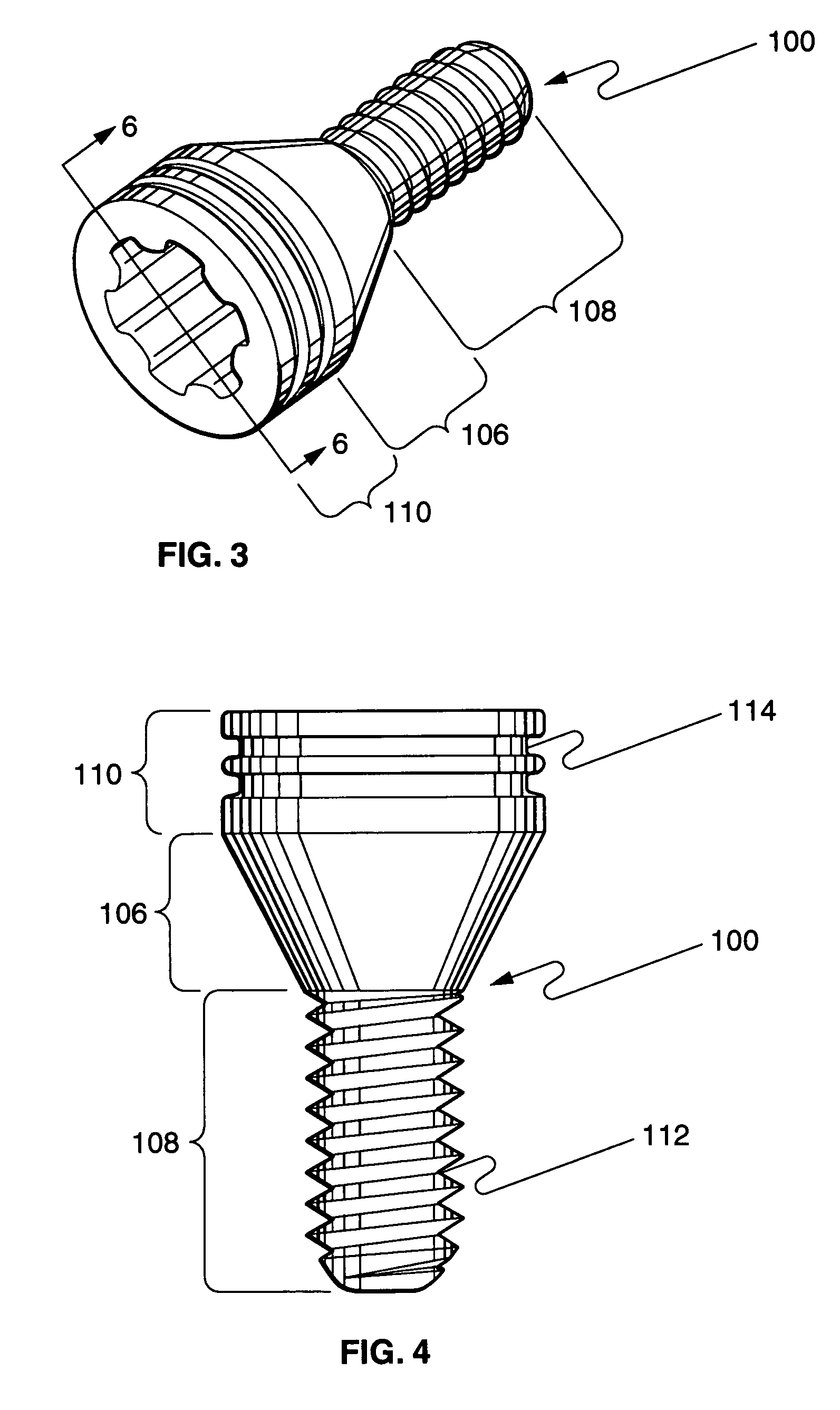
Figure 3
Abstract
Description
BACKGROUND OF THE INVENTION
[0001] This invention relates to a medical apparatus for enhancing and for correcting skeletal mechanics. More specifically, this invention relates to the correction of certain bone alignment deformities that impair optimal biped mechanics.
[0002] Excessive pronation (hyperpronation) is caused by abnormal motion between two bones of the foot; the ankle bone (talus) and the heel bone (calcaneus). This abnormal motion will eventually lead to anatomical mal-alignment both proximally and distally. The abnormal motion is due to obliteration or closure of a naturally occurring space (sinus) formed between the talus and calcaneus.
[0003] This sinus is referred to anatomically as the sinus tarsi. In anatomical terms, the sinus tarsi is located anterior to the subtalar joint and posterior to the talocalcaneo-navicular joint. As will be described in greater detail below, the subtalar joint is formed by the posterior talar facet of the calcaneus and the posterior calcanea...
Examples
Embodiment Construction
[0037]Referring now to the drawings wherein like numerals indicate the parts, FIG. 1 is a schematic representation of a patient's foot with a sinus tarsi implant 100 placed in accordance with a preferred embodiment of the invention. As described previously, the implant operates by arthroeresis (blocking of motion) of the patient's subtalar joint. The subtalar joint is the articulation between the talus 102 superiorly and the calcaneus 104 inferiorly. FIG. 1 also illustrates an axis A—A of subtalar joint motion which is approximately 16 degrees measured from a midline axis B—B of a human foot.
[0038]FIG. 2 depicts the sinus tarsi implant 100, talus 102 and calcaneus 104 in a side view. Also shown, axis C—C of subtalar joint motion is approximately 42 degrees measured with respect to a horizontal plane. FIG. 2 further discloses line-of-sight views “7,”“8,” and “9” for FIGS. 7–9 respectively.
[0039]FIG. 3 illustrates a perspective view of an implant 100 comprising a first member 106 with...