
Antimicrobial indoline compounds for treatment of bacterial infections
a technology of indoline and bacterial infections, applied in the field of indoline heterocyclic compounds, can solve the problems of limited indications, increased resistance, and widespread use of drugs, and achieve the effect of high antimicrobial activity and useful antibacterial activity
Patent Information
- Authority / Receiving Office
- US · United States
- Current Assignee / Owner
- Publication Date
- 2010-03-18
- Estimated Expiration
- Not applicable · inactive patent
Smart Images
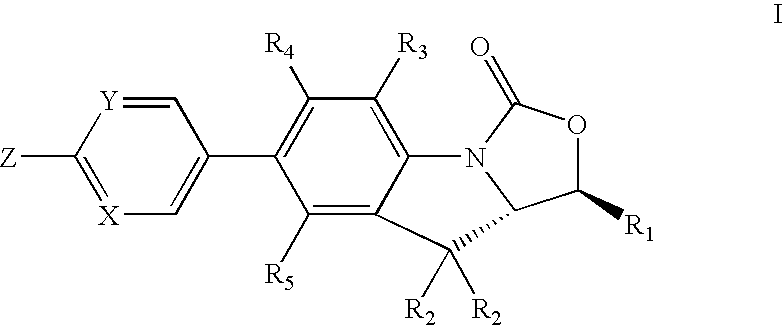
Figure 1 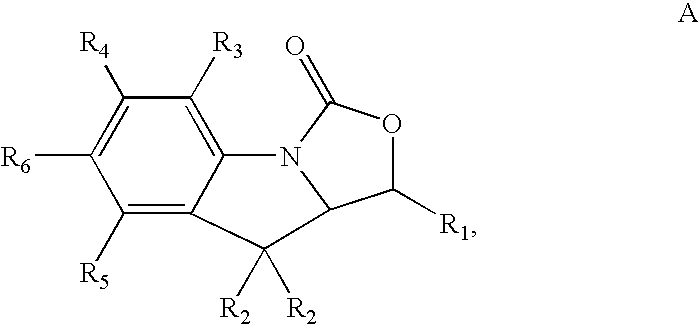
Figure 2 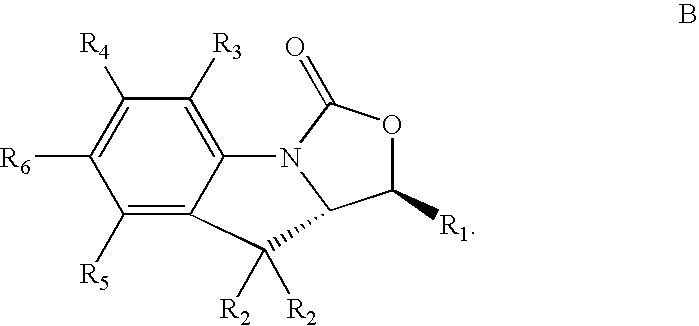
Figure 3
Abstract
Description
RELATED APPLICATIONS
[0001] This application claims the benefit under 35 U.S.C. §119 of U.S. Provisional Application No. 61 / 093,696, filed Sep. 2, 2008, incorporated herein by reference in its entirety.FIELD OF THE INVENTION
[0002] The present invention provides novel indoline heterocyclic compounds with useful antimicrobial properties, pharmaceutical compositions thereof, methods for their use, and methods for preparing of the same. These compounds have potent activities against pathogenic bacterial species.BACKGROUND OF THE INVENTION
[0003] Due to an increasing antibiotic resistance, novel classes of antibacterial compounds are acutely needed for the treatment of bacterial infections. The antibacterials should possess useful levels of activity against certain human and veterinary pathogens, including gram-positive aerobic bacteria such as multiply-resistant staphylococci and streptococci, select anaerobes such as bacteroides and clostridia species, and acid-fast microorganisms such as M...
Examples
example 1
Compound of Structure
[0187]
[0188]Scheme for Compound of Example 1:
[0189]Intermediate 2. Cbz-Cl (20 mL, 0.13 mol) in MeCN (50 mL) was added dropwise to Intermediate 1 (20 g, 0.12 mol) and DIEA (43 mL, 0.25 mol) in MeCN (350 mL) at 5-10° C. over 20 min. The mixture was allowed to warm up r.t. After 3 h, volatiles were removed under vacuum. The oily residue was dissolved in EtOAc and washed with 1% aq. HCl, water, brine, and dried (MgSO4). Solvent was removed under vacuum to afford the product as thick oil that crystallized in refrigerator into a brownish solid.
[0190]Intermediate 3. CDI (14.2 g, 0.087 mol) was added to Intermediate 2 (20 g, 0.067 mol) in DCM (150 mL) at −5° C., and the solution was kept at −5° C. for 1 h. DIEA (15.3 mL, 0.087 mol) was added, followed by N,O-dimethylhydroxylamine hydrochloride (8.5 g, 0.087 mol). The mixture was allowed to warmed up to r.t. and stirred for 30 min, then filtered and washed with EtOAc to obtain the product as a white solid.
[0191]Intermedi...
example 2
Compound of Structure
[0201]
[0202]Scheme for Compound of Example 2:
[0203]Intermediate 2a. Intermediate 2a was prepared analogously to the procedure for Intermediate 10a just as described in the preparation of Compound of Example 1, except using 5-bromo-2-(1-methyl-1H-tetrazol-5-yl)pyridine (prepared as described in PCT WO 2005 / 058886) instead of Intermediate 9a. 1H NMR (300 MHz, CDCl3, ppm): 9.03 (d, J=1.8 Hz, 1H), 8.27 (dd, J=8.4 and 1.8 Hz, 2H), 4.52 (s, 3H), 1.39 (s, 12H).
[0204]Intermediate 2b. Intermediate 2b was prepared analogously to the procedure for Intermediate 10 just as described in the preparation of Compound of Example 1, except using Intermediate 2a instead of Intermediate 10a.
[0205]Intermediate 12. Intermediate 12 was prepared analogously to the procedure for Intermediate 11 just as described in the preparation of Compound of Example 1, except using Intermediate 2b instead of Intermediate 10. MS (m / z): 364 (M+1).
[0206]Compound of Example 2. The compound of Example 2 w...
example 3
Compound of Structure
[0207]
[0208]Scheme for Compound of Example 3:
[0209]Intermediate 3a. To the solution of 5-bromo-2-(1,2,3,4-tetrazol-1-yl)pyridine (80 mg, 0.36 mmol) in dioxane (3 ml) was added pinacol diborane (100 mg, 0.39 mmol), KOAc (100 mg, 1.08 mmol) and PdCl2(dppf)DCM (10 mg, 0.01 mmol). The reaction mixture was degassed and protected by N2, then stirred at 80° C. for 4 h. The reaction mixture was diluted with DCM (100 mL), filtered, and evaporated under vacuum to give a yellow solid, which was purified by preparative TLC (5-10% Mesh in DCM) to give Intermediate 3a as white solid (48 mg). 1H NMR (300 MHz, CDCl3, ppm): 9.58 (s, 1H), 8.83 (m, 1H), 8.32 (dd, J=8.4 and 1.8 Hz, 1H), 8.06 (d, J=8.70 Hz, 1H), 1.38 (s, 12H).
[0210]Intermediate 3b. Intermediate 3b was prepared analogously to the procedure for Intermediate 10 just as described in the preparation of Compound of Example 1, except using Intermediate 3a instead of Intermediate 10a.
[0211]Intermediate 13. Intermediate 13 w...