
Thioxanthene derivates useful to treat infectious diseases
a technology of thioxanthene and derivatives, applied in the field of antiinfective agents, can solve problems such as unsuitability of phenothiazines
Patent Information
- Authority / Receiving Office
- US · United States
- Patent Type
- Applications(United States)
- Current Assignee / Owner
- Publication Date
- 2010-05-06
- Estimated Expiration
- Not applicable · inactive patent
Smart Images
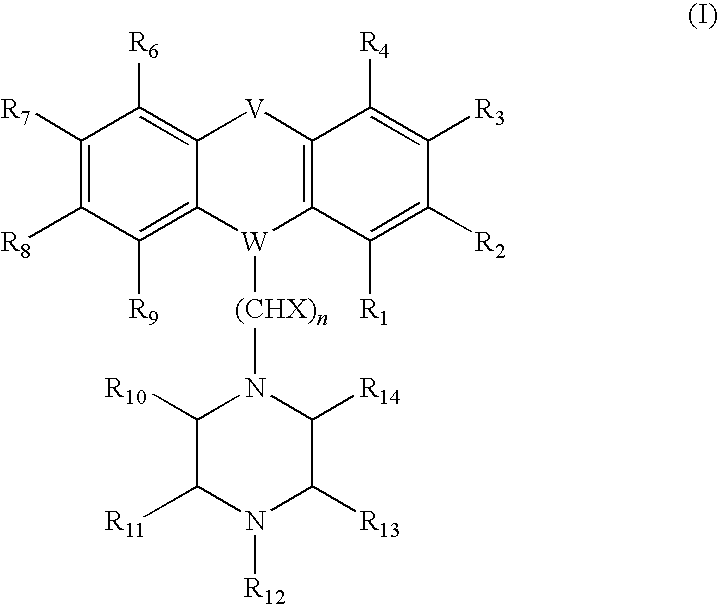
Figure 1 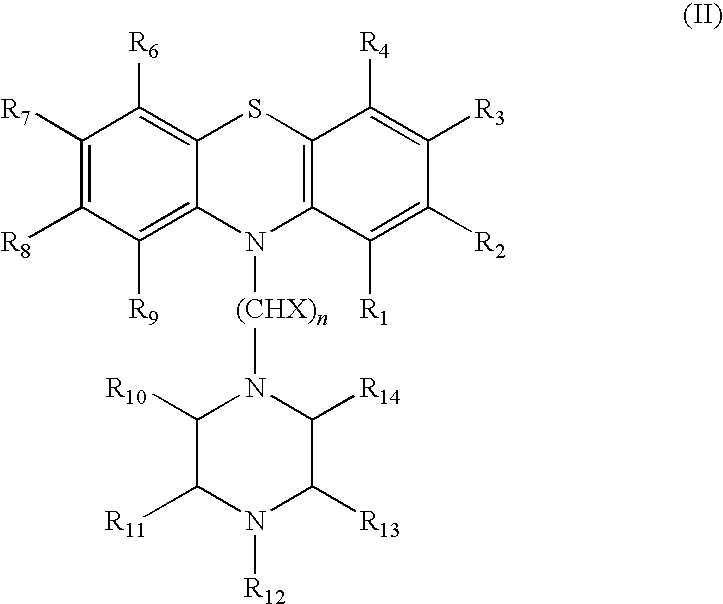
Figure 2 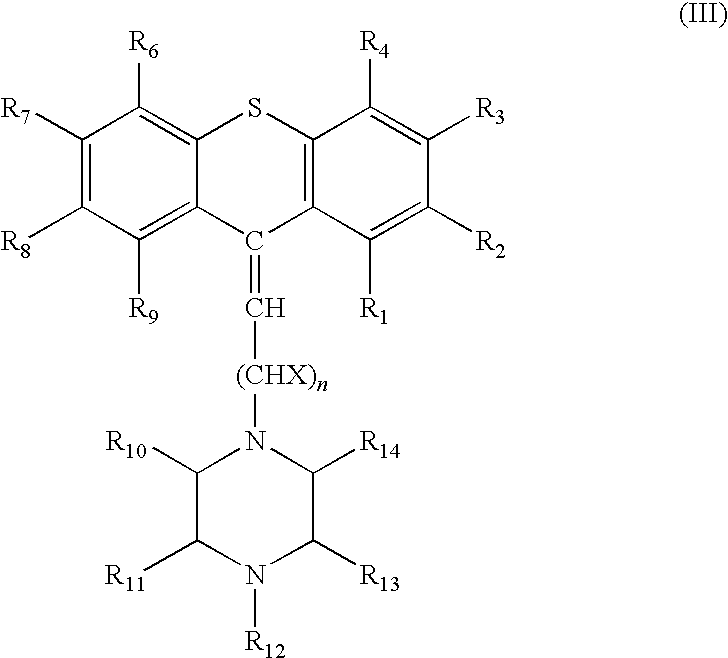
Figure 3
Abstract
Description
TECHNICAL FIELD
[0001] The present invention is directed to the use of anti-infective agents, in particular thioxanthene derivatives and phenothiazine derivatives, for treatment of infectious diseases.BACKGROUND
[0002] Resistance to chemotherapy is a common clinical problem in patients with infectious diseases. During treatment of infections the drug targets of prokaryotic or eukaryotic microorganisms cells are often found to be refractory to a variety of drugs that have different structures and functions. This phenomenon has been termed multidrug resistance (MDR).
[0003] The incidence of the multiple antimicrobial resistance of bacteria which cause infections in hospitals / intensive care units is increasing, and finding microorganisms insensitive to more than 10 different antibiotics is not unusual. Examples of such resistant bacteria include methicillin-resistant and methicillin-vancomycin-resistant Staphylococcus aureus; vancomycin-resistant enterococci, such as Enterococcus faecalis an...
Examples
example 1
Effect of Dealkylated or Demethylated Phenothiazines and Thioxanthenes on a Clinically Relevant Isolate
[0142]A clinically relevant isolate of Staphylococcus epidermidis was cultured and assayed as described above for susceptibility towards the compounds listed in table 1. The results are shown in Table 1.
TABLE 1Effect of dealkylated or demethylated phenothiazines and thioxantheneson a multiresistant clinical isolate of Staphylococcus epidermidis.Compound GroupMIC ug / mlN-desmethyl-chlorpromazinePhenothiazine16N-deshydroxy-ethyl-Fluphenazine (Phenothiazine)16Desmethyl-perphenazin (Phenothiazine)16N-desmethyl-Chlorprothixen (Phenothiazine)16N-dealk-trans-clopenthixol (Thixoanthene)0.5N-dealkyl-trans-flupenthixol (Thioxanthene)1.0N-dealkyl-cis-flupenthixol (Thioxanthene)16N-dealkyl-cis-clopenthixol (Thioxanthene)16
example 2
Antibacterial Effect of Demethylated / Dealkylated Phenothiazine or Thioxanthene Compounds on Clinical Isolates of Fungi
[0143]The antibacterial effect of demethylated / dealkylated phenothiazine or thioxanthene compounds were studied by growth inhibition studies exposing cells to 0-32 μg / ml of drug. Each experiment was repeated in triplicate. MIC values represent the mean values of two separate triplicate experiments.
[0144]4 clinical isolates of Candida sp. (including 3 fluconazole resistant isolates) were subcultured for 24 h on Sabouraud glucose agar before susceptibility testing. Broth microdilution tests were performed according to NCCLS document M27-A (Ref: National Committee for Clinical Laboratory Standards. (1997). Reference Method for Broth Dilution Antifungal Susceptibility Testing of Yeasts: Approved Standard M27-A. NCCLS, Wayne, Pa.). Microtitre plates were read spectrophotometrically at 530 nm, after mixing the wells by pipetting to resuspend yeast sediments. In this experi...
example 3
Antibacterial Effect of N-dealkyl-clopenthixol Against a Broad Spectrum of Bacterial Species
[0146]A broad spectrum of bacteria were cultured and assayed as described above for susceptibility towards N-dealkyl-clopenthixol. The results are shown in Table 3 below.
TABLE 3aAntibacterial effect of N-dealkyl-clopenthixolTrans-TranscompoundcompoundCis-MIC ug / mlIC90compoundNo ofNo of resistant(mean)ug / mlMIC ug / mlMicroorganismstrainsstrainsrange(mean)(mean)Staphylococci,302010.516Micrococci.(20 MRSA)0.5-2Including MRSAStreptococci302010.5160.5-2Gram negative252022>16sp.0.5-2
TABLE 3bAntibacterial effect of N-dealkyl-trans flupenthixolTrans-compoundNo of resistantMIC ug / mlMicroorganismNo of strainsstrains(median)Staphylococci,30201.5Micrococci.(20 MRSA)Including MRSAStreptococci30201.5Gram negative25202sp.
[0147]As seen, N-dealkyl-trans flupenthixol exhibits a potent antimicrobial effect against multiresistant bacterial isolates.
[0148]The results in Table 3a and 3b show that the tested compound...