
Resin foam sheet and resin foam member
a technology of resin foam and resin foam, which is applied in the direction of film/foil adhesives, layered products, transportation and packaging, etc., can solve the problems of low surface skin expansion, disadvantageous poor flexibility, and inferior bump conformability, and achieve satisfactory stab wounding, low apparent density, and thin and flexible
Patent Information
- Authority / Receiving Office
- US · United States
- Patent Type
- Applications(United States)
- Current Assignee / Owner
- Publication Date
- 2013-08-29
- Estimated Expiration
- Not applicable · inactive patent
Smart Images
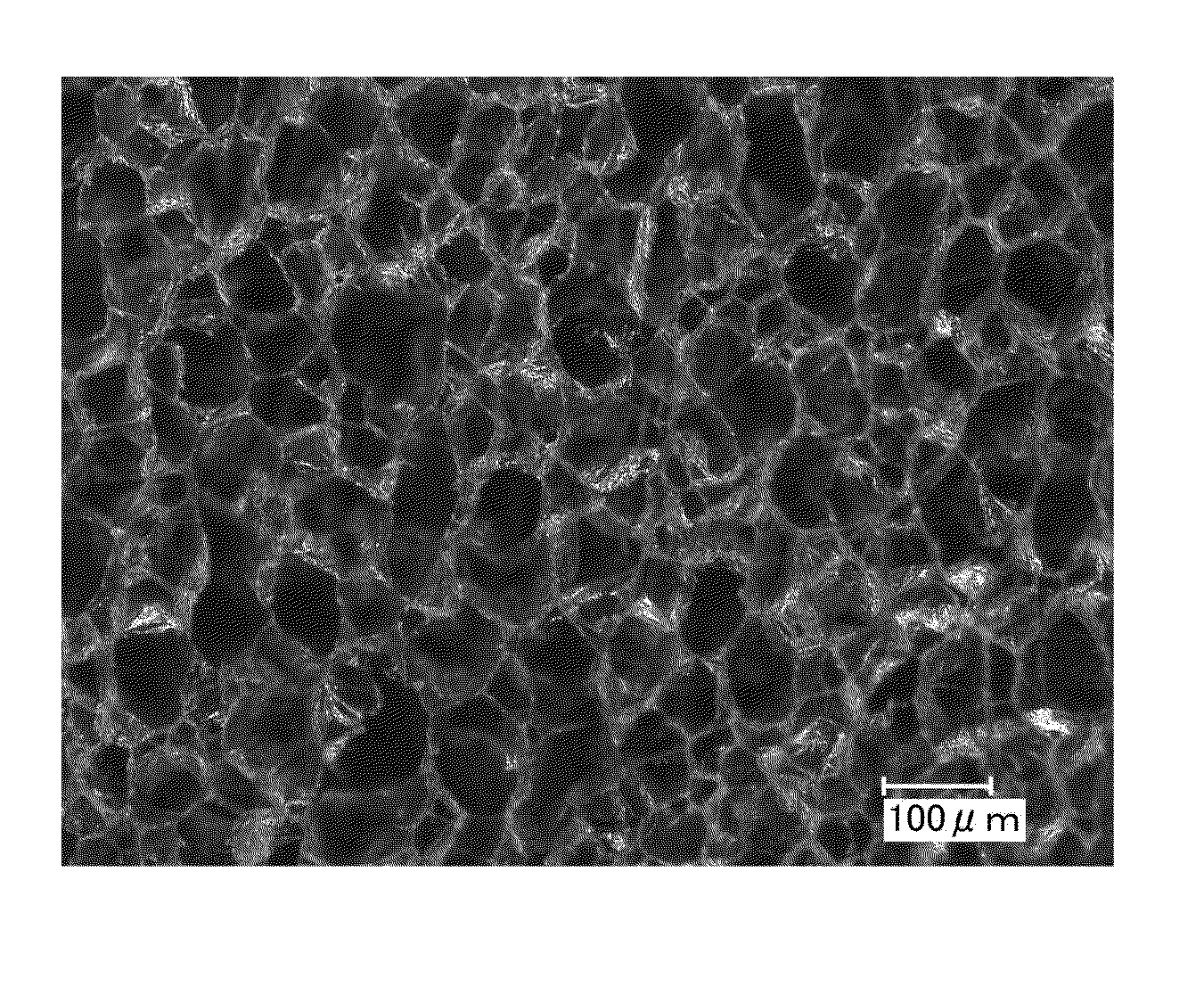
Figure 1 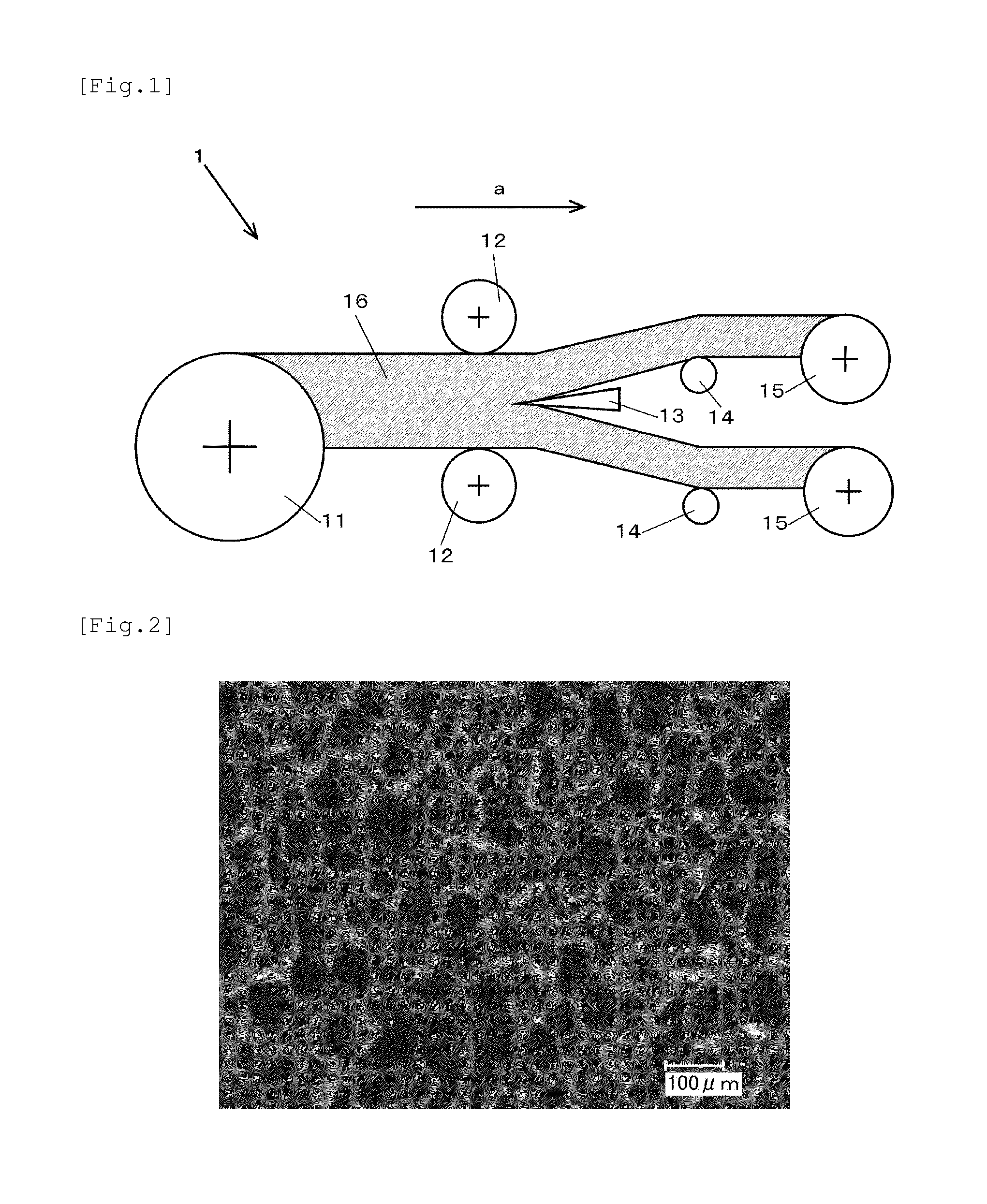
Figure 2 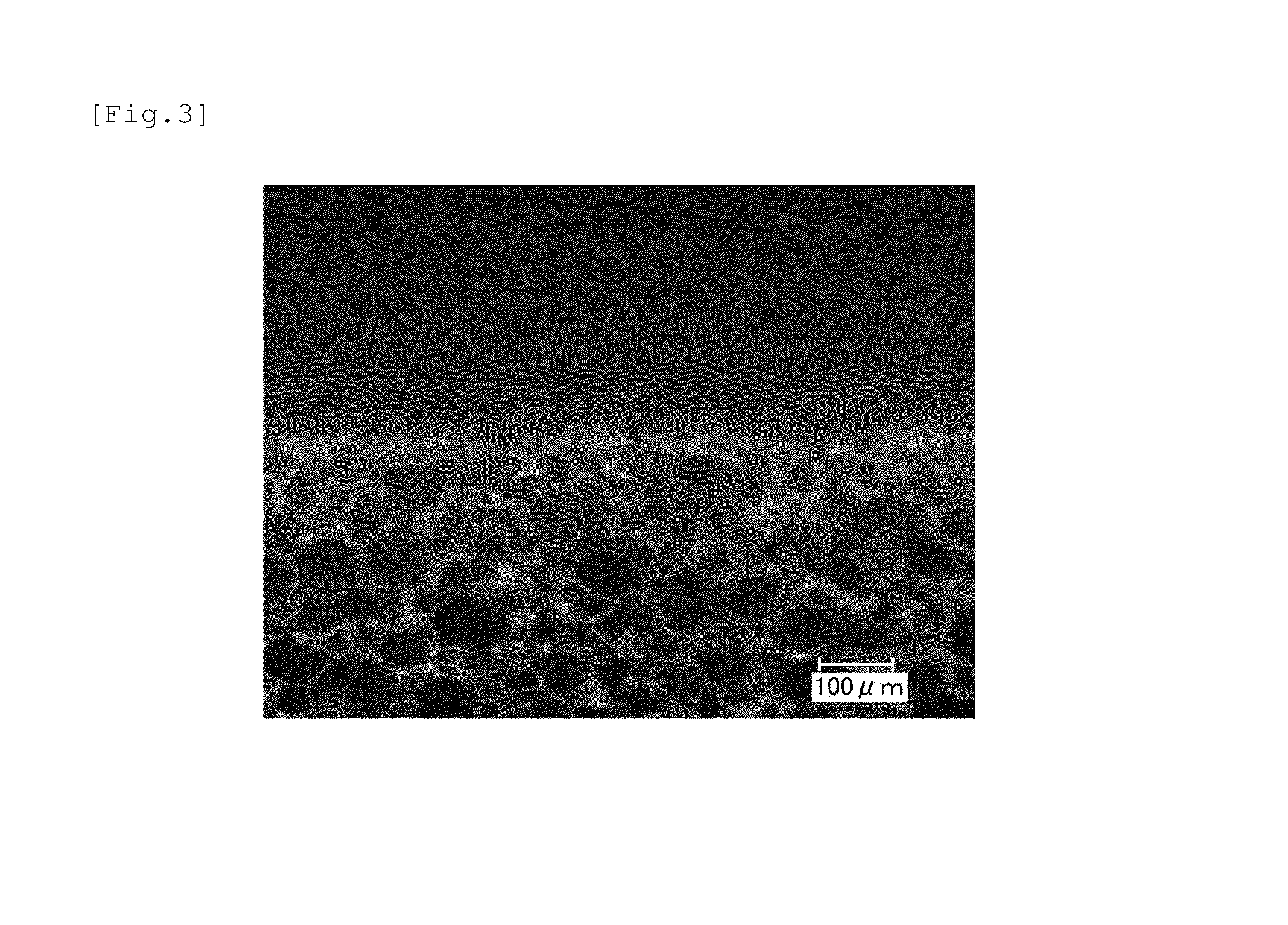
Figure 3
Abstract
Description
TECHNICAL FIELD
[0001] The present invention relates to a resin foam sheet and a resin foam member including the resin foam sheet.BACKGROUND ART
[0002] Resin foams are used typically as cushioning materials, heat insulating materials, and packaging materials upon transportation; building materials; as well as sealants and cushioning materials in electronic appliances. With decreasing sizes of electronic appliances and with increasing sizes of their screens, resin foams for use as sealants and cushioning materials in such electronic appliances have smaller and smaller areas and should have such flexibility as to exhibit sufficient sealability and shock-absorbing properties even having small areas. The resin foams should also have smaller thicknesses because the electronic appliances have smaller and smaller thicknesses.
[0003] Exemplary thin resin foams include a foam sheet obtained by compressing or stretching during or after foaming or by coating after foaming (see, for example, Japanese...
Examples
example 1
[0128]In a twin-screw kneader (The Japan Steel Works, LTD. (JSW)) at a temperature of 200° C. were kneaded 45 parts by weight of a polypropylene [trade name “EA9,” Japan Polypropylene Corporation, melt flow rate (MFR): 0.5 g / 10 min], 45 parts by weight of a mixture [melt flow rate (MFR): 6 g / 10 min, JIS-A hardness: 79°] including a polyolefinic elastomer and a softener, 10 parts by weight of magnesium hydroxide, 10 parts by weight of carbon (trade name “Asahi #35,” Asahi Carbon Co., Ltd.), and 1.5 parts by weight of stearic monoglyceride. The kneadate was extruded into strands, cooled with water, and formed into pellets. The pellets were charged into a single-screw extruder (The Japan Steel Works, LTD.), into which carbon dioxide gas was injected at an ambient temperature of 220° C. and a pressure of 19 MPa, where the pressure became 16 MPa after injection. The carbon dioxide gas was injected in an amount of 5.9 percent by weight relative to the total amount of the pellets. After be...
example 2
[0131]In a twin-screw kneader (The Japan Steel Works, LTD. (JSW)) at a temperature of 200° C. were kneaded 40 parts by weight of a polypropylene [trade name “EA9,” Japan Polypropylene Corporation, melt flow rate (MFR): 0.5 g / 10 min], 55 parts by weight of a mixture [melt flow rate (MFR): 2 g / 10 min, JIS-A hardness: 69°] including a dynamically-cross-linked polyolefinic elastomer and a softener, 10 parts by weight of magnesium hydroxide, 10 parts by weight of carbon (trade name “Asahi #35,” Asahi Carbon Co., Ltd.), and 0.8 part by weight of stearic monoglyceride. The kneadate was extruded into strands, cooled with water, and formed into pellets. The pellets were charged into a single-screw extruder (The Japan Steel Works, LTD.), into which carbon dioxide gas was injected at an ambient temperature of 220° C. and a pressure of 19 MPa, where the pressure became 16 MPa after injection. The carbon dioxide gas was injected in an amount of 4.8 percent by weight relative to the total amount ...
example 3
[0134]In a twin-screw kneader (The Japan Steel Works, LTD. (JSW)) at a temperature of 200° C. were kneaded 40 parts by weight of a polypropylene [trade name “EA9,” Japan Polypropylene Corporation, melt flow rate (MFR): 0.5 g / 10 min], 40 parts by weight of a mixture [melt flow rate (MFR): 2 g / 10 min, JIS-A hardness: 69°] including a dynamically-cross-linked polyolefinic elastomer and a softener, 10 parts by weight of magnesium hydroxide, 10 parts by weight of carbon (trade name “Asahi #35,” Asahi Carbon Co., Ltd.), and 1.5 parts by weight of stearic monoglyceride. The kneadate was extruded into strands, cooled with water, and formed into pellets. The pellets were charged into a single-screw extruder (The Japan Steel Works, LTD.), into which carbon dioxide gas was injected at an ambient temperature of 220° C. and a pressure of 19 MPa, where the pressure became 16 MPa after injection. The carbon dioxide gas was injected in an amount of 4.6 percent by weight relative to the total amount...