
Magnetic nanoparticle cellulose material
a technology of cellulose and nanoparticles, applied in the field of magnetic nanoparticle cellulose materials, can solve the problems of uneven distribution of nanoparticle systems, severe agglomeration and aggregates of nanoparticles, and poor representation of micron-sized filler materials in polymers, and achieve high mechanical performance nanoparticles, low apparent density, and reproducibility. high
Patent Information
- Authority / Receiving Office
- US · United States
- Patent Type
- Applications(United States)
- Current Assignee / Owner
- Publication Date
- 2010-08-12
- Estimated Expiration
- Not applicable · inactive patent
Smart Images
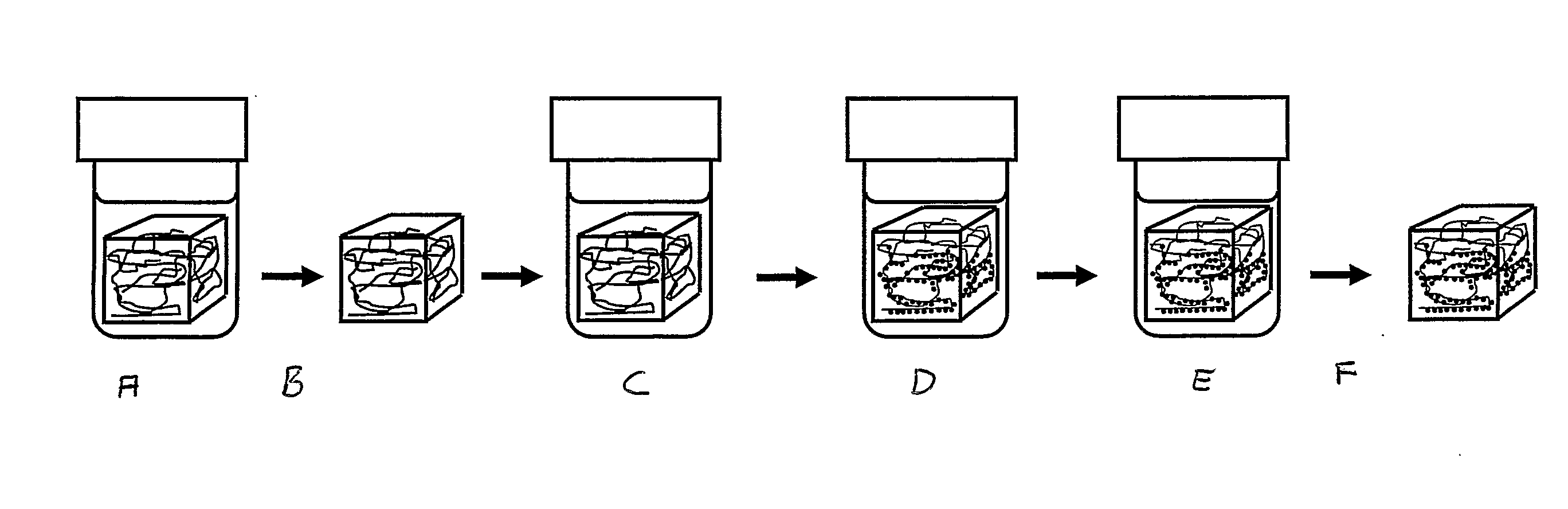
Figure 1 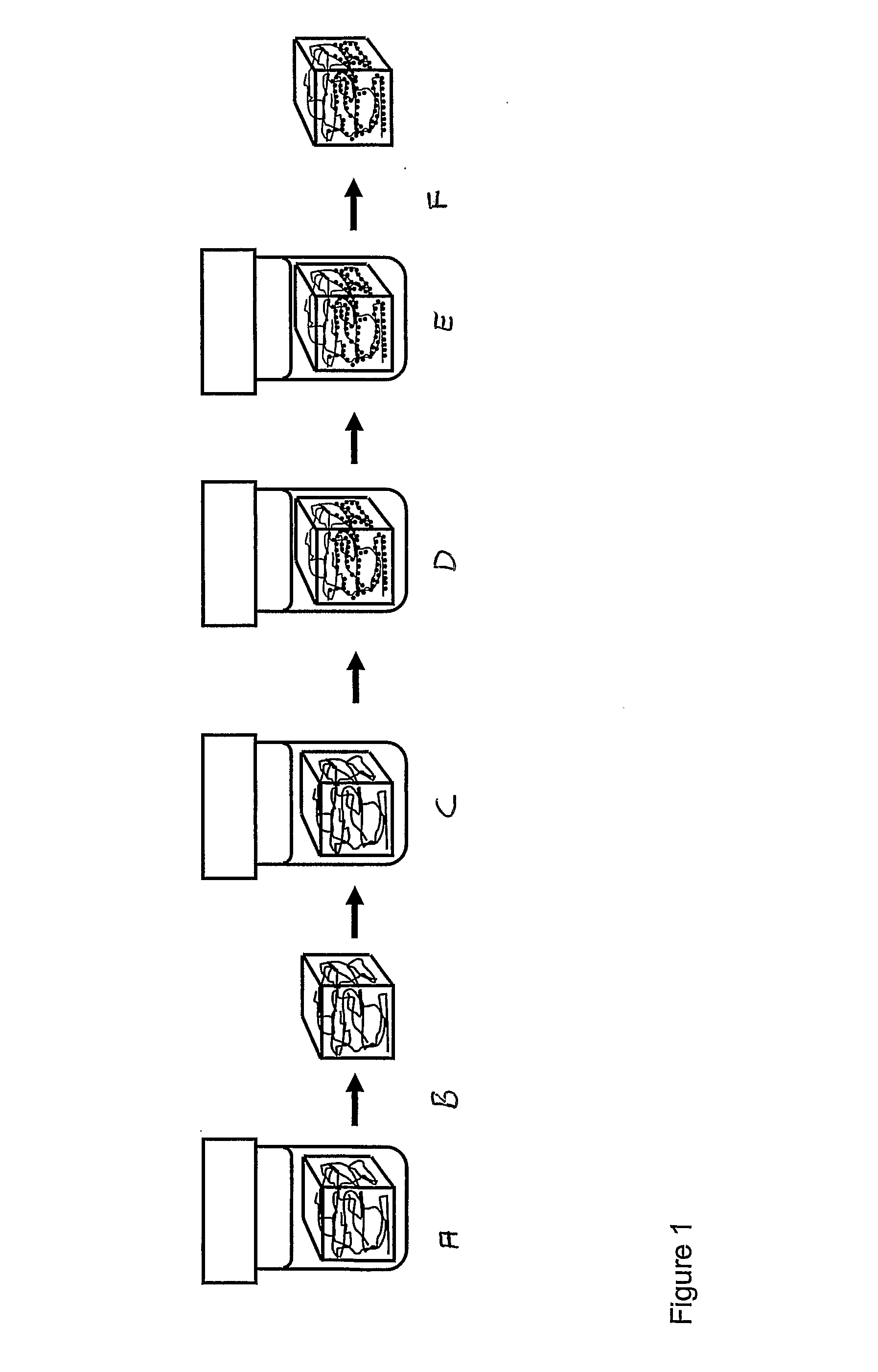
Figure 2 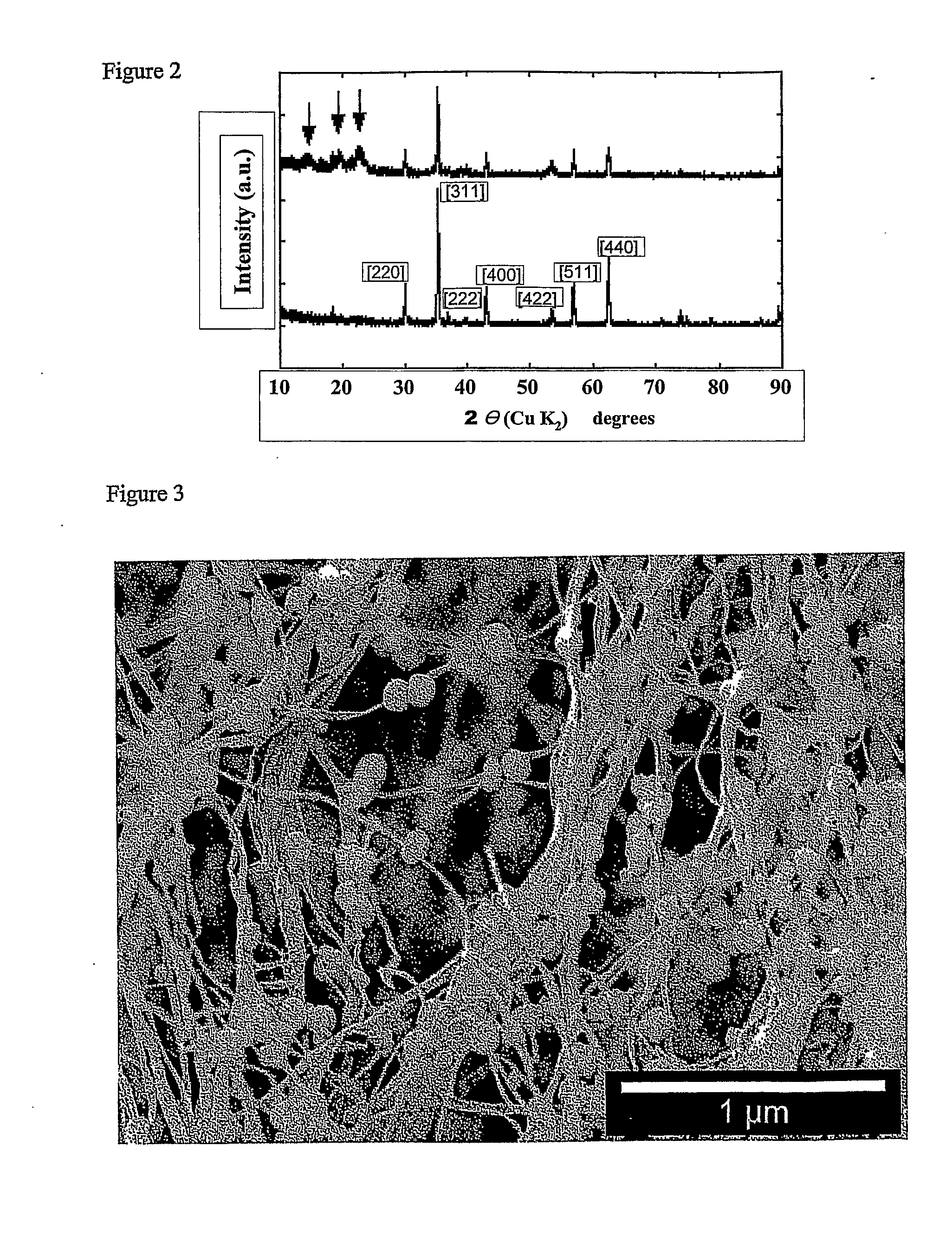
Figure 3
Abstract
Description
BACKGROUND OF THE INVENTION
[0001] Magnetic nanoparticles with large surface to bulk ratio is a growing area of interest. Considering the potentially large area of application of magnetic nanoparticles, as filler materials of various polymer materials, it can easily be understood that their relatively poor representation in comparison to micron-sized filler materials in polymers is an effect of the difficulties related to the processing of high-surface area nanoparticles. The explanation mainly lies in the fact that large surface areas also brings problems in achieving evenly distributed nanoparticle systems due to the favoured particle-particle interaction in comparison to particle-polymer / liquid interactions. The result is often severe agglomeration and aggregates of nanoparticles. The agglomerates in turn affect many macroscopic properties, such as mechanical, optical and magnetic etc. since these properties on a macroscopic scale are affected by the degree of close interaction at ...
Examples
example 1
CoFe2O4
[0081]Precipitation of cobalt ferrite to form nanocrystals on the nanofibres of the bacterial cellulose.[0082]1. A piece of gel-like bacterial cellulose (0.5×0.5×1.5 cm) is boiled with 10 vol % NaOH solution (3 h) and sub sequentially washed with running distilled water (6 h) before immersion in liquid nitrogen followed by freeze-drying during a period of 12 hours.[0083]2. The dry cellulose piece is swollen in freshly prepared MilliQ-water solution of metal salt consisting of CoCl2×6H2O (0.033 M) and FeSO4×7H2O (0.66 M), i.e. stoichiometric proportions of Co:Fe (1:2).[0084]3. The solutions with the immersed pieces of cellulose is heated to 90° C. and kept at 90° C. for 3 h in order to thermally force the precipitation of the iron / cobalt salt solution to the related hydroxide / oxide structures of the cobalt / iron ions inside the matrix network of the bacterial cellulose.[0085]4. The piece is transferred into a 90° C. solution of NaOH (1.32 M) with KNO3 (0.15 M) ; ([Fe2+]* / [NO3−...
example 2
CoFe2O4
[0090]1. A piece of gel-like bacterial cellulose (0.5×0.5×1.5 cm) is boiled with 10 vol % NaOH solution (3 h) and sub sequentially washed with running distilled water (6 h) before immersion in liquid nitrogen followed by freeze-drying during a period of 12 hours.[0091]2. The dry cellulose piece is swollen in freshly prepared MilliQ-water solution of metal salt consisting of CoCl2×6H2O (0.055 M) and FeSO4×7H2O (0.11 M), i.e. stoichiometric proportions of Co:Fe (1:2).[0092]3. The solutions with the immersed pieces of cellulose is heated to 90° C. and kept at 90° C. for 3 h in order to thermally force the precipitation of the iron / cobalt salt solution to the related hydroxide / oxide structures of the cobalt / iron ions inside the matrix network of the bacterial cellulose.[0093]4. The piece is transferred into a 90° C. solution of NaOH (1.32 M) with KNO3 (0.25 M); ([Fe2+]* / [NO3−]=0.44). The piece is kept in this alkaline solution, which is maintained at 90° C. for 6 h.[0094]5. The...
example 3
CoFe2O4
[0098]1. A piece of gel-like bacterial cellulose (0.5×0.5×1.5 cm) is boiled with 10 vol % NaOH solution (3 h) and sub sequentially washed with running distilled water (6 h) before immersion in liquid nitrogen followed by freeze-drying during a period of 12 hours.[0099]2. The dry cellulose piece is swollen in freshly prepared MilliQ-water solution of metal salt (saturated) prepared by dissolving CoCl2×6H2O (0.33 M) and FeSO4×7H2O (0.66 M), i.e. stoichiometric proportions of Co:Fe (1:2).[0100]3. The solutions with the immersed pieces of cellulose is heated to 90° C. and kept at 90° C. for 3 h in order to thermally force the precipitation of the iron / cobalt salt solution to the related hydroxide / oxide structures of the cobalt / iron ions inside the matrix network of the bacterial cellulose.[0101]4. The piece is transferred into a 90° C. solution of NaOH (1.32 M) with KNO3 (1.5 M); ([Fe2+]* / [NO3−]=0.44). The piece is kept in the alkaline solution at 90° C. for 6 h.[0102]5. The pie...