
Method for producing polyguanidines
a polyguanidine and polyguanidine technology, applied in the direction of antibacterial agents, paints with biocides, drug compositions, etc., can solve the problems of non-negligible toxicity of aminoguanidine compounds, toxicity that cannot be completely satisfied regarding antimicrobial effectiveness or toxicity, etc., to achieve clear biocidal activity, better antimicrobial activity, and even lower toxicity
Patent Information
- Authority / Receiving Office
- US · United States
- Patent Type
- Applications(United States)
- Current Assignee / Owner
- Publication Date
- 2017-08-10
Smart Images
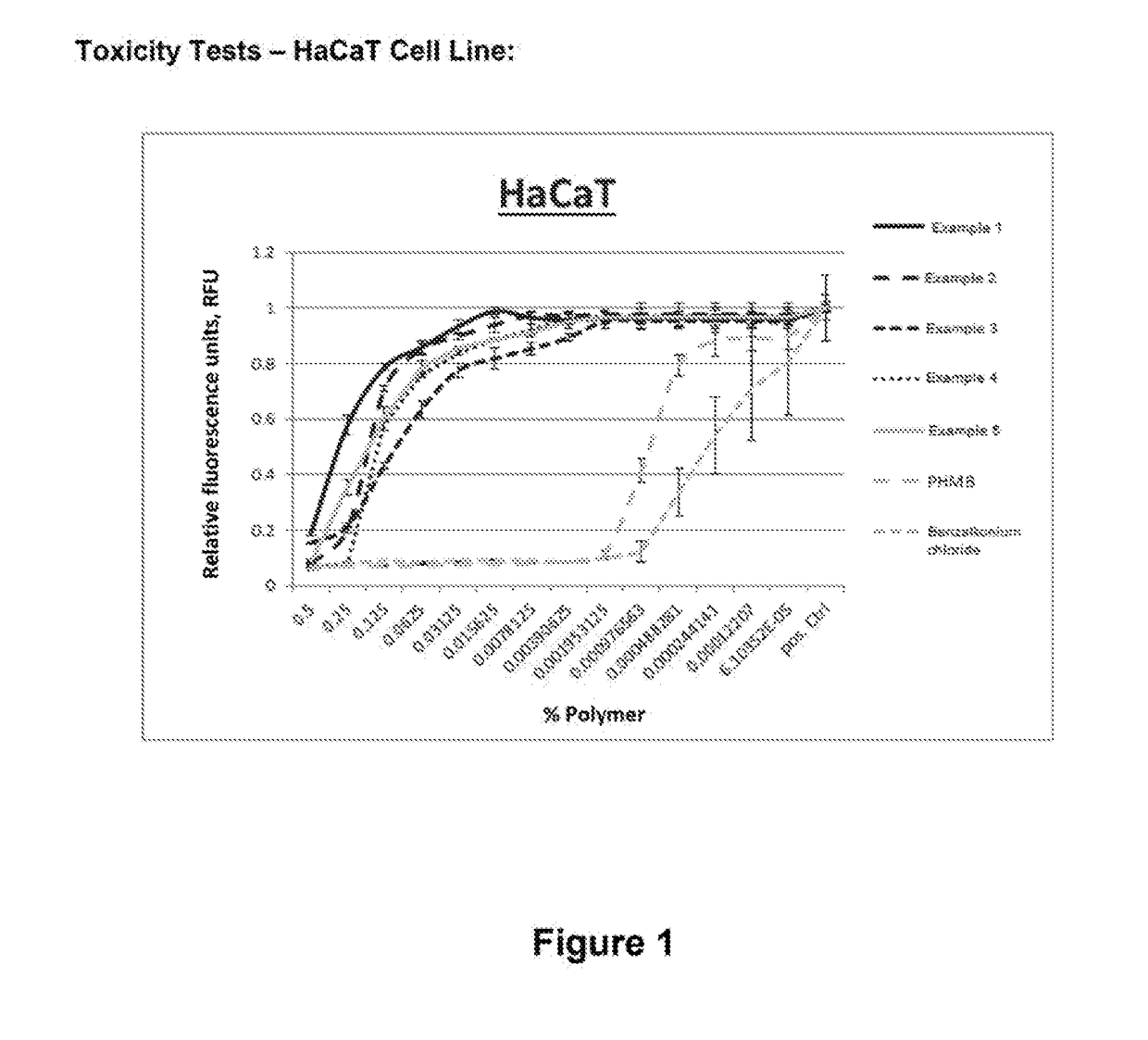
Figure 1 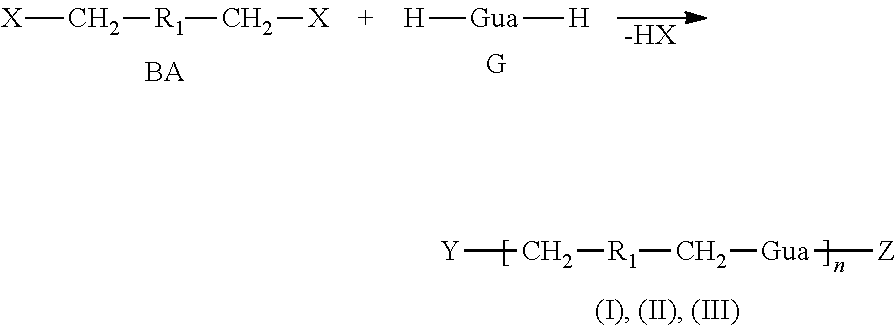
Figure 2 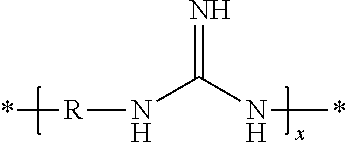
Figure 3
Abstract
Description
[0001] The present invention relates to a new method for producing polyguanidines, polycondensation products produced thereby, and their use as antimicrobial or antiinfective agents.STATE OF THE ART
[0002] Polyguanidines of the following formula and various derivatives thereof have been known for a long time.
[0003] Already in 1943, patent literature described in U.S. Pat. No. 2,325,586 several production methods for various polyguanidines by polycondensation of i) guanidine or salts thereof, ii) cyano halides, iii) dicyanamides, or iv) isocyanide dihalides with diamines, or v) two dicyandiamides with each other (resulting in cyano-substituted polyguanidines), as well as the use of polyguanidines thus produced as coloring aids:
[0004] Already at that time, the diamines disclosed for the use in the reactions i) to iv) were alkylene and phenylene diamines as well as oxyalkylene or polyether diamines, later known as Jeffamine®.
[0005] Decades later, such polyguanidines have proven to be excelle...
Examples
example 1
[0060]Preparation of Polyaminoguanidine (1)
[0061]α,α′-Dichloro-p-xylene (880 mg, 5.03 mmol) and 1.95 equivalents of aminoguanidine hydrochloride (1083 mg, 9.80 mmol) were heated with stirring to 160° C. for 3 h in an open reaction vessel, followed by heating to 180° C. for 2 h. After the reaction mixture had cooled to below 80° C., the tenfold amount of water was added to the reaction product, and after thoroughly mixing by means of stirring or ultrasound treatment, a clear, light yellow solution with traces of solid contents was obtained. It was filtered through a 0.2 μm PFTE membrane and then evaporated to obtain polyguanidine (1) as a yellow, amorphous solid.
[0062]For analysis, a sample was dissolved in a tenfold amount of D2O. When recording the 1H and the 13C NMR spectra, DSS (4,4-dimethyl-4-silapentane-1-sulfonic acid) was added for reference as an internal standard:
[0063]1H NMR (D2O), δ (ppm): 3.72-3.91 (ad, CH2A—N(Gua)-CH2A, JA,B=12.4 Hz, CH2A chain), 3.934.05 (as, CH2—NH-Gu...
example 2
Preparation of Polyaminoguanidine (2)
[0067]
[0068]In analogy to Example 1, polyguanidine (2) was prepared from α,α′-dichloro-m-xylene and aminoguanidine hydrochloride, yielding a yellowish, amorphous, completely water-soluble solid.
[0069]1H NMR (D2O), δ (ppm): 3.73-3.92 (ad, CH2A—N(Gua)-CH2A, JA,B=12.7 Hz, CH2A chain), 3.94-4.05 (as, CH2—NH-Gua, CH2 terminal), 4.10-4.23 (ad, CH2B—N(Gua)-CH2B, JA,B=12.7 Hz, CH2B chain), 4.29-4.38 (m, CH2A α-Gua), 4.45-4.53 (m, CH2B α-Gua), 7.23-7.85 (m, ═CH Ar), 8.10 (as, N═CH).
[0070]13C NMR (D2O), δ (ppm): 46.36, 46.66, 47.01 (CH2 α-Gua), 57.01, 57.04, 57.12, 57.14 (CH2 terminal), 63.94 (CH2—N(Gua)-CH2 chain), 129.63, 129.75, 130.09, 130.20, 130.83, 131.38, 131.44, 131.53, 131.57, 131.67, 131.82, 131.89, 132.18, 132.34, 132.73, 133.52, 134.23, 134.52, 135.29 (CH Ar), 135.72, 135.81, 136.12, 138.59, 138.69, 138.73, 139.13, 139.77, 139.90, 140.30 (Cq Ar), 151.24 (N═CH), 157.67, 159.78, 159.81, 160.86 (Cq Gua).
[0071]The NMR signals in the ranges of 3.73...
example 3
Preparation of Polyamino Guanidine (3)
[0073]
[0074]In analogy to Example 2, polyguanidine (3) was prepared from 132 mg (0.5 mmol) of α,α′-dibromo-m-xylene (instead of the dichloro derivative) as well as 1.75 equivalents of aminoguanidine hydrochloride (97 mg, 0.88 mmol), yielding a brownish, amorphous, water-soluble solid.
[0075]1H NMR (D2O), δ (ppm): 3.63-3.95 (m, CH2A—N(Gua)-CH2A, CH2A chain), 3.95-4.08 (as, CH2—NH-Gua, CH2 terminal), 4.13-4.24 (ad, CH2B—N(Gua)-CH2B, JA,B=12.5 Hz, CH2B chain), 4.31-4.40 (m, CH2A α-Gua), 4.47-4.55 (m, CH2B α-Gua), 7.17-7.86 (m, ═CH Ar), 8.12 (as, N═CH).
[0076]13C NMR (D2O), δ (ppm): 46.38, 46.64, 46.99 (CH2 α-Gua), 56.98, 57.11, 57.48 (CH2 terminal), 63.90 (CH2—N(Gua)-CH2 chain), 128.58, 129.08, 129.64, 129.76, 130.05, 130.20, 130.81, 130.98, 131.35, 131.41, 131.51, 131.71, 131, 80, 131.87, 132.16, 132.33, 132.69, 133.49, 134.21, 134.51, 135.29 (CH Ar), 135.66, 135.76, 136.06, 138.68, 138.98, 139.07, 139.25, 139.72, 139.85, 140.25 (Cq Ar), 150.46, 151...