
System and method for active reduction of a predefined audio acoustic noise by using synchronization signals
a technology of synchronization signal and active reduction, which is applied in the field of active reduction of audio acoustic noise, can solve the problems of high construction requirements, high cost, and disconnection of users from the surroundings, and achieve the effect of maximizing improving the attenuation of undesired audio acoustic nois
Patent Information
- Authority / Receiving Office
- US · United States
- Patent Type
- Applications(United States)
- Current Assignee / Owner
- Publication Date
- 2018-06-07
Smart Images
Figure 1 
Figure 2 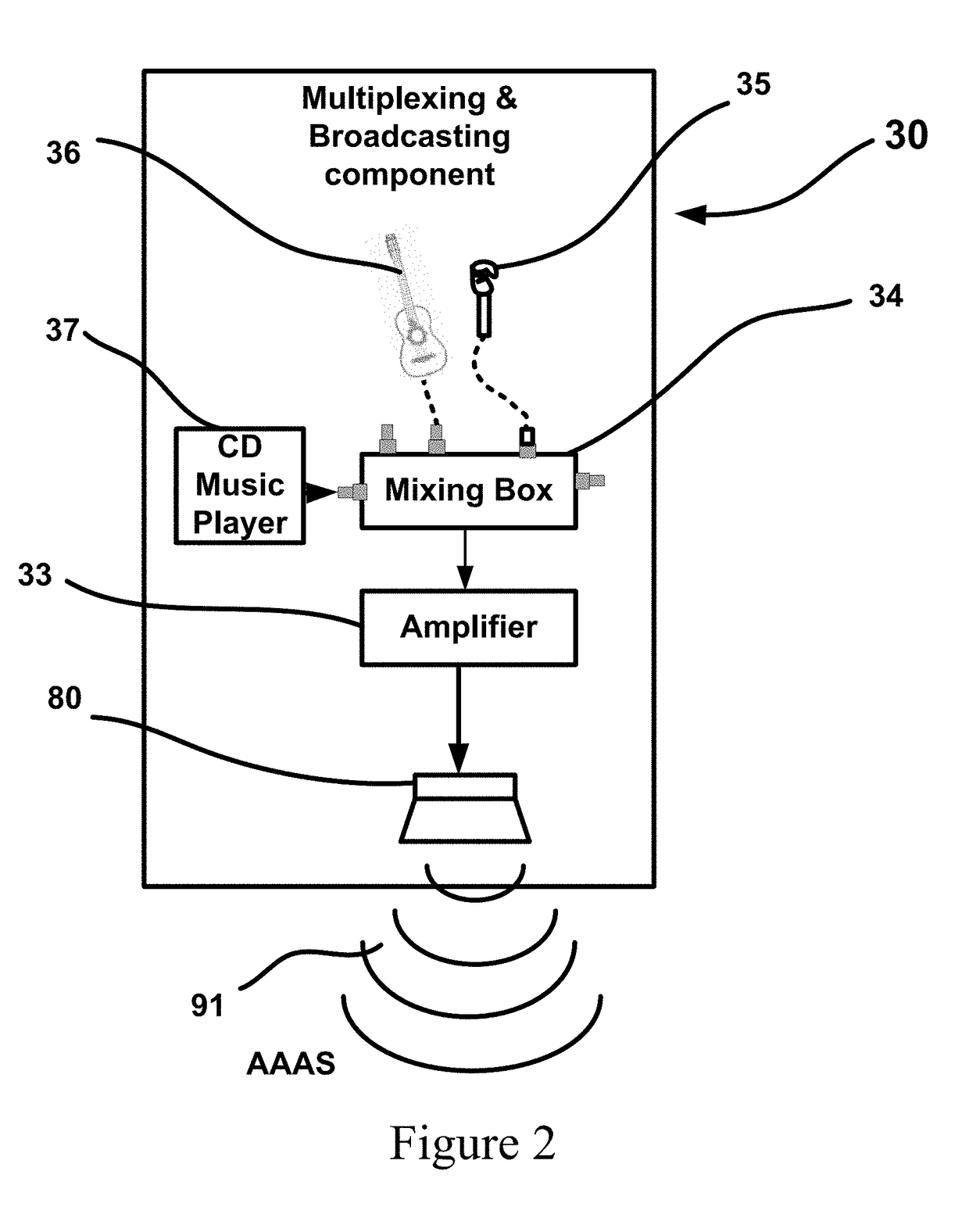
Figure 3
Abstract
Description
FIELD OF THE INVENTION
[0001] A system and device for active reduction of audio acoustic noise.BACKGROUND OF THE INVENTION
[0002] In order to ease the understanding of the descriptions and figures in the presentation of the present invention, an index of the used abbreviations is hereby given:
[0003] AAAS Ambient Audio Acoustic Signal
[0004] Ablock Acoustical channel's block
[0005] ADC (A / D) Analog to Digital Converter
[0006] ANC Active noise cancellation
[0007] ASYNC Acoustical SYNC
[0008] DAC (D / A) Digital to Analog Converter
[0009] DSP Digital Signal Processor
[0010] EA Electrical Audio Acoustic Signal
[0011] Eblock Electrical channel's block
[0012] ESYNC Electrical SYNC
[0013] FIR Finite Impulse Response
[0014] FxLMS Filter X LMS
[0015] GSM Generated Sequence Mark
[0016] GTT Generated Time Tag
[0017] Imic Inside Microphone
[0018] LMS Least Mean Square
[0019] QAAS Electrical Audio Acoustic Signal
[0020] QASYNC Quiet Acoustical SYNC
[0021] QEAAS Quiet Electrical Audio Acoustic Signal
[0022] QESYNC Quiet Electrical SYNC[0023...
Examples
Embodiment Construction
[0095]FIG. 5 illustrates schematically the major components of a system and method (10) for active reduction of an audio acoustic noise signal of the present invention and their employment mode relative to each other. The figure illustrates the three major components of system: 1) an audio Multiplexing and Broadcasting component (30); 2) synchronization and transmitting component (40); and 3) a quieting component (50). A detailed explanation of the three major components of the system (10) is given in FIG. 6. The structure and usage of the synchronization signal, referred to as “SYNC signal”, is given further on in the text, as well as analysis of the SYNC employment algorithm.
[0096]The method and system of the present invention is based on generating antiphase signal which is synchronized to the predefined noise, by using dedicated synchronization signals, referred in the present text as “SYNC”. The SYNC signals are electrically generated (38), and then acoustically emitted through...