
Curable resin composition, composition for molding, resin molded article, and method for producing resin molded article
a technology of curable resin and composition, which is applied in the field of curable resin composition, composition for molding, resin molded article, and method for producing resin molded article, can solve the problems of easy cracking, easy cracking of molded article, and hardness of shape memory resin at low temperature, and achieve excellent shape restorability, high strength, and high elongation at break
Patent Information
- Authority / Receiving Office
- US · United States
- Patent Type
- Applications(United States)
- Current Assignee / Owner
- Publication Date
- 2018-08-23
- Estimated Expiration
- Not applicable · inactive patent
Smart Images
Figure 1 
Figure 2 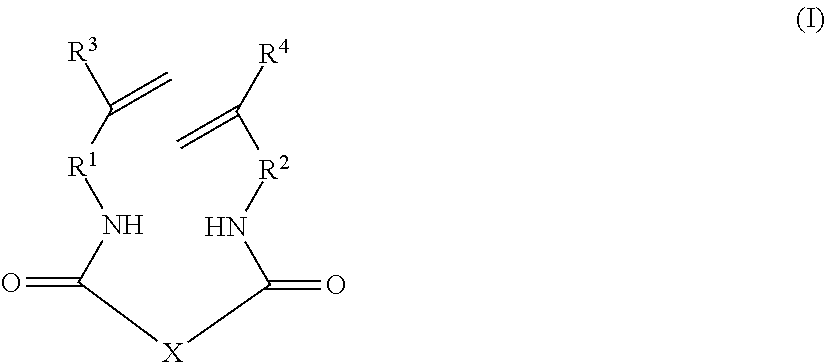
Figure 3
Abstract
Description
TECHNICAL FIELD
[0001] The present invention relates to a curable resin composition, a composition for molding, a resin molded article, and a method for producing a resin molded article.BACKGROUND ART
[0002] In connection with resin molded articles, there is a demand for a material having excellent mechanical characteristics such as hardness that does not easily allow deformation, and strength and flexibility that do not lead to breakage even if the material is deformed. One of the methods for increasing the strength of a resin molded article is a method of forming a three-dimensional crosslinked structure. However, even though hardness is increased when this method is applied, the molded article tends to become brittle and crack easily.
[0003] As a method of increasing strength and flexibility, for example, a method of dispersing an elastomer component that is easily deformable, such as an acrylic rubber, in the resin and thereby relieving stress is generally known. Furthermore, it is al...
Examples
synthesis example 1
1,2-bis(2-acryloyloxyethylcarbamoyloxy)cyclohexane (BACH)
[0141]Trans-1,2-cyclohexanediol (2.32 g, 20.0 mmol) was introduced into a 100-mL double-necked pear-shaped flask, and the interior of the flask was purged with nitrogen. Dichloromethane (40 mL) and dibutyltin dilaurate (11.8 μL, 0.10 mol %: 0.020 mmol) were introduced into the flask. To the reaction liquid in the flask, a dichloromethane (4 mL) solution of 2-acryloyloxyethyl isocyanate (5.93 g, 42.0 mmol) was added dropwise from a dropping funnel, and the reaction liquid was stirred for 24 hours at 30° C. to cause a reaction to proceed. After completion of the reaction, diethyl ether was added to the reaction liquid, and the mixture was washed with saturated brine. The organic layer was dried over anhydrous magnesium sulfate, and then the solvent was distilled off under reduced pressure. A solution containing the intended product was isolated from the residue by silica gel chromatography (developing solvent: chloroform), and t...
synthesis example 2
G Oligomer 1
[0142]A polyethylene glycol (PEG1500, 750 mg, 0.500 mmol, number average molecular weight 1,500) and a polypropylene glycol (PPG4000, 2,000 mg, 0.500 mmol, number average molecular weight 4,000) were added to a 20-mL pear-shaped flask, and then the interior of the flask was purged with nitrogen. The content was melted at 115° C. 4,4′-Dicyclohexylmethane diisocyanate (262 mg, 1.00 mmol) was added to the molten liquid, and the molten liquid was stirred for 24 hours at 115° C. in a nitrogen atmosphere. Thus, PEG-PPG Oligomer 1 (second polymer containing polyoxyethylene chains and polyoxypropylene chains) was obtained.
[0143]The weight average molecular weight (Mw) of resulting Oligomer 1 was 9,300, and the weight average molecular weight / number average molecular weight (Mw / Mn) of Oligomer 1 was 1.65.
synthesis example 3
G Oligomer 2
[0144]A polyethylene glycol (PEG1500, 750 mg, 0.500 mmol, number average molecular weight 1,500) and a polypropylene glycol (PPG4000, 2,000 mg, 0.500 mmol, number average molecular weight 4,000) were added to a 20-mL pear-shaped flask, and then the interior of the flask was purged with nitrogen. The content was melted at 115° C. 4,4′-Dicyclohexylmethane diisocyanate (262 mg, 1.00 mmol) and dibutyltin laurate (11.8 μL, 0.10 mol %: 0.020 mmol) were added to the molten liquid, and the molten liquid was stirred for 24 hours at 115° C. in a nitrogen atmosphere. Thus, PEG-PPG Oligomer 2 (second polymer having polyoxyethylene chains and polyoxypropylene chains) was obtained.
[0145]The weight average molecular weight (Mw) of resulting Oligomer 2 was 50,000, and the weight average molecular weight / number average molecular weight (Mw / Mn) of Oligomer 2 was 1.95.
2. Measurement of Molecular Weight
[0146]A GPC chromatograph of an oligomer was obtained by using DMF (N,N-dimethylformamide...