
Synthetic composition for microbiota modulation
Patent Information
- Authority / Receiving Office
- US · United States
- Current Assignee / Owner
- Publication Date
- 2020-05-28
Smart Images
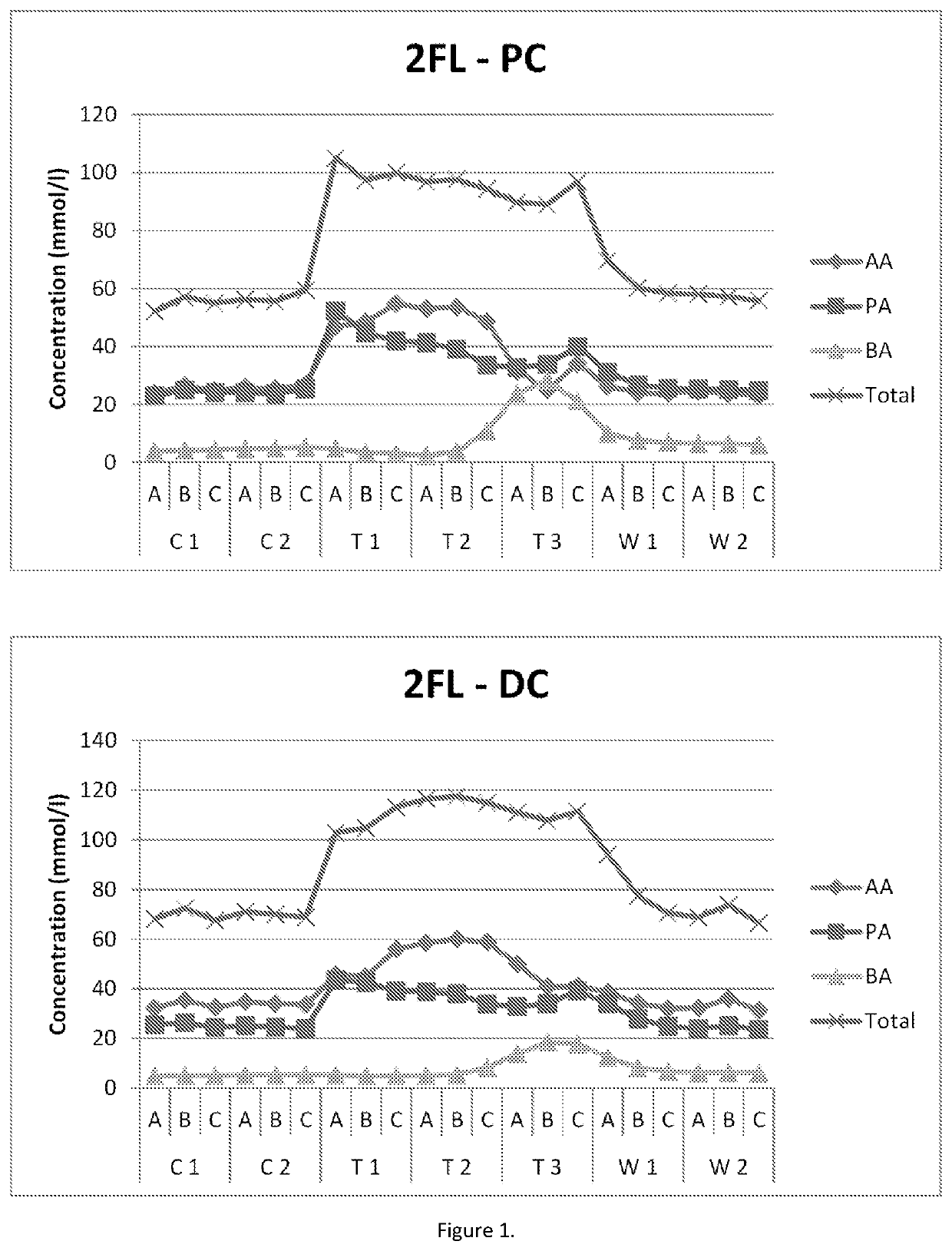
Figure 1
Abstract
Description
FIELD OF THE INVENTION
[0001] This invention relates to a method and composition for increasing the level of butyrate produced in the gastro-intestinal tract of non-infant humans.BACKGROUND OF THE INVENTION
[0002] It has been estimated that the human intestine harbours 1013 to 1014 bacterial cells and the number of bacteria outnumbers the total number of cells in the body by a factor of 10. The microbiota of the human intestine is a complex and very dynamic microbial ecosystem, which is considered to serve numerous important functions for its human host, including protection against pathogens, induction of immune regulatory functions, nutrient processing and metabolic functions. The intestinal microbiota consists of various populations, which are important to preserve human health, and recent research has been able to link imbalances in the intestinal bacterial population to both intestinal and extra-intestinal inflammatory diseases.
[0003] Selective stimulation of specific intestinal bac...
Examples
example 1
[0123]A total of 100 male and female healthy adults are recruited to participate in the study. After a screening visit and run-in period of 1-2 weeks, the participants are selected and randomized into ten groups, each of 10 subjects. One group is administered a placebo product containing 2 grams of glucose. The remaining 9 groups are administered treatment product containing a) 20 g of 2′-FL, b) 10 g of 2′-FL, c) 5 g of 2′-FL, d) 20 g of LNnT, e) 10 g of LNnT, f) 5 g of LNnT, g) 20 g of a 2:1 mixture of 2′-FL and LNnT, h) 10 g of a 2:1 mixture of 2′-FL and LNnT, and i) 5 g of a 2:1 mixture of 2′-FL and LNnT for 4 weeks. The placebo and treatment products are in powder form in a unit dosage container.
[0124]The healthy adults are eligible to participate if they are at an age between 18-60 years. All recruited participants are able and willing to understand and comply with the study procedures. Participants are excluded if: they had participated in a clinical study one month prior to s...
example 2
[0139]The impact of the HMOs on microbiota was investigated in the M-SHIME® (M-TripleSHIME®) in vitro gastrointestinal model (Prodigest). The typical reactor setup of the M-TripleSHIME® consisted of a succession of four reactors simulating the different parts of the human gastrointestinal tract. The first two reactors were of the fill-and-draw principle to simulate different steps in food uptake and digestion, with peristaltic pumps adding a defined amount of SHIME feed (140 ml 3× / day) and pancreatic and bile liquid (60 ml 3× / day), respectively to the stomach and small intestine compartment and emptying the respective reactors after specified intervals. The last two compartments were continuously stirred reactors with constant volume and pH control. The retention time and pH of the different vessels were chosen to resemble in vivo conditions in the different parts of the colon. The proximal colon was set to pH 5.4-5.6 and retention time=12 h, and the distal colon was set to pH 6.0-6...