
Visible-light-induced direct oxidation method for saturated hydrocarbon bonds
Patent Information
- Authority / Receiving Office
- US · United States
- Current Assignee / Owner
- Publication Date
- 2021-05-06
Smart Images
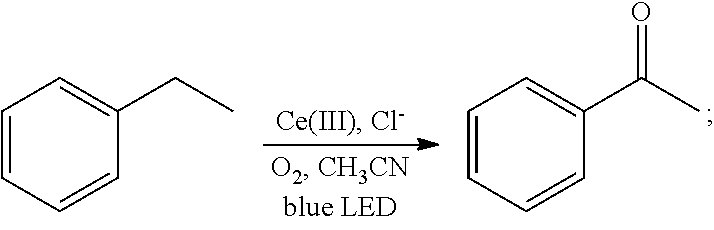
Figure 1 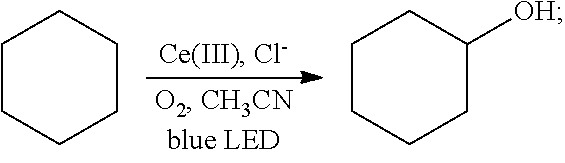
Figure 2 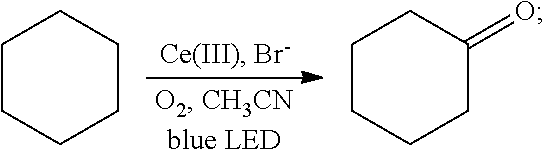
Figure 3
Abstract
Description
BACKGROUNDTechnical Field
[0001] The present invention relates to the field of organic synthesis, and in particular, to a direct oxidation method for saturated hydrocarbon bonds in an organic compound, which is induced by visible light and efficiently catalyzed by a cerium complex.Description of Related Art
[0002] Direct oxidation of hydrocarbon bonds in organic compounds has attracted increasing attention in the field of catalysis. The synthetic strategy is capable of directly converting widely existing hydrocarbon bonds into diverse functional groups (hydroxyl, carbonyl, amine, etc.). With inexpensive starting materials and significantly shortened synthetic routes, the synthetic strategy would be a promising choice for value-added drug molecules or intermediates thereof, and thus has broad application prospects in pharmaceutical industry. However, the high energy of such hydrocarbon bonds renders its activity relatively low. Existing processes typically require expensive transition me...
Examples
embodiment 1
[0020]A visible-light-induced direct oxidation method for saturated hydrocarbon bonds, including the following specific steps:
[0021]Oxygen was introduced into 2 mL of a solution of ethylbenzene (106 mg, 1 mmol) in acetonitrile for 20 min, until the solution was saturated with the oxygen. Then 1 mol % cerium complex cerium trichloride (2.4 mg, 0.01 mmol) and 2 mol % additive tetrabutylammonium chloride (5.5 mg, 0.02 mmol) were added. After the addition, the ethylbenzene and the oxygen were allowed to react for 2 hrs in the presence of the cerium complex and the additive at room temperature (25° C.) under the irradiation of a blue LED lamp (wavelength of 380 nm-550 nm). With the hydrocarbon bond in the ethylbenzene oxidized, the oxidation product acetophenone was thus acquired. The reaction was as follows:
[0022]After the reaction had stopped, the mixture was diluted with dichloromethane, washed sequentially with water and saturated brine, and dried. After separation by column chromato...
embodiment 2
[0023]A visible-light-induced direct oxidation method for saturated hydrocarbon bonds, including the following specific steps:
[0024]Oxygen was introduced into 2 mL of a solution of cyclohexane (85 mg, 1 mmol) in acetonitrile for 20 min, until the solution was saturated with the oxygen. Then 1 mol % cerium complex cerium trichloride (2.4 mg, 0.01 mmol) and 2 mol % additive tetrabutylammonium chloride (5.5 mg, 0.02 mmol) were added. After the addition, the cyclohexane and the oxygen were allowed to react for 5 hrs in the presence of the cerium complex and the additive at room temperature (25° C.) under the irradiation of a blue LED lamp (wavelength of 380 nm-550 nm). With the hydrocarbon bond in the cyclohexane oxidized, the oxidation product cyclohexanol was thus acquired. The reaction was as follows:
[0025]After the reaction had stopped, the mixture was diluted with dichloromethane, washed sequentially with water and saturated brine, and dried. After separation by column chromatograp...
embodiment 3
[0026]A visible-light-induced direct oxidation method for saturated hydrocarbon bonds, including the following specific steps:
[0027]Oxygen was introduced into 2 mL of a solution of cyclohexane (85 mg, 1 mmol) in acetonitrile for 20 min, until the solution was saturated with the oxygen. Then 2 mol % cerium complex cerium nitrate (8.7 mg, 0.02 mmol) and 4 mol % additive tetrabutylammonium bromide (12.9 mg, 0.04 mmol) were added. After the addition, the cyclohexane and the oxygen were allowed to react for 48 hrs in the presence of the cerium complex and the additive at room temperature (25° C.) under the irradiation of a blue LED lamp (wavelength of 380 nm-550 nm). With the hydrocarbon bond in the cyclohexane oxidized, the oxidation product cyclohexanone was thus acquired. The reaction was as follows:
[0028]After the reaction had stopped, the mixture was diluted with dichloromethane, washed sequentially with water and saturated brine, and dried. After separation by column chromatography...