
Protective case for information storage disc
a protective case and information storage technology, applied in the field of protective cases, to achieve the effect of increasing structural strength, facilitating opening the case, and reducing mechanical damag
Patent Information
- Authority / Receiving Office
- US · United States
- Patent Type
- Patents(United States)
- Current Assignee / Owner
- Publication Date
- 2007-11-27
- Estimated Expiration
- Not applicable · inactive patent
Smart Images
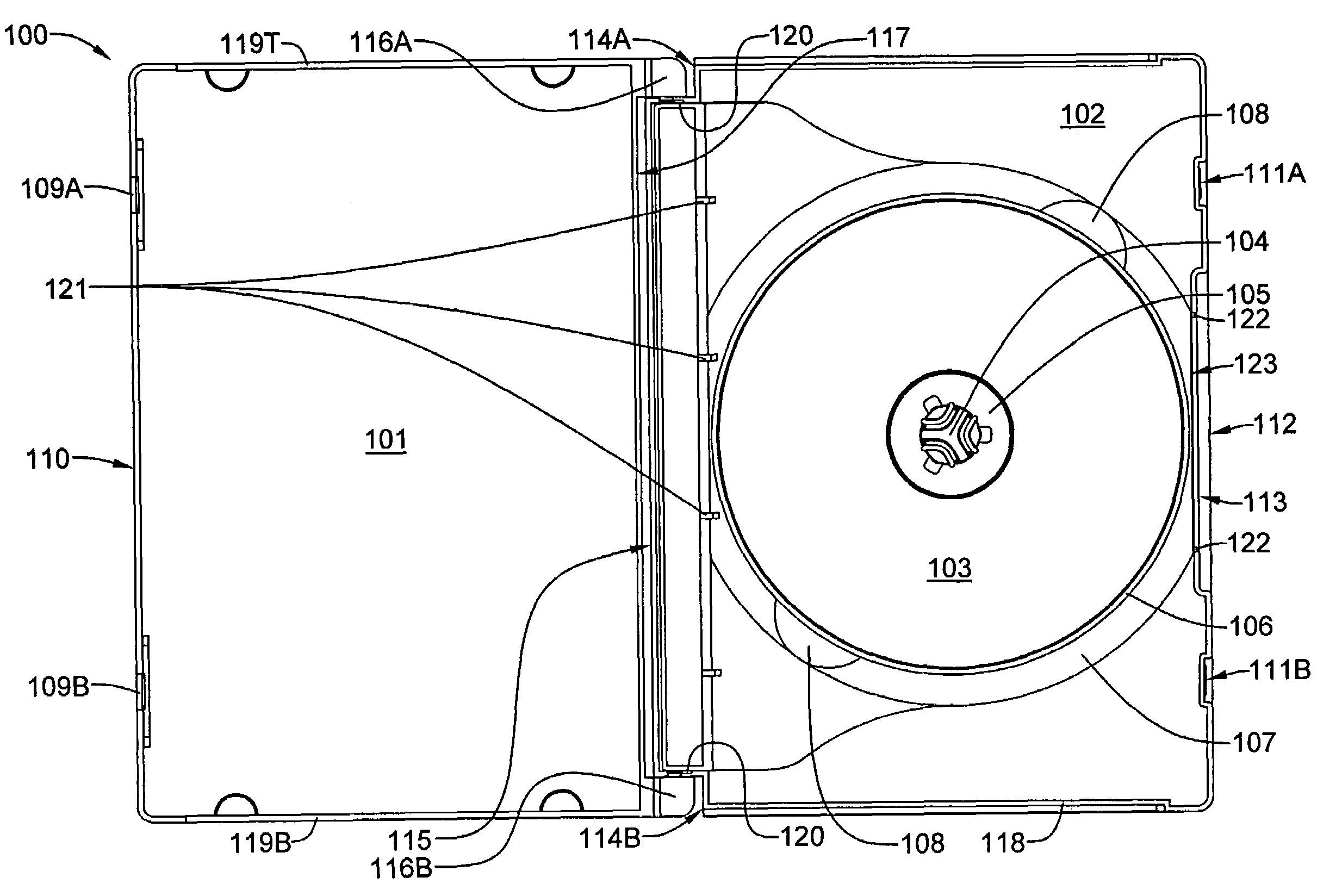
Figure 1 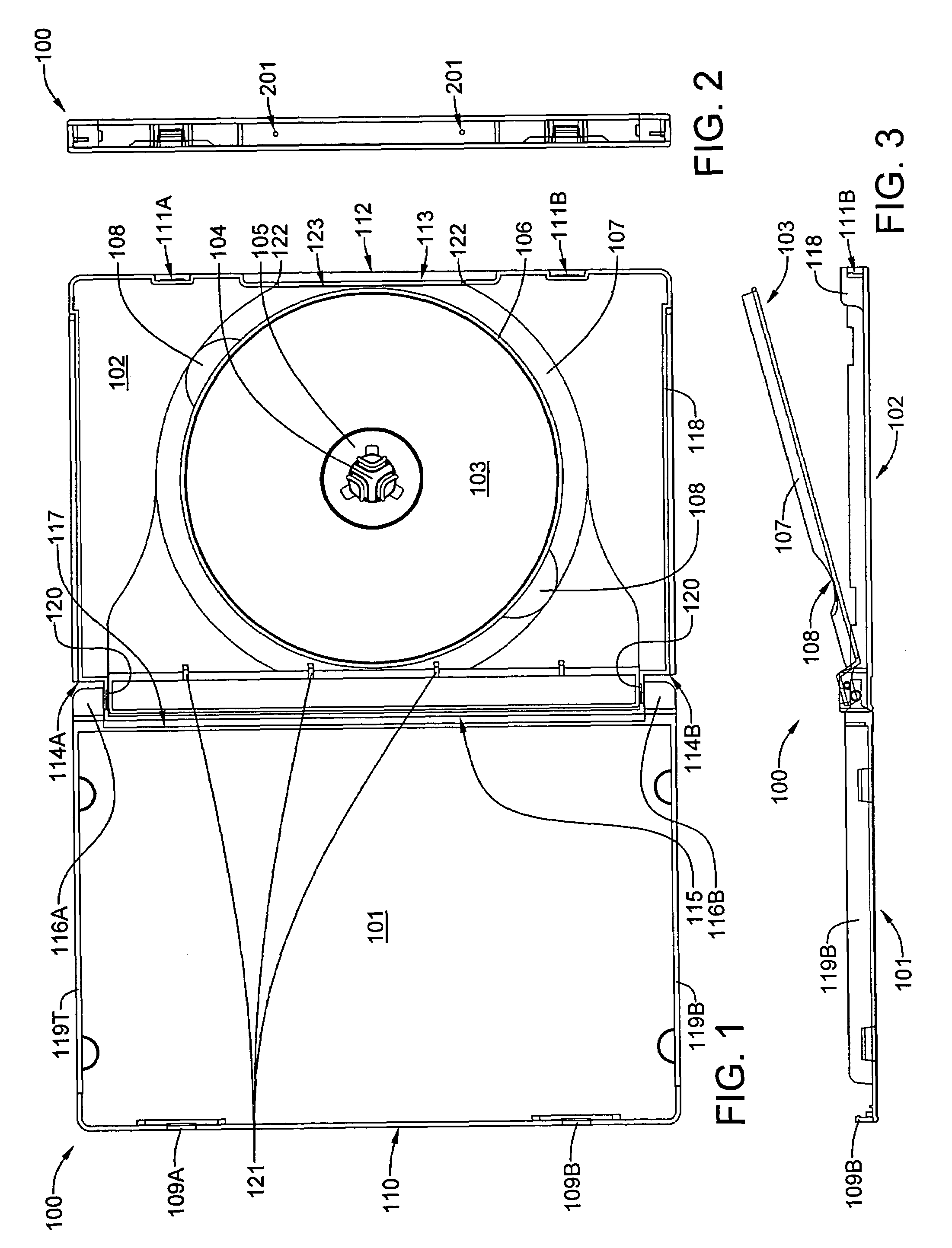
Figure 2 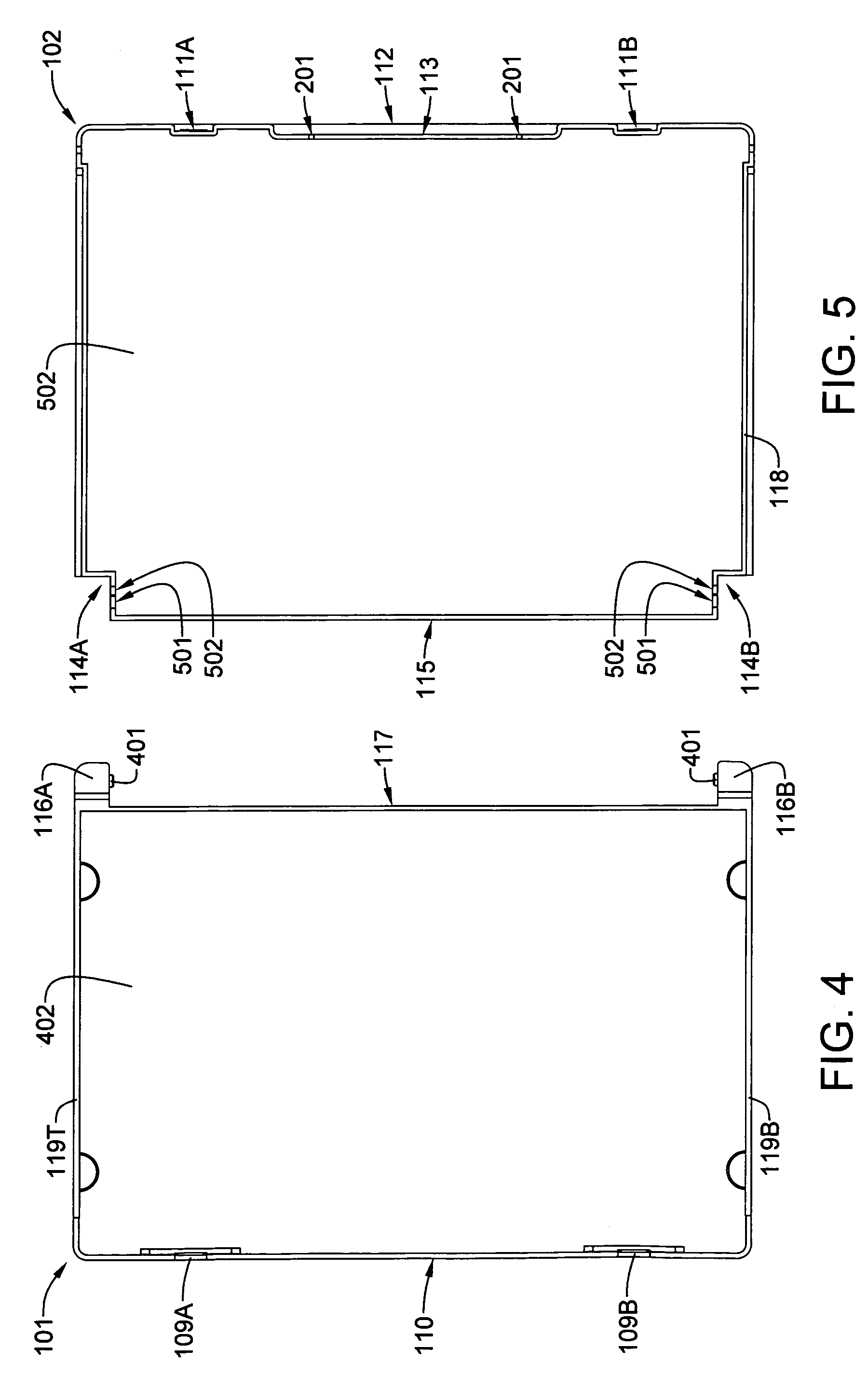
Figure 3
Abstract
Description
BACKGROUND OF THE INVENTION
[0001] 1. Field of the Invention
[0002] The invention relates generally to protective cases for storing and shipping disc-shaped information storage media such as compact discs and digital video disks and, more particularly to protective jewel cases of a clam-shell design comprising an assembly of three pieces: a bottom cover piece, a top cover piece hingeably connected to the bottom cover piece, and an internal swing-out piece hingeably connected to the bottom cover piece.
[0003] 2. History of the Prior Art
[0004] The use of optically-scannable discs for high-density storage of digital data has exploded since the advent of the compact disc (CD) in 1983. Capable of storing 650 to 700 megabytes of digital data, a single CD could hold 74 to 80 minutes of high-quality music. Fourteen years later, the digital video disc (DVD) was introduced. Although a DVD is identical in thickness (1.2 millimeters) and diameter (120 millimeters or 4.7 inches) to a standard CD, the D...
Examples
first embodiment
[0041]Still referring to FIG. 1, it will be noted that the base member 101 incorporates a pair of hinge alcoves 114A and 114B, which are located at opposite ends of the rear edge 115 of the base member 102. It will also be noted that the lid member 101 incorporates a pair of hinge arms 116A and 116B located at opposite, adjacent corners on the rear edge 117 of the lid member 101. The lid member 101 and the base member 102 are hingeably coupled via a system of axially-aligned studs and apertures. For the preferred embodiment, each of the hinge alcoves 114A and 114B incorporates a cylindrical aperture that is axially aligned with the cylindrical aperture of the other hinge alcove. Each of the hinge arms 116A and 116B incorporates a pivot stud that is axially aligned with the pivot stud of the other hinge arm. By slightly distorting the lid member 101, the base member 102, or both, the lid member 101 can be pivotally attached to the base member 102. It will be further noted that the ba...
second embodiment
[0050]Referring now to FIGS. 11 and 12, the hinge arm 116A of FIGS. 9 and 10 has been modified to remove additional polymeric plastic material by forming dimples in the upper and lower surfaces thereof. The modified second embodiment hinge arm 1101A is still solid from side to side through the pivot axis 1103.
[0051]Referring now to FIGS. 13 and 14, a third embodiment hinge arm 1301A retains the full height H2 of the jewel case. However, polymeric plastic material has been removed in the well 1302 shown in FIG. 13 and in the valley 1401 shown in FIG. 14. Nevertheless, the third embodiment hinge arm 1301A is still solid from side to side through the pivot axis 1103.
[0052]Referring now to FIGS. 15 and 16, a second embodiment media tray 1501 completely covers the inner surface of base member 102. This may be an advantageous feature when a paper base member insert or label is used, as media tray 1501 will completely cover a full-size insert. Other than size, the primary difference betwee...