
Process for the recovery of value metals from material containing base metal oxides
Patent Information
- Authority / Receiving Office
- US · United States
- Current Assignee / Owner
- Publication Date
- 2008-02-12
- Estimated Expiration
- Not applicable · inactive patent
Smart Images
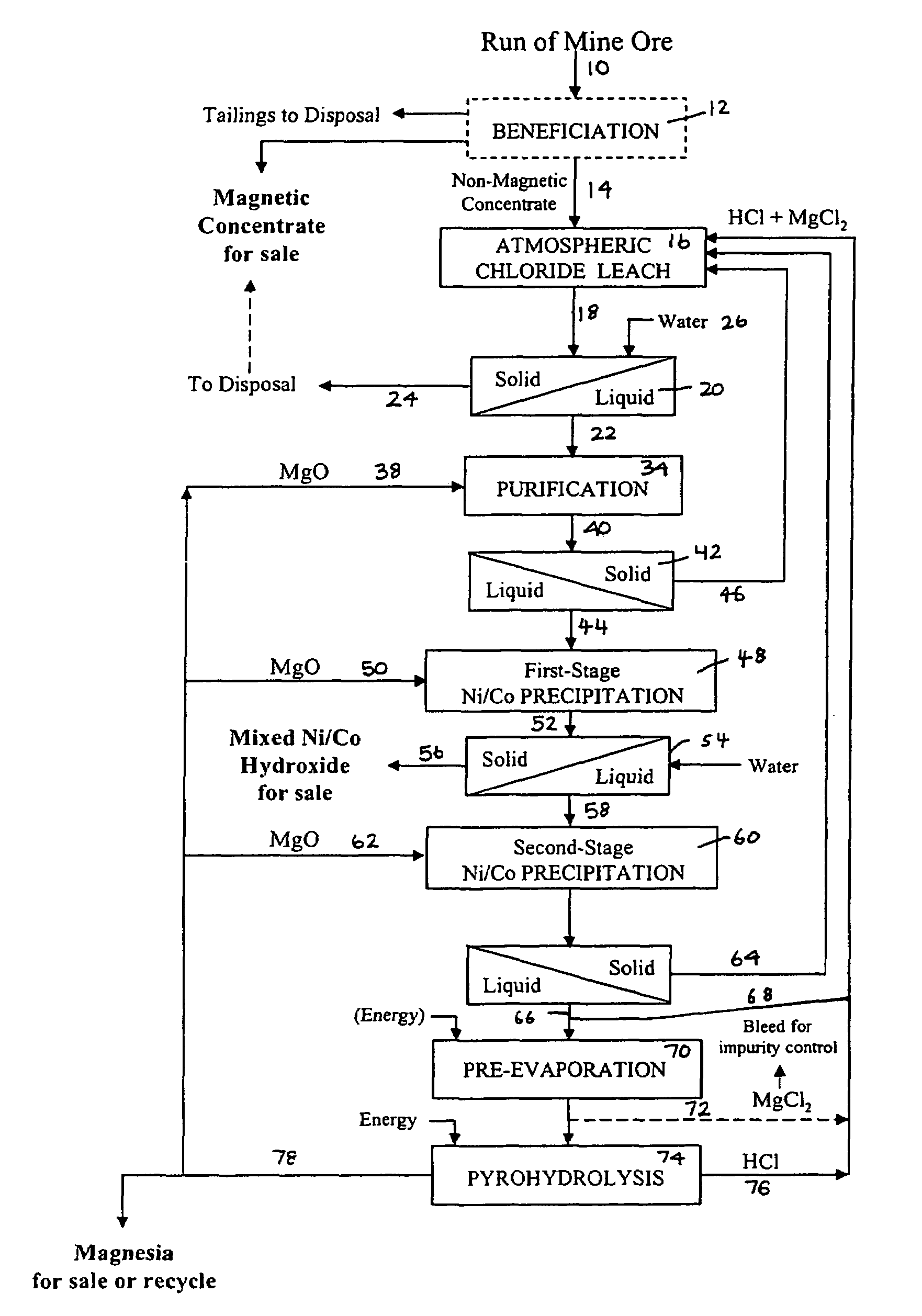
Figure 1 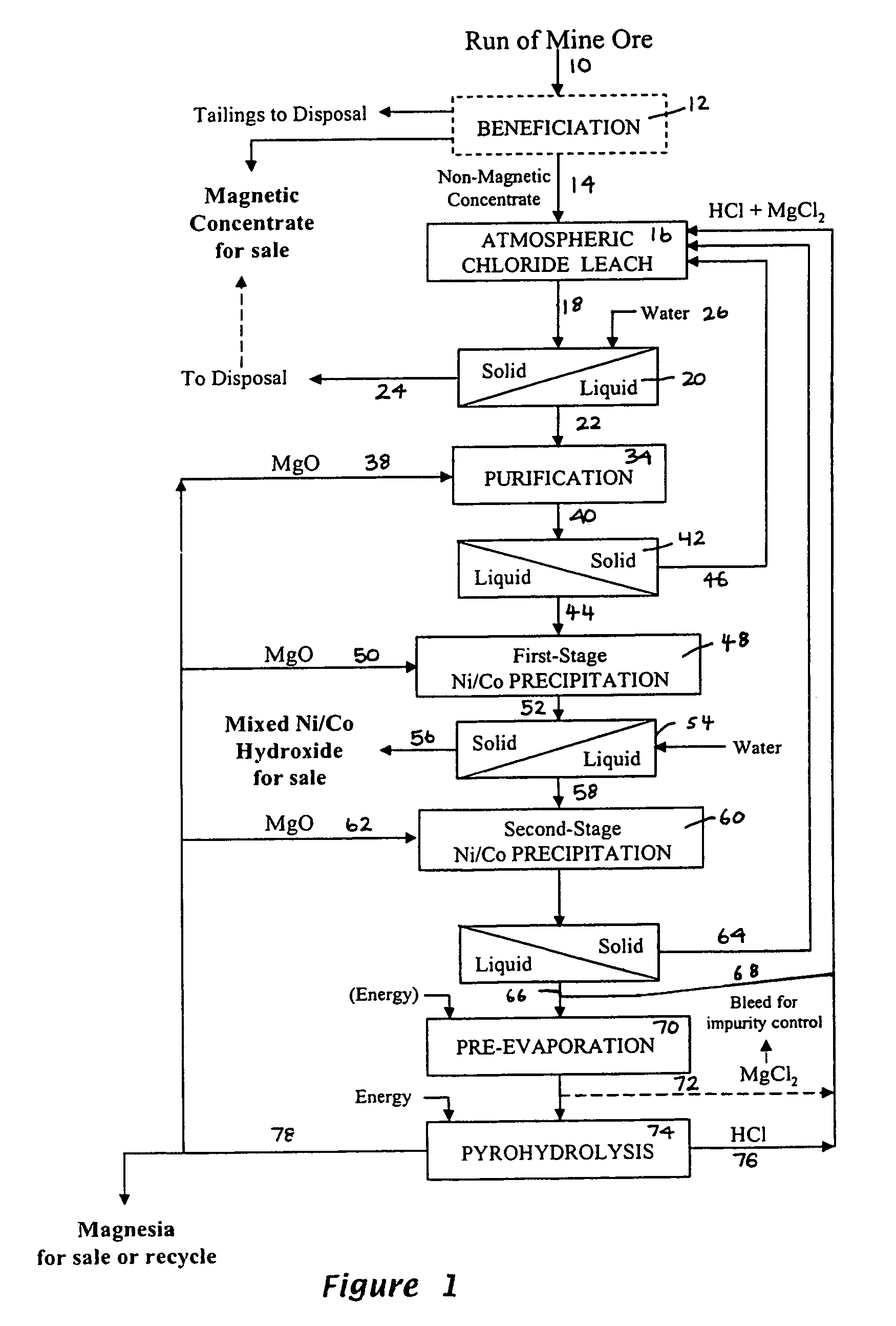
Figure 2 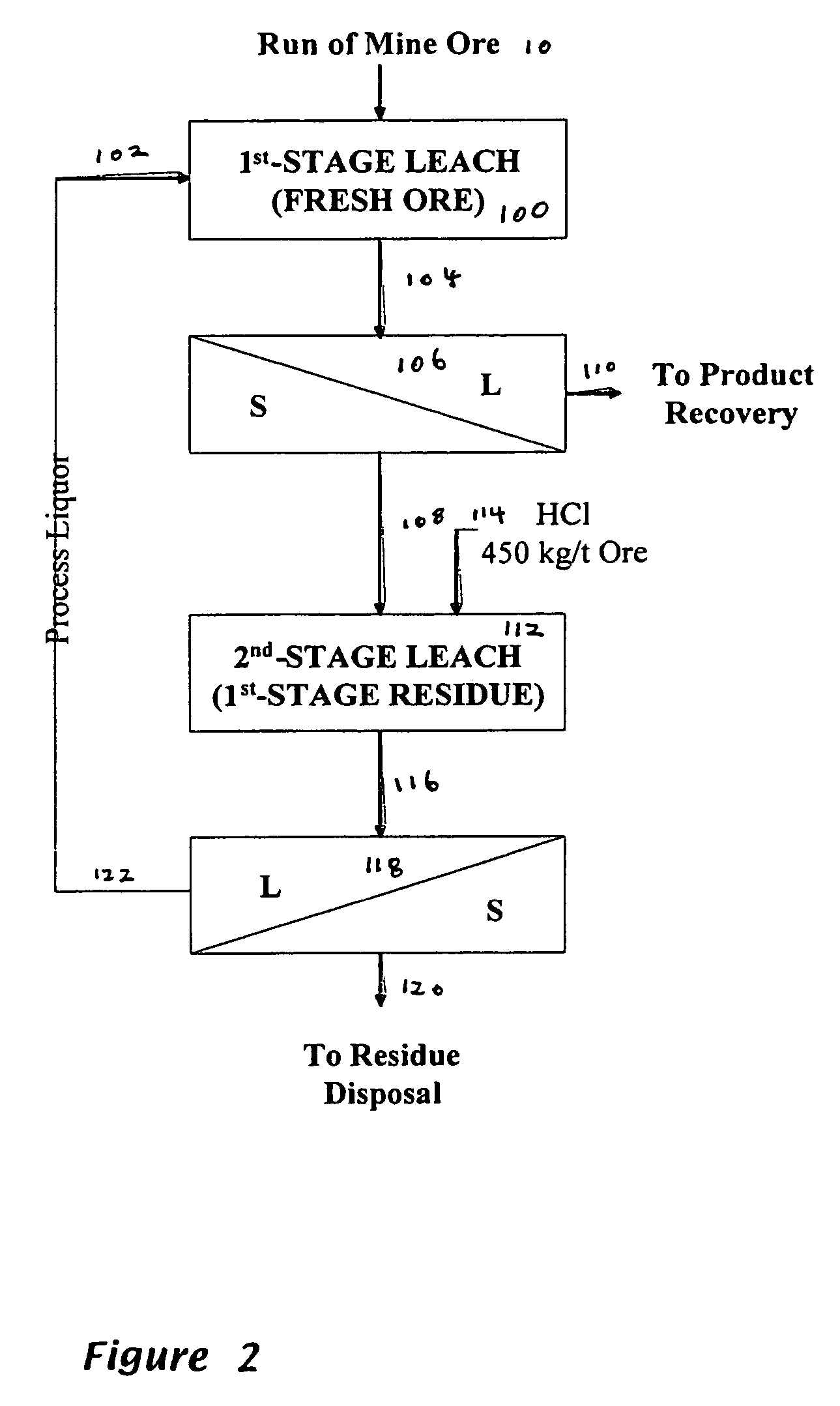
Figure 3
Abstract
Description
FIELD OF THE INVENTION
[0001] The present invention relates to a method for the leaching of value metals from oxidic materials. In one particular aspect, the oxidic material is a lateritic nickel ore. Accordingly, the process may be used to recover nickel, and cobalt (if present) from both limonite and saprolite ores. The leaching process may also be operated to inhibit the leaching of magnesium or, alternately to leach a selected amount of magnesium.BACKGROUND OF THE INVENTION
[0002] There has been a great deal of interest in the processing of lateritic nickel ores in the past few years, with the Western Australian projects, those of Minara Resources (formerly Anaconda Nickel) at Murrin Murrin, Preston Resources at Bulong, the Cawse plant (now owned by OMG), and BHPBilliton's Ravensthorpe Project, together with Inco's Goro Project in New Caledonia, being principal examples.
[0003] All of the purely hydrometallurgical processes developed to date for the commercial processing of lateritic ...
Examples
example i
[0140]A series of laboratory experiments was carried out, wherein samples of 100 g of mixed saprolitic and limonitic ore from the Sechol deposit in Guatemala were treated. The mixed ore had the following analysis, the amounts being reported in wt %: nickel 2.25%; cobalt 0.03%; magnesium 14.4%; iron 15.2%; silicon 16.0%; calcium <0.05%; aluminum 0.9%; copper <0.05%; zinc <0.05% and chromium 0.53%. This ore also contained 20% of a refractory magnetite phase, which was not readily amenable to leaching. The samples were leached at 20% solids density for four hours at 100° C. in mixtures of magnesium chloride and hydrochloric acid, varying (i) the total chloride ion concentration, and (ii) the magnesium to acid ratio. Table 1 provides further details and the results obtained.
[0141]
TABLE I%ChlorideExtrac-Initial HCl ConcentrationConcentrationtion1N1.5N2N3N4NMg / HCl0.370.14ratio150 g / LNi75.971.3Fe1.110.8Mg53.440.8pH0.890.47Eh581619Mg / HCl1.831.10.750.390.21ratio230 g / LNi60.569.781.288.193.1F...
example ii
[0143]An example of a counter-current leach test is shown in FIG. 4. Fresh ore was fed to a first leaching step, in which there was a lixiviant containing 360 g / L of magnesium chloride in hydrochloric acid, the hydrochloric acid being obtained from recycled lixiviant. The first leaching step was operated at 105° C. The pH was 0.38, the Eh was about 400 mV and the ratio of Mg / HCl on a mass basis was 0.84. The leach slurry obtained was fed to a solids / liquid separation step, from which liquor containing value metals was separated for further processing. The solids were fed to a second leaching step to which hydrochloric acid was fed at a rate of 450 kg / ton of solids. The lixiviant again contained 360 g / L of magnesium chloride. The second leach was conducted at 105° C. for 4 hours. The pH was in the range 0.68-0.72, the Eh was about 400 mV and the ratio of Mg / HCl on a mass basis was 0.91. A second solids / liquid separation step was conducted; the liquor, which contained 1.2 g / L of nicke...
example iii
[0144]A sample of a lateritic nickel ore with a relatively low iron content was subjected to leaching. The composition of the ore was as follows, the amounts being in wt %: Ni 2.3%, Co 0.03%, Mg 14.4%, Fe 15.2%, Si 16.0%, Ca <0.05%, Al 0.9%, Cu <0.05%, Zn <0.05%, Cr 0.5% and Mn 0.18%. The mesh size of the ore was −100. The leach time was 4 hours and the temperature was 95° C. The leach solutions had 20% solids.
[0145]Further process details and the results obtained are given in Table II. In Run 1, the lixiviant did not contain hydrochloric acid, and in Run 2 magnesium chloride was not added. Thus, Runs 1 and 2 are comparative runs.
[0146]
TABLE IIRun No.12345Initial HCl concentration,—2.252.252.252.25NChloride conc. (g / L)12079200230250Mg / HCl (mass)10 / 10.50.620.7PH5.20.2Eh (mV)100450520528538Ore weight loss (%)2.43546.544.442.7Ni concentration (g / L)0.042.23.544.54.42Fe concentration (g / L)0.834.55.89.89.8Ni extraction (%)044.085.987.086.5
[0147]The residue from Run 4 was analyzed, and con...