
Obesity gene and use thereof
a technology of obesity and predisposing gene, applied in the field of human genetics, can solve the problems of increasing the risk of disease and premature death, reducing the clinical value of obesity, so as to achieve the effect of increasing health risk, increasing adiposity, and increasing obesity
Patent Information
- Authority / Receiving Office
- US · United States
- Patent Type
- Patents(United States)
- Current Assignee / Owner
- Publication Date
- 2011-10-11
- Estimated Expiration
- Not applicable · inactive patent
Smart Images
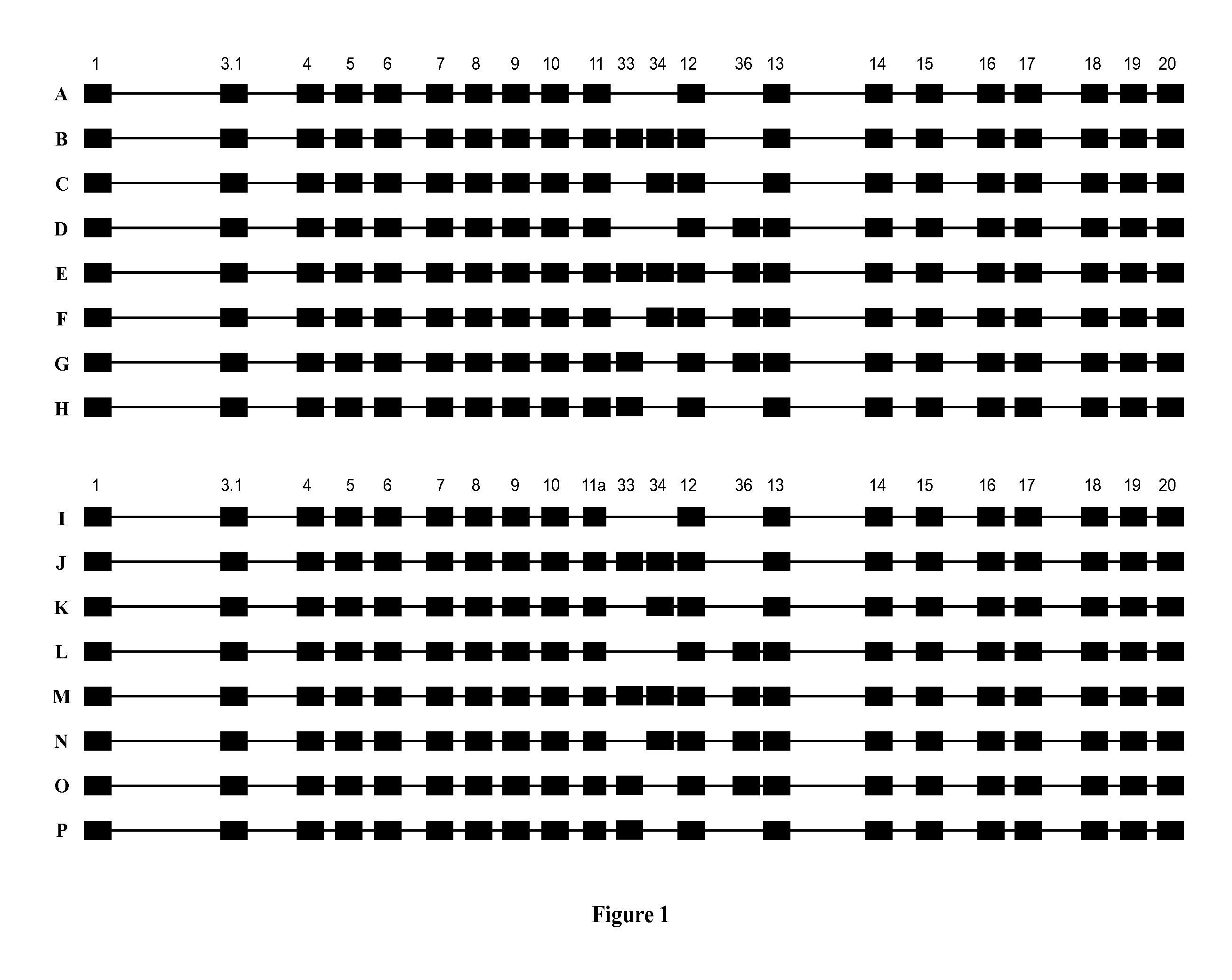
Figure 1
Abstract
Description
CROSS REFERENCE TO OTHER U.S. APPLICATIONS
[0001] This application is a Continuation of U.S. patent application Ser. No. 10 / 655,543 filed on Sep. 3, 2003; now U.S. Pat. No. 7,314,713 which claims the benefit (under 35 U.S.C. §119(e)) of U.S. Provisional Application Ser. No. 60 / 407,817 filed Sep. 3, 2002, and U.S. Provisional Application Ser. No. 60 / 433,074 filed Dec. 13, 2002, the contents of both of which are incorporated herein by reference in their entirety.SEQUENCE LISTING
[0002] The instant application was filed with a formal Sequence Listing submitted electronically as a text file. An amended formal Sequence Listing was also submitted electronically as a text file. This text file, which was named “1312-01-11C 2007-06-27-SEQ-LIST-JBO-ST25”, was created on Jun. 27, 2007, and is 695,786 bytes in size. Its contents are incorporated by reference herein in their entirety.FIELD OF THE INVENTION
[0003] This invention relates generally to the field of human genetics, and particularly to an i...
Examples
example 1
Association of TBC1D1 and Obesity
[0158]We have conducted a genome wide search with 628 markers using multigenerational Utah pedigrees to identify genes involved in obesity predisposition. Models used in this analysis were females-only and affecteds-only with dominant, codominant and recessive modes of inheritance. The resource used to define this linkage was 37 Utah pedigrees with 994 individuals.
[0159]From the genome search, we identified a highly significant linkage to high BMI at D4S2632 with a multipoint HLOD score of 6.1 (p-value 10−7) and a nonparametric linkage score of 5.3 (p-value 10−6). To pursue the 4p14-15 linkage, we increased both the marker density around D4S2632 and the size of our pedigree data set. As a result, the linkage evidence increased to a HLOD score of 9.2 (at D4S3350, p-value 10−10) and a nonparametric linkage score of 11.3 (p-value 10−12). The fraction of families that support the linkage (α) is 0.46. The region defined by the linkage evidence is 10 cM or...
example 2
Cell and Animal Obesity Disease Models
[0166]Compounds identified by the drug screens of the invention (i.e., those that modify TCB1D1 bioactivity) can be further tested in obesity disease models. Preferably, any compound or molecule identified as being capable of affecting the bioactivity of TCB1D1 in a primary screen is tested in an animal or cell-based obesity disease model. Compounds that show activity in the secondary screen (i.e., obesity disease model) are identified as having obesity disease modifying activity.
[0167]The skilled artisan is capable of testing compounds that affect TCB1D1 bioactivity in obesity disease models. Any obesity disease model can be used. Preferably, drug candidates that have obesity disease modifying activity, show an effect in several different obesity disease models. It is preferred that the drug candidates that have obesity disease modifying activity show a disease modifying affect in at least 2, 3, 4, or more obesity disease models.
[0168]A variety...