
Lipase activity inhibitors containing high-molecular weight polyphenol fractions, tea extracts, and processes for producing the same
a technology of polyphenol fractions and activity inhibitors, which is applied in the field of high-molecular weight polyphenol fractions, tea extracts, and processes for producing the same, can solve the problems of affecting the effect of triglyceride production,
Patent Information
- Authority / Receiving Office
- US · United States
- Patent Type
- Applications(United States)
- Current Assignee / Owner
- Publication Date
- 2007-08-02
Smart Images
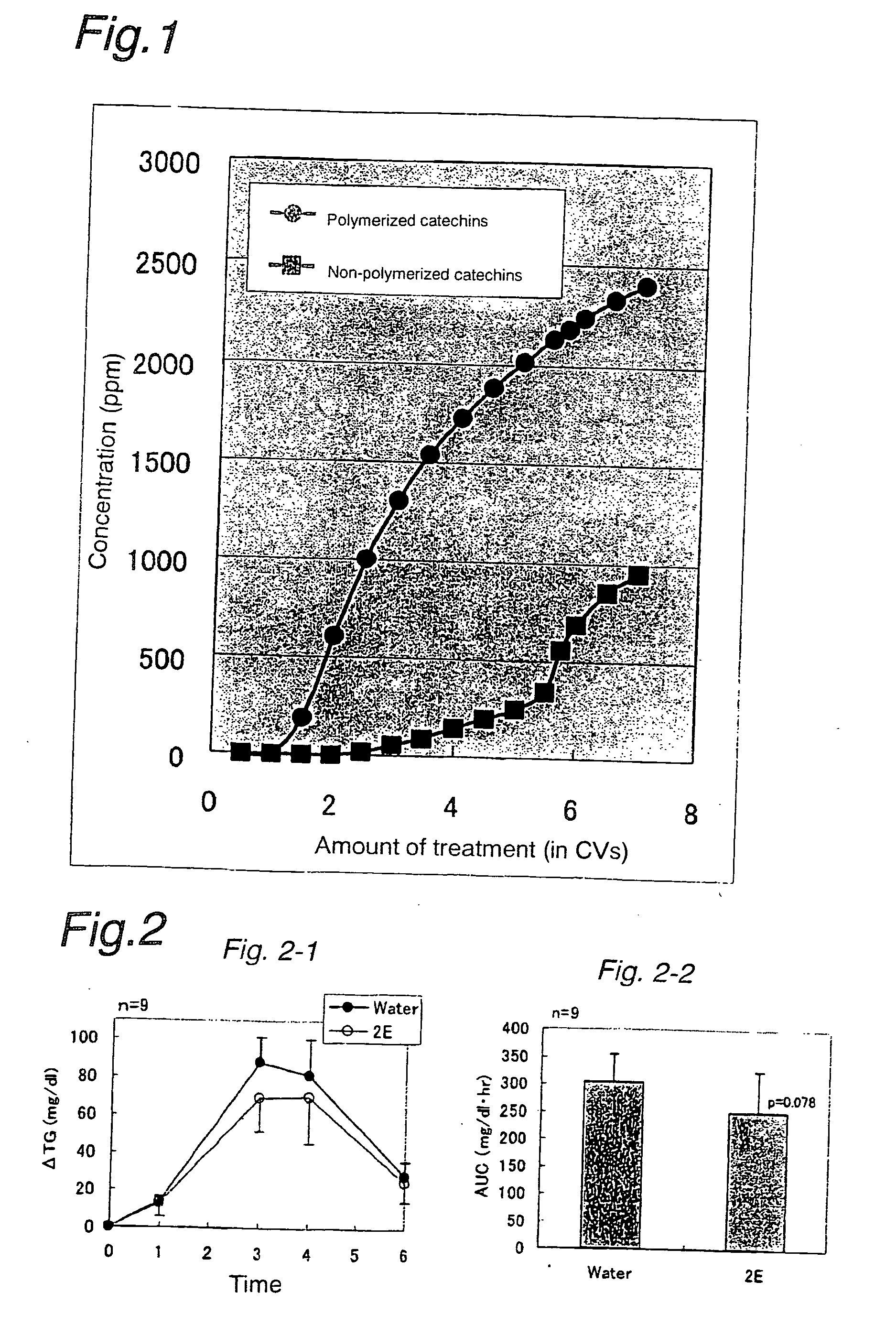
Figure 1 
Figure 2 
Figure 3
Abstract
Description
TECHNICAL FIELD
[0001] The present invention has been accomplished on the basis of the finding that high-molecular weight polyphenols (polymerized catechins) contained in oolong tea and other tea products exhibit various beneficial effects whereas they are less astringent and bitter than other tannins and non-polymerized catechins. It relates to a method of selectively fractionating polymerized catechins in tea, etc., compositions such as tea extracts that are obtained by that method with the polymerized catechins in enriched form, lipase activity inhibitors containing the fractions obtained by that method, and foods or beverages that have the compositions added thereto and which are not impaired in flavor but present high preferences and can be taken in for health promoting purposes. BACKGROUND ART
[0002] With the recent tendency toward westernized eating habits in Japan, intake of high fat diet continues to increase. According to a National Nutrition Survey in Japan (1999), it is ...
Examples
example 2
[0052] Separation
[0053] Fifty milliliters of commercial particulate activated charcoal (e.g., GW-H32 / 60 of KURARAY CO., LTD.) was degassed and packed into a column. The liquid extract of oolong tea obtained in Example 1 was passed through the column at a flow rate of SV=3 to separate the ingredients. For this operation, the temperature of the liquid extract and the column was set at 20, 40, 50 or 60° C.; the results of analysis of the separated ingredients following a separation for about 5 CV at each temperature are shown in Table 2.
TABLE 2Polymerized catechinsNon-polymerized catechinsLiquid extract2235 ppm3813 ppm20° C.1592109440° C.153268550° C.147035160° C.1526267
[0054] Thus, it was found that the higher the temperature for separation, the more selectively the non-polymerized catechins could be separated for removal.
[0055]FIG. 1 shows an exemplary behavior of the two ingredients when they were separated at 60° C.
example 3
[0056] Pilot Production
[0057] Leaves of oolong tea (600 kg) were subjected to column extraction with a 0.15% solution of sodium hydrogencarbonate (95° C.), whereupon a liquid extract was obtained in an amount of about 6,000 kg. With its temperature held at 60-65° C., the liquid extract was passed through a column of 400 kg particulate activated charcoal (GW-H32 / 60 of KURARAY CO., LTD.) so that non-polymerized catechins and caffeine were selectively removed. The effluent from the column was concentrated under reduced pressure to prepare about 900 kg of a tea extract having a Brix value of 10 or more.
[0058] The concentration of the polymerized catechins (OTPP) in the prepared tea extract was 14648 ppm, whereas that of the adsorbed catechins (EGCG+GCG+ECG+CG) was 366 ppm.
example 4
[0059] Lipase Inhibitory Activity
[0060] The liquid extract of Example 1 and the tea extract obtained in Example 3 which had the polymerized catechins enriched selectively (the non-polymerized catechins removed selectively) were compared for their action in inhibiting lipase which was known to be involved in fat absorption.
Lipase Inhibitory Activity Measurement:
[0061] Lipase activity measurement was carried out by using oleic acid ester of fluorescent 4-methylumbelliferone (4-UMO) as a substrate, and measuring the fluorescence of 4-methylumbelliferone produced by reaction.
[0062] In the measurement, 13 mM Tris-HCl containing 150 mM NaCl and 1.36 mM CaCl2 was used as a buffer (pH 8.0). Substrate 4-UMO (Sigma) was prepared as 0.1M solution in DMSO and diluted 1000-fold with the buffer mentioned above. Similarly, lipase (porcine pancreatic lipase (Sigma)) was prepared as 400 U / ml solution in the buffer mentioned above and used in enzymatic measurement.
[0063] 50 μl of the 4-UMO buff...