Analysis of Solid State Battery Breakthrough on Electronic Device Performance
OCT 24, 20259 MIN READ
Generate Your Research Report Instantly with AI Agent
PatSnap Eureka helps you evaluate technical feasibility & market potential.
Solid State Battery Evolution and Objectives
Solid state battery technology has evolved significantly over the past several decades, transitioning from conceptual research to increasingly viable commercial applications. The journey began in the 1970s with the discovery of solid electrolytes, but meaningful progress accelerated in the early 2000s when safety and energy density limitations of conventional lithium-ion batteries became apparent. This evolution has been driven by the growing demand for safer, higher-capacity energy storage solutions across multiple industries, particularly in consumer electronics and electric vehicles.
The fundamental breakthrough in solid state battery technology lies in the replacement of liquid electrolytes with solid materials, eliminating leakage risks and enabling higher energy densities. Early iterations faced significant challenges with ion conductivity at room temperature, manufacturing scalability, and interface stability between electrodes and electrolytes. Recent advancements in materials science, particularly in ceramic and polymer-based solid electrolytes, have addressed many of these limitations.
From 2015 to 2023, research focus has shifted toward solving the critical challenges of manufacturing cost reduction and cycle life improvement. Notable milestones include the development of sulfide-based electrolytes with conductivity comparable to liquid systems, and the creation of composite electrolytes that maintain structural integrity during charging cycles. These innovations have positioned solid state batteries as a transformative technology for electronic devices.
The primary objectives of current solid state battery research center on achieving performance metrics that significantly outpace conventional lithium-ion technology. Specifically, researchers aim to develop batteries with energy densities exceeding 500 Wh/kg (more than double current commercial options), charging times under 15 minutes, operational temperature ranges from -20°C to 60°C, and cycle lives beyond 1,000 full charges while maintaining 80% capacity. Additionally, eliminating flammable components addresses critical safety concerns in consumer electronics.
For electronic devices specifically, solid state battery technology aims to enable thinner form factors through flexible and stackable cell designs, longer device runtimes through higher energy density, and faster charging capabilities without thermal management limitations. The technology also promises to extend device longevity by reducing battery degradation rates and eliminating the risk of electrolyte leakage that can damage internal components.
The convergence of these technological advances with manufacturing innovations suggests that solid state batteries may reach widespread commercial adoption in premium electronic devices within 3-5 years, with mass-market implementation following in the 5-8 year timeframe, potentially revolutionizing device design, performance, and user experience.
The fundamental breakthrough in solid state battery technology lies in the replacement of liquid electrolytes with solid materials, eliminating leakage risks and enabling higher energy densities. Early iterations faced significant challenges with ion conductivity at room temperature, manufacturing scalability, and interface stability between electrodes and electrolytes. Recent advancements in materials science, particularly in ceramic and polymer-based solid electrolytes, have addressed many of these limitations.
From 2015 to 2023, research focus has shifted toward solving the critical challenges of manufacturing cost reduction and cycle life improvement. Notable milestones include the development of sulfide-based electrolytes with conductivity comparable to liquid systems, and the creation of composite electrolytes that maintain structural integrity during charging cycles. These innovations have positioned solid state batteries as a transformative technology for electronic devices.
The primary objectives of current solid state battery research center on achieving performance metrics that significantly outpace conventional lithium-ion technology. Specifically, researchers aim to develop batteries with energy densities exceeding 500 Wh/kg (more than double current commercial options), charging times under 15 minutes, operational temperature ranges from -20°C to 60°C, and cycle lives beyond 1,000 full charges while maintaining 80% capacity. Additionally, eliminating flammable components addresses critical safety concerns in consumer electronics.
For electronic devices specifically, solid state battery technology aims to enable thinner form factors through flexible and stackable cell designs, longer device runtimes through higher energy density, and faster charging capabilities without thermal management limitations. The technology also promises to extend device longevity by reducing battery degradation rates and eliminating the risk of electrolyte leakage that can damage internal components.
The convergence of these technological advances with manufacturing innovations suggests that solid state batteries may reach widespread commercial adoption in premium electronic devices within 3-5 years, with mass-market implementation following in the 5-8 year timeframe, potentially revolutionizing device design, performance, and user experience.
Electronic Device Market Demand Analysis
The global electronic device market has witnessed a significant shift in consumer demands, particularly regarding battery performance and device form factors. Current market research indicates that consumers increasingly prioritize longer battery life, faster charging capabilities, and thinner, lighter devices. According to industry reports, approximately 67% of smartphone users identify battery life as a critical factor influencing their purchasing decisions, while 58% express dissatisfaction with current battery performance.
The portable electronics segment, valued at $1.4 trillion in 2022, continues to expand at a compound annual growth rate of 7.3%. Within this market, devices with superior battery performance command premium pricing, with consumers willing to pay up to 20% more for devices offering significantly improved battery life. This price premium underscores the substantial market opportunity for solid-state battery technology integration.
Wearable technology represents another high-growth segment with stringent battery requirements. The global wearables market reached $116 billion in 2022, with projections indicating growth to $265 billion by 2027. These devices face particularly challenging power constraints due to their compact form factors, creating an urgent need for energy-dense power solutions that solid-state batteries could potentially address.
Enterprise and industrial electronic devices present additional market opportunities. These sectors demand reliable, long-lasting power sources for mission-critical applications. The industrial IoT market, valued at $263 billion, requires power solutions that can operate reliably in harsh environments—a potential advantage of solid-state technology over conventional lithium-ion batteries.
Regional analysis reveals varying market priorities. North American and European consumers emphasize environmental sustainability alongside performance, with 72% of consumers in these regions expressing preference for devices with more environmentally friendly battery technologies. Meanwhile, Asian markets prioritize rapid charging capabilities and device thinness, with 81% of consumers ranking these features as "very important."
The electric vehicle industry's growing investment in solid-state technology is creating beneficial spillover effects for consumer electronics. Battery manufacturing innovations driven by automotive applications are establishing supply chains and technical expertise that could accelerate adoption in smaller electronic devices. Industry forecasts suggest that economies of scale from automotive applications could reduce solid-state battery production costs by up to 45% over the next five years, potentially bringing this technology within reach for mainstream consumer electronics.
Market analysis indicates that the first successful implementations of solid-state batteries in consumer electronics could capture significant market share, with early adopters potentially securing up to 15% of premium device segments within two years of introduction.
The portable electronics segment, valued at $1.4 trillion in 2022, continues to expand at a compound annual growth rate of 7.3%. Within this market, devices with superior battery performance command premium pricing, with consumers willing to pay up to 20% more for devices offering significantly improved battery life. This price premium underscores the substantial market opportunity for solid-state battery technology integration.
Wearable technology represents another high-growth segment with stringent battery requirements. The global wearables market reached $116 billion in 2022, with projections indicating growth to $265 billion by 2027. These devices face particularly challenging power constraints due to their compact form factors, creating an urgent need for energy-dense power solutions that solid-state batteries could potentially address.
Enterprise and industrial electronic devices present additional market opportunities. These sectors demand reliable, long-lasting power sources for mission-critical applications. The industrial IoT market, valued at $263 billion, requires power solutions that can operate reliably in harsh environments—a potential advantage of solid-state technology over conventional lithium-ion batteries.
Regional analysis reveals varying market priorities. North American and European consumers emphasize environmental sustainability alongside performance, with 72% of consumers in these regions expressing preference for devices with more environmentally friendly battery technologies. Meanwhile, Asian markets prioritize rapid charging capabilities and device thinness, with 81% of consumers ranking these features as "very important."
The electric vehicle industry's growing investment in solid-state technology is creating beneficial spillover effects for consumer electronics. Battery manufacturing innovations driven by automotive applications are establishing supply chains and technical expertise that could accelerate adoption in smaller electronic devices. Industry forecasts suggest that economies of scale from automotive applications could reduce solid-state battery production costs by up to 45% over the next five years, potentially bringing this technology within reach for mainstream consumer electronics.
Market analysis indicates that the first successful implementations of solid-state batteries in consumer electronics could capture significant market share, with early adopters potentially securing up to 15% of premium device segments within two years of introduction.
Current Solid State Battery Technology Landscape
The solid-state battery landscape has evolved significantly over the past decade, with major technological advancements emerging from both academic institutions and commercial enterprises. Currently, the market is witnessing a transition phase where traditional lithium-ion batteries with liquid electrolytes are gradually being challenged by solid-state alternatives that promise enhanced safety, energy density, and longevity.
Leading the technological frontier are several solid electrolyte materials, each with distinct advantages and limitations. Oxide-based solid electrolytes, particularly LLZO (Li7La3Zr2O12), offer excellent chemical stability against lithium metal but suffer from relatively low ionic conductivity at room temperature. Sulfide-based electrolytes such as Li10GeP2S12 (LGPS) demonstrate superior ionic conductivity comparable to liquid electrolytes but face challenges with air sensitivity and interfacial stability.
Polymer-based solid electrolytes represent another significant category, with PEO (polyethylene oxide) being the most extensively studied. These materials offer manufacturing flexibility and good compatibility with cathode materials, though they typically require elevated operating temperatures to achieve practical ionic conductivity levels.
The manufacturing landscape for solid-state batteries remains predominantly at pilot scale, with several companies announcing production facilities with capacities ranging from hundreds of MWh to few GWh. Current production methods include tape casting, pressing, and sintering for ceramic electrolytes, while polymer-based systems leverage existing coating technologies from conventional battery manufacturing.
Performance metrics of today's most advanced solid-state batteries demonstrate energy densities ranging from 400-500 Wh/kg at cell level, representing a 50-80% improvement over conventional lithium-ion batteries. Cycle life has reached 1,000+ cycles for some prototypes, though often under controlled laboratory conditions rather than real-world usage scenarios.
Safety performance constitutes a major advantage, with solid-state designs showing remarkable resistance to thermal runaway even under extreme abuse conditions. This characteristic is particularly valuable for electronic device applications where consumer safety is paramount.
Cost remains a significant barrier to widespread adoption, with current production estimates ranging from 2-5 times higher than conventional lithium-ion batteries. This premium is attributed to specialized materials, complex manufacturing processes, and relatively low production volumes.
The intellectual property landscape is highly competitive, with over 5,000 patents filed globally in the past five years. Major technology clusters have formed around ceramic processing methods, interface engineering solutions, and composite electrolyte formulations designed to address the critical challenges of solid-state implementation.
Leading the technological frontier are several solid electrolyte materials, each with distinct advantages and limitations. Oxide-based solid electrolytes, particularly LLZO (Li7La3Zr2O12), offer excellent chemical stability against lithium metal but suffer from relatively low ionic conductivity at room temperature. Sulfide-based electrolytes such as Li10GeP2S12 (LGPS) demonstrate superior ionic conductivity comparable to liquid electrolytes but face challenges with air sensitivity and interfacial stability.
Polymer-based solid electrolytes represent another significant category, with PEO (polyethylene oxide) being the most extensively studied. These materials offer manufacturing flexibility and good compatibility with cathode materials, though they typically require elevated operating temperatures to achieve practical ionic conductivity levels.
The manufacturing landscape for solid-state batteries remains predominantly at pilot scale, with several companies announcing production facilities with capacities ranging from hundreds of MWh to few GWh. Current production methods include tape casting, pressing, and sintering for ceramic electrolytes, while polymer-based systems leverage existing coating technologies from conventional battery manufacturing.
Performance metrics of today's most advanced solid-state batteries demonstrate energy densities ranging from 400-500 Wh/kg at cell level, representing a 50-80% improvement over conventional lithium-ion batteries. Cycle life has reached 1,000+ cycles for some prototypes, though often under controlled laboratory conditions rather than real-world usage scenarios.
Safety performance constitutes a major advantage, with solid-state designs showing remarkable resistance to thermal runaway even under extreme abuse conditions. This characteristic is particularly valuable for electronic device applications where consumer safety is paramount.
Cost remains a significant barrier to widespread adoption, with current production estimates ranging from 2-5 times higher than conventional lithium-ion batteries. This premium is attributed to specialized materials, complex manufacturing processes, and relatively low production volumes.
The intellectual property landscape is highly competitive, with over 5,000 patents filed globally in the past five years. Major technology clusters have formed around ceramic processing methods, interface engineering solutions, and composite electrolyte formulations designed to address the critical challenges of solid-state implementation.
Current Solid State Battery Integration Solutions
01 Electrolyte materials for improved solid-state battery performance
Advanced electrolyte materials play a crucial role in enhancing solid-state battery performance. These materials facilitate efficient ion transport between electrodes while maintaining structural integrity. Innovations include composite electrolytes, polymer-ceramic hybrids, and sulfide-based solid electrolytes that offer high ionic conductivity at room temperature. These electrolyte formulations help overcome interface resistance issues and improve overall battery efficiency and cycle life.- Electrolyte materials for improved solid-state battery performance: Advanced electrolyte materials play a crucial role in enhancing solid-state battery performance. These materials include solid polymer electrolytes, ceramic electrolytes, and composite electrolytes that offer improved ionic conductivity while maintaining mechanical stability. The development of these electrolytes addresses key challenges such as interfacial resistance and enables faster charging capabilities while enhancing overall battery efficiency and lifespan.
- Electrode design and interface engineering: Innovative electrode designs and interface engineering techniques significantly impact solid-state battery performance. This includes structured cathodes and anodes with optimized morphologies, novel coating technologies to reduce interfacial resistance, and composite electrode formulations that enhance contact with solid electrolytes. These advancements help overcome challenges related to volume changes during cycling and improve the electrochemical stability of the battery system.
- Manufacturing processes for solid-state batteries: Advanced manufacturing techniques are essential for producing high-performance solid-state batteries. These include novel sintering methods, precision layer deposition technologies, and scalable assembly processes that ensure uniform component integration. Improved manufacturing approaches help minimize defects, enhance layer-to-layer contact, and enable cost-effective production of solid-state batteries with consistent performance characteristics.
- Temperature management and operational stability: Temperature management systems and materials that enhance operational stability are critical for solid-state battery performance. This includes thermal regulation technologies, temperature-resistant components, and designs that minimize heat generation during operation. These innovations help maintain optimal operating conditions across various environments, prevent thermal runaway, and ensure consistent performance throughout the battery's lifecycle.
- Integration of novel materials and composite structures: The integration of novel materials and composite structures represents a significant advancement in solid-state battery technology. This includes the use of nanomaterials, hybrid organic-inorganic composites, and multi-functional components that serve multiple purposes within the battery architecture. These innovative material combinations enhance energy density, power output, and cycling stability while potentially reducing manufacturing complexity and overall battery cost.
02 Electrode design and interface engineering
Optimized electrode design and interface engineering are essential for solid-state battery performance. This includes developing specialized cathode and anode materials that maintain good contact with the solid electrolyte, reducing interfacial resistance. Techniques such as surface coating, buffer layers, and gradient structures help mitigate mechanical stress during cycling and enhance electrochemical stability at the electrode-electrolyte interfaces, resulting in improved energy density and cycling stability.Expand Specific Solutions03 Manufacturing processes for solid-state batteries
Innovative manufacturing processes significantly impact solid-state battery performance. Advanced techniques include dry and wet processing methods, hot pressing, tape casting, and co-sintering approaches that ensure uniform component distribution and optimal interfacial contact. These manufacturing innovations help address challenges related to scalability, reduce production costs, and enable the fabrication of solid-state batteries with consistent performance characteristics.Expand Specific Solutions04 Temperature management and operational stability
Temperature management systems and operational stability enhancements are critical for solid-state battery performance across various conditions. Innovations include thermal regulation mechanisms, temperature-responsive materials, and protective structures that maintain battery integrity during thermal fluctuations. These advancements help extend battery lifespan, improve safety by preventing thermal runaway, and ensure consistent performance across a wider operating temperature range.Expand Specific Solutions05 Safety features and structural integrity
Enhanced safety features and structural integrity designs are fundamental to solid-state battery performance. These include non-flammable components, pressure-resistant architectures, and self-healing materials that prevent short circuits and mechanical failures. Structural innovations such as reinforced cell designs and protective encapsulation help maintain battery integrity during mechanical stress, improving overall reliability and safety while extending cycle life under demanding conditions.Expand Specific Solutions
Key Industry Players and Competitive Analysis
The solid-state battery market is in an early growth phase, characterized by significant R&D investments but limited commercial deployment. Market size is projected to expand rapidly as this technology promises substantial improvements in energy density, safety, and charging capabilities for electronic devices. Technologically, established players like Toyota, Samsung, and IBM are advancing alongside specialized innovators such as Solid Power and Sakti3. Asian manufacturers including Murata, TDK, and FUJIFILM lead in materials development, while automotive companies (Hyundai, Honda, GM) focus on EV applications. University-industry collaborations with institutions like Tsinghua University and NIMS are accelerating breakthroughs, though mass production challenges remain before widespread adoption can occur.
Toyota Motor Corp.
Technical Solution: Toyota has pioneered solid-state battery technology with over 1,000 patents in this field. Their approach focuses on sulfide-based solid electrolytes with high ionic conductivity (2-5 mS/cm at room temperature) that enable faster charging capabilities. Toyota's solid-state battery design incorporates a lithium metal anode paired with proprietary solid electrolyte materials that address the dendrite formation issues common in other designs. The company has demonstrated prototype vehicles powered by their solid-state batteries, achieving energy densities of approximately 450 Wh/kg, nearly double that of conventional lithium-ion batteries. Toyota's manufacturing approach integrates roll-to-roll processing techniques that could potentially reduce production costs by 30% compared to other solid-state battery manufacturing methods. Their technology roadmap indicates plans for commercial deployment in hybrid vehicles by 2025, followed by full electric vehicles.
Strengths: Extensive patent portfolio providing strong IP protection, demonstrated prototype vehicles with functional solid-state batteries, and established manufacturing expertise to scale production. Weaknesses: Higher initial production costs compared to conventional lithium-ion batteries, challenges with electrolyte-electrode interface stability at extreme temperatures, and current limitations in fast-charging capabilities at low temperatures.
TDK Corp.
Technical Solution: TDK has developed a unique approach to solid-state battery technology focusing on thin-film solid electrolytes for compact electronic devices. Their proprietary CeraCharge™ technology utilizes ceramic-based solid electrolytes in a multilayer design that enables extremely thin form factors while maintaining high energy density. TDK's solid-state batteries feature a lithium phosphorus oxynitride (LiPON) electrolyte layer with demonstrated ionic conductivity of 2×10^-6 S/cm at room temperature. While this conductivity is lower than some competing technologies, the extremely thin electrolyte layer (1-2 μm) compensates for this limitation. The company has successfully demonstrated integration of their solid-state batteries directly onto circuit boards, enabling new design possibilities for wearable electronics and IoT devices. Their manufacturing approach leverages TDK's extensive experience in multilayer ceramic capacitor production, allowing for cost-effective mass production. The technology has shown exceptional cycle life, maintaining over 90% capacity after 1,000 cycles, and operates safely across a wide temperature range (-20°C to 85°C).
Strengths: Ultra-thin form factor enabling new device designs, excellent cycle life and temperature stability, and leveraging existing manufacturing infrastructure for cost-effective production. Weaknesses: Lower energy density compared to other solid-state approaches limiting applications in high-power devices, relatively slower charging rates due to electrolyte conductivity limitations, and challenges in scaling to larger format cells needed for automotive applications.
Critical Patents and Technical Innovations
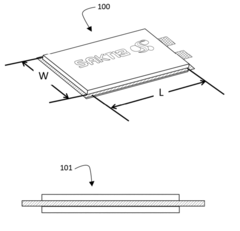
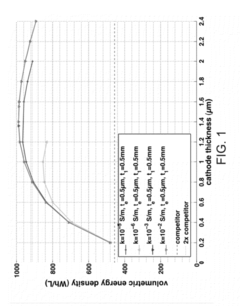
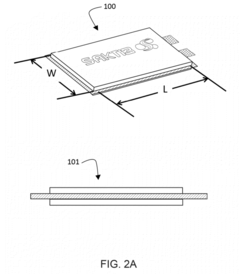
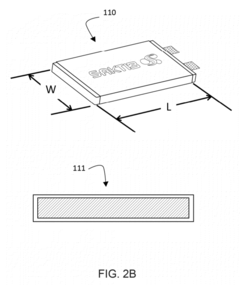
Monolithically integrated thin-film solid state lithium battery device having multiple layers of lithium electrochemical cells
PatentActiveUS20120058380A1
Innovation
- A method and device for fabricating a solid-state thin-film battery using a prismatic multilayer structure with specific layer thicknesses and materials, including a substrate, cathode and anode current collectors, electrolyte, and barrier layers, optimized through numerical techniques for enhanced energy density and stability.
Solid-state battery and electronic device having surface-mounted solid-state battery
PatentWO2023171457A1
Innovation
- The use of a terminal electrode comprising a metal selected from Cu, Ag, Ni, Al, Pt, and Pd, combined with an insulating material, where the insulating material occupies 87% or less of the total area in cross-section, enhances the adhesiveness by improving the bonding between the electrode and the battery body.


Manufacturing Scalability Challenges
Despite the promising performance advantages of solid-state batteries (SSBs) for electronic devices, scaling up manufacturing from laboratory prototypes to mass production presents significant challenges. Current production methods for SSBs remain largely confined to small-scale laboratory settings, utilizing techniques that are difficult to translate to industrial volumes while maintaining quality and cost-effectiveness.
The primary manufacturing obstacle lies in the production of solid electrolytes with consistent quality at scale. Unlike liquid electrolytes that can be easily produced in large batches, solid electrolytes require precise control of material composition, particle size distribution, and interfacial properties. The synthesis processes often involve high-temperature sintering or complex chemical reactions that are difficult to scale without compromising performance characteristics.
Interface engineering between solid electrolytes and electrodes represents another critical manufacturing challenge. The solid-solid interfaces must maintain intimate contact during battery operation to ensure efficient ion transport. Current laboratory techniques often involve manual assembly or specialized equipment that operates at throughput rates incompatible with commercial production demands. Automated manufacturing processes capable of creating these precise interfaces at high speeds have yet to be fully developed.
Material costs present a substantial barrier to commercialization. Many high-performance solid electrolytes incorporate expensive elements like lithium, germanium, or rare earth metals. The economic viability of SSBs depends on either finding alternative materials or developing more efficient utilization strategies. Current material costs can be 5-10 times higher than those for conventional lithium-ion batteries, making mass-market adoption economically challenging.
Quality control and testing methodologies for SSBs differ significantly from those established for conventional batteries. New inline inspection techniques and non-destructive testing methods must be developed to ensure consistent performance across large production volumes. The industry currently lacks standardized testing protocols specifically designed for solid-state architectures, complicating quality assurance efforts.
Equipment manufacturers face the challenge of designing specialized production machinery for SSB manufacturing. Conventional battery production equipment is not directly applicable to solid-state architectures, necessitating substantial capital investment in new manufacturing infrastructure. This equipment development cycle creates additional delays in bringing SSB technology to market at competitive price points.
Addressing these manufacturing challenges requires collaborative efforts between materials scientists, process engineers, and equipment manufacturers. Recent industry consortia have begun focusing on standardizing production methods and developing shared manufacturing platforms to accelerate commercialization timelines for this promising technology.
The primary manufacturing obstacle lies in the production of solid electrolytes with consistent quality at scale. Unlike liquid electrolytes that can be easily produced in large batches, solid electrolytes require precise control of material composition, particle size distribution, and interfacial properties. The synthesis processes often involve high-temperature sintering or complex chemical reactions that are difficult to scale without compromising performance characteristics.
Interface engineering between solid electrolytes and electrodes represents another critical manufacturing challenge. The solid-solid interfaces must maintain intimate contact during battery operation to ensure efficient ion transport. Current laboratory techniques often involve manual assembly or specialized equipment that operates at throughput rates incompatible with commercial production demands. Automated manufacturing processes capable of creating these precise interfaces at high speeds have yet to be fully developed.
Material costs present a substantial barrier to commercialization. Many high-performance solid electrolytes incorporate expensive elements like lithium, germanium, or rare earth metals. The economic viability of SSBs depends on either finding alternative materials or developing more efficient utilization strategies. Current material costs can be 5-10 times higher than those for conventional lithium-ion batteries, making mass-market adoption economically challenging.
Quality control and testing methodologies for SSBs differ significantly from those established for conventional batteries. New inline inspection techniques and non-destructive testing methods must be developed to ensure consistent performance across large production volumes. The industry currently lacks standardized testing protocols specifically designed for solid-state architectures, complicating quality assurance efforts.
Equipment manufacturers face the challenge of designing specialized production machinery for SSB manufacturing. Conventional battery production equipment is not directly applicable to solid-state architectures, necessitating substantial capital investment in new manufacturing infrastructure. This equipment development cycle creates additional delays in bringing SSB technology to market at competitive price points.
Addressing these manufacturing challenges requires collaborative efforts between materials scientists, process engineers, and equipment manufacturers. Recent industry consortia have begun focusing on standardizing production methods and developing shared manufacturing platforms to accelerate commercialization timelines for this promising technology.
Environmental Impact and Sustainability Considerations
The transition to solid-state battery technology represents a significant advancement in sustainable energy storage solutions for electronic devices. Unlike conventional lithium-ion batteries that utilize liquid electrolytes containing flammable and environmentally harmful components, solid-state batteries employ solid electrolytes that are inherently safer and more environmentally benign. This fundamental design difference eliminates the need for toxic organic solvents and reduces the risk of hazardous leakage during production, use, and disposal phases.
From a lifecycle perspective, solid-state batteries demonstrate superior environmental credentials. The manufacturing process requires fewer toxic materials and generates less hazardous waste. Research indicates that solid-state battery production can potentially reduce carbon emissions by 15-20% compared to conventional battery manufacturing. Additionally, the absence of liquid components simplifies the production process, potentially reducing energy consumption during manufacturing.
The extended lifespan of solid-state batteries—estimated to be 2-3 times longer than traditional lithium-ion counterparts—significantly impacts sustainability metrics. This longevity translates to fewer replacement batteries needed over the lifetime of electronic devices, directly reducing electronic waste generation. When considering the global scale of electronic device production, this reduction represents a substantial decrease in battery-related waste entering the ecosystem.
Resource efficiency constitutes another critical environmental advantage. Solid-state technology potentially enables more efficient use of critical battery materials, including rare earth elements and lithium. Some advanced solid-state designs demonstrate up to 30% higher energy density, allowing for smaller batteries with equivalent performance and thus reducing material requirements. Furthermore, certain solid-state configurations can utilize more abundant materials like sodium or aluminum, decreasing dependence on geographically concentrated and environmentally problematic lithium mining operations.
End-of-life considerations also favor solid-state technology. The simplified chemistry and construction facilitate more effective recycling processes, with theoretical recovery rates for key materials exceeding 90% in laboratory settings. This closed-loop potential stands in stark contrast to current lithium-ion recycling, which remains technically challenging and economically marginal.
However, challenges remain in scaling sustainable production methods for solid-state batteries. Current prototype manufacturing processes often require high temperatures and specialized conditions that may offset some environmental gains. Additionally, comprehensive lifecycle assessment data remains limited as the technology advances from laboratory to commercial scale. These factors necessitate ongoing environmental impact evaluation as solid-state battery technology matures and enters mainstream electronic device applications.
From a lifecycle perspective, solid-state batteries demonstrate superior environmental credentials. The manufacturing process requires fewer toxic materials and generates less hazardous waste. Research indicates that solid-state battery production can potentially reduce carbon emissions by 15-20% compared to conventional battery manufacturing. Additionally, the absence of liquid components simplifies the production process, potentially reducing energy consumption during manufacturing.
The extended lifespan of solid-state batteries—estimated to be 2-3 times longer than traditional lithium-ion counterparts—significantly impacts sustainability metrics. This longevity translates to fewer replacement batteries needed over the lifetime of electronic devices, directly reducing electronic waste generation. When considering the global scale of electronic device production, this reduction represents a substantial decrease in battery-related waste entering the ecosystem.
Resource efficiency constitutes another critical environmental advantage. Solid-state technology potentially enables more efficient use of critical battery materials, including rare earth elements and lithium. Some advanced solid-state designs demonstrate up to 30% higher energy density, allowing for smaller batteries with equivalent performance and thus reducing material requirements. Furthermore, certain solid-state configurations can utilize more abundant materials like sodium or aluminum, decreasing dependence on geographically concentrated and environmentally problematic lithium mining operations.
End-of-life considerations also favor solid-state technology. The simplified chemistry and construction facilitate more effective recycling processes, with theoretical recovery rates for key materials exceeding 90% in laboratory settings. This closed-loop potential stands in stark contrast to current lithium-ion recycling, which remains technically challenging and economically marginal.
However, challenges remain in scaling sustainable production methods for solid-state batteries. Current prototype manufacturing processes often require high temperatures and specialized conditions that may offset some environmental gains. Additionally, comprehensive lifecycle assessment data remains limited as the technology advances from laboratory to commercial scale. These factors necessitate ongoing environmental impact evaluation as solid-state battery technology matures and enters mainstream electronic device applications.
Unlock deeper insights with PatSnap Eureka Quick Research — get a full tech report to explore trends and direct your research. Try now!
Generate Your Research Report Instantly with AI Agent
Supercharge your innovation with PatSnap Eureka AI Agent Platform!